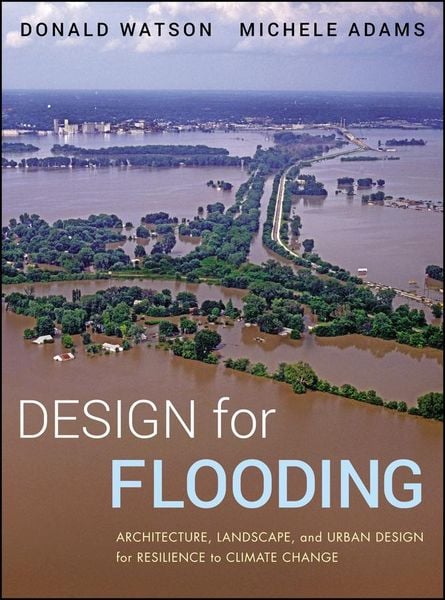
Produktbild: Design for Flooding

Design for Flooding Architecture, Landscape, and Urban Design for Resilience to Flooding and Climate Change

112,99 €

inkl. gesetzl. MwSt., Versandkostenfrei


Beschreibung

Produktdetails

Einband

Gebundene Ausgabe

Erscheinungsdatum

23.11.2010

Abbildungen

Photos: 100 B&W, 40 Color; Drawings: 100 B&W, 0 Color

Verlag

John Wiley & Sons

Seitenzahl

336

Maße (L/B/H)

28,4/22,4/2,5 cm

Gewicht

1114 g

Sprache

Englisch

ISBN

978-0-470-47564-5

Beschreibung

Produktdetails

Einband

Gebundene Ausgabe

Erscheinungsdatum

23.11.2010

Abbildungen

Photos: 100 B&W, 40 Color; Drawings: 100 B&W, 0 Color

Verlag

John Wiley & Sons

Seitenzahl

336

Maße (L/B/H)

28,4/22,4/2,5 cm

Gewicht

1114 g

Sprache

Englisch

ISBN

978-0-470-47564-5

Herstelleradresse

Libri GmbH
Europaallee 1
36244 Bad Hersfeld
DE

Email: gpsr@libri.de

Noch keine Bewertungen vorhanden

Verfassen Sie die erste Bewertung zu diesem Artikel

Helfen Sie anderen Kundinnen und Kunden durch Ihre Meinung.

Kundinnen und Kunden meinen

Bewertungen (0)

Weitere Artikel finden Sie in

Die Leseprobe wird geladen.
  • Produktbild: Design for Flooding
  • Preface and Acknowledgments vii

    Foreword by Carol Franklin, RLA, FASLA ix

    Foreword by Daniel E. Williams, FAIA xi

    Introduction xv

    Part I: Nature of Water 1

    Chapter 1: Weather 3

    1.1 Sun and Earth 3

    1.2 The Atmosphere 6

    1.3 Weather 17

    Chapter 2: Land and Water 31

    2.1 Water and Carbon Cycles 31

    2.2 Biodiversity and the Landscape 36

    2.3 Follow the Water: The Opportunity for Watershed Planning 43

    Chapter 3: Flooding 49

    3.1 Flooding from Increased Precipitation 49

    3.2 Flooding from Severe Storms 54

    3.3 Economic and Social Costs of Water-Related Natural Disasters 61

    Part II: Design With Water 67

    Chapter 4: The Natural Landscape 71

    4.1 Understanding the Natural Water Balance 71

    4.2 When the Water Balance Is Altered 74

    4.3 Soils and Vegetation 78

    4.4 Subsurface Water Movement 83

    4.5 Stream Systems, Wetlands, Riparian Zones, and Floodplains 84

    Chapter 5: The Altered Landscape 91

    5.1 When the Landscape Is Altered 91

    5.2 Altered Stream Systems and Increased Flood Damage 95

    5.3 Why Detention Does Not Solve Flooding 98

    5.4 Summary: The Natural Landscape as a Model for Resilient Design 99

    Chapter 6: Design for Inland Flooding 103

    6.1 Resilient Design for Inland Flooding 103

    6.2 Tools for Watershed Protection 125

    6.3 Communities and Buildings in Floodplains 129

    Part III: Flood-Resistant Design 131

    Chapter 7: Flood Design Analysis 135

    7.1 Definition of Terms 135

    7.2 Flood Elevation: Base Flood and Design Flood 143

    Chapter 8: The Coast 151

    8.1 Coastal Processes 151

    8.2 Shoreline Protection 160

    8.3 Flood Barriers and Floodgates 164

    8.4 Summary of Coastal Protection Measures 164

    Chapter 9: Flood Design Practices for Buildings 169

    9.1 Overview of Flood Design 169

    9.2 Flood Design at the Building Scale 176

    Part IV: Design For Resilience 197

    Chapter 10: Flood-Resistant Design for Sites and Communities 199

    10.1 Coastal Communities 199

    10.2 Comprehensive Planning for Resilient Communities 207

    10.3 Local Actions to Build Community Resilience 210

    Chapter 11: Sea Level Rise 219

    11.1 Sea Level Rise: The Issues 220

    11.2 Sea Level Rise: Design Responses 223

    Chapter 12: Design for Resilience 257

    12.1 The Wave of the Future 257

    12.2 Models for National and International Action 259

    12.3 Design Resolution 268

    Epilogue 271

    Glossary 273

    Index 295