Gutscheinbedingungen

**Gültig bis 06.07.2026 auf fremdsprachige Bücher online auf thalia.at, in der Thalia App ab einem Mindestbestellwert von 30€ und in allen Thalia Buchhandlungen in Österreich. In den Buchhandlungen nur gültig auf lagernde Ware. Einzelne Artikel können ausgeschlossen sein. Ausgenommen sind preisgebundene Artikel & eBooks. Pro Einkauf einmal einlösbar. Nur gültig gegen Vorlage oder im Onlineshop hinterlegter Bonuscard. Infos zur Einlösung in der Buchhandlung sind auf der Bonuscard-Vorteilspreisseite zu finden. Click & Collect nur bei Onlinevorabzahlung möglich. Keine Einlösung bei Scan & Go-Bezahlung. Keine Barauszahlung. Nicht kombinierbar mit anderen Aktionen und Gutscheinen. Gutschein wird auf max. 500€ Bestellwert angerechnet. Nicht gültig für Versandkosten und Services.

  • Produktbild: Behind Human Error
  • Produktbild: Behind Human Error

Behind Human Error

68,99 €

inkl. gesetzl. MwSt., Versandkostenfrei


Beschreibung

Produktdetails

Einband

Taschenbuch

Erscheinungsdatum

28.08.2010

Verlag

Taylor & Francis

Seitenzahl

292

Maße (L/B/H)

23,4/15,6/1,6 cm

Gewicht

300 g

Auflage

2. Auflage

Sprache

Englisch

ISBN

978-0-7546-7834-2

Beschreibung

Rezension

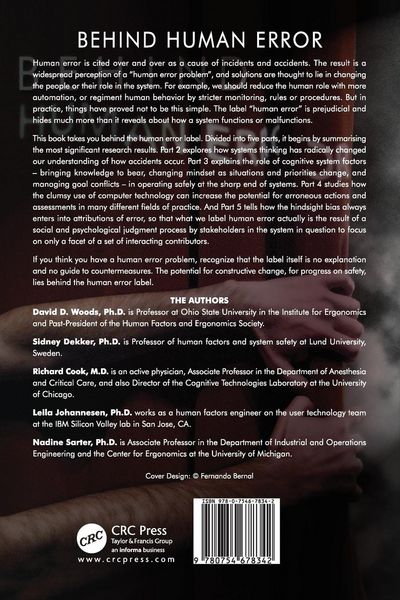
'This book, by some of the leading error researchers, is essential reading for everyone concerned with the nature of human error. For scholars, Woods et al provide a critical perspective on the meaning of error. For organizations, they provide a roadmap for reducing vulnerability to error. For workers, they explain the daily tradeoffs and pressures that must be juggled. For technology developers, the book offers important warnings and guidance. Masterfully written, carefully reasoned, and compellingly presented.' Gary Klein, Chairman and Chief Scientist of Klein Associates, USA 'This book is a long-awaited update of a hard-to-get work originally published in 1994. Written by some of the world's leading practitioners, it elegantly summarises the main work in this field over the last 30 years, and clearly and patiently illustrates the practical advantages of going "behind human error". Understanding human error as an effect of often deep, systemic vulnerabilities rather than as a cause of failure, is an important but necessary step forward from the oversimplified views that continue to hinder real progress in safety management.' Erik Hollnagel, MINES ParisTech, France 'If you welcome the chance to re-evaluate some of your most cherished beliefs, if you enjoy having to view long-established ideas from an unfamiliar perspective, then you will be provoked, stimulated and informed by this book. Many of the ideas expressed here have been aired before in relative isolation, but linking them together in this multi-authored book gives them added power and coherence.' James Reason, Professor Emeritus, University of Manchester, UK 'This updated and substantially expanded book draws together modern scientific understanding of mishaps too often simplistically viewed as caused by "human error". It helps us understand the actions of human operators at the "sharp end" and puts those actions appropriately in the overall system context of task, social, organizational, and e

Produktdetails

Einband

Taschenbuch

Erscheinungsdatum

28.08.2010

Verlag

Taylor & Francis

Seitenzahl

292

Maße (L/B/H)

23,4/15,6/1,6 cm

Gewicht

300 g

Auflage

2. Auflage

Sprache

Englisch

ISBN

978-0-7546-7834-2

Noch keine Bewertungen vorhanden

Verfassen Sie die erste Bewertung zu diesem Artikel

Helfen Sie anderen Kundinnen und Kunden durch Ihre Meinung.

Kundinnen und Kunden meinen

Bewertungen (0)

Die Leseprobe wird geladen.
  • Produktbild: Behind Human Error
  • Produktbild: Behind Human Error
  • I: An Introduction to The Second Story; 1: The Problem With “Human Error”; 2: Basic Premises; II: Complex Systems Failure; 3: Linear and Latent Failure Models; 4: Complexity, Control and Sociological Models; 5: Resilience Engineering; III: Operating at The Sharp End; 6: Bringing Knowledge to Bear in Context; 7: Mindset; 8: Goal Conflicts; IV: How Design Can Induce Error; 9: Clumsy Use of Technology; 10: How Computer-Based Artifacts Shape Cognition and Collaboration; 11: Mode Error in Supervisory Control; 12: How Practitioners Adapt to Clumsy Technology; V: Reactions to Failure; 13: Hindsight Bias; 14: Error as Information; 15: Balancing Accountability and Learning; 16: Summing Up: How to go Behind The Label “Human Error”