
• Produktbild: Extremely Violent Societies
  • Produktbild: Extremely Violent Societies

Extremely Violent Societies Mass Violence in the Twentieth-Century World

47,99 €

inkl. gesetzl. MwSt., Versandkostenfrei


Beschreibung

Produktdetails

Einband

Taschenbuch

Erscheinungsdatum

24.08.2017

Verlag

Cambridge University Press

Seitenzahl

502

Maße (L/B/H)

22,9/15,2/2,7 cm

Gewicht

790 g

Sprache

Englisch

ISBN

978-0-521-70681-0

Beschreibung

Rezension

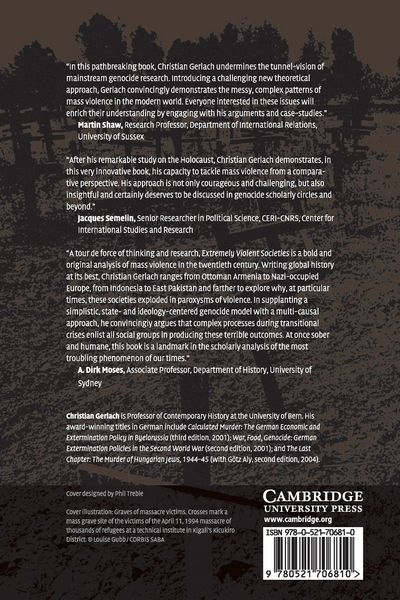
'In this pathbreaking book, Christian Gerlach undermines the tunnel-vision of mainstream genocide research. Introducing a challenging new theoretical approach, Gerlach convincingly demonstrates the messy, complex patterns of mass violence in the modern world. Everyone interested in these issues will enrich their understanding by engaging with his arguments and case-studies.' Martin Shaw, University of Sussex

Produktdetails

Einband

Taschenbuch

Erscheinungsdatum

24.08.2017

Verlag

Cambridge University Press

Seitenzahl

502

Maße (L/B/H)

22,9/15,2/2,7 cm

Gewicht

790 g

Sprache

Englisch

ISBN

978-0-521-70681-0

Herstelleradresse

Libri GmbH
Europaallee 1
36244 Bad Hersfeld
DE

Email: gpsr@libri.de

Noch keine Bewertungen vorhanden

Verfassen Sie die erste Bewertung zu diesem Artikel

Helfen Sie anderen Kundinnen und Kunden durch Ihre Meinung.

Kundinnen und Kunden meinen

Bewertungen (0)

Die Leseprobe wird geladen.
  • Produktbild: Extremely Violent Societies
  • Produktbild: Extremely Violent Societies
  • 1. Introduction: extremely violent societies; Part I. Participatory Violence: 2. A coalition for violence: mass slaughter in Indonesia, 1965-66; 3. Participating and profiteering: the destruction of the Armenians, 1915-23; Part II. The Crisis of Society: 4. From rivalries between elites to a crisis of society: mass violence and famine in Bangladesh (East Pakistan), 1971-77; 5. Sustainable violence: strategic resettlement, militias and 'development' in anti-guerrilla warfare; 6. What connects the fate of different victim groups? The German occupation and Greek society in crisis; Part III. General Observations: 7. The ethnization of history: the historiography of mass violence and national identity construction; 8. Conclusions.