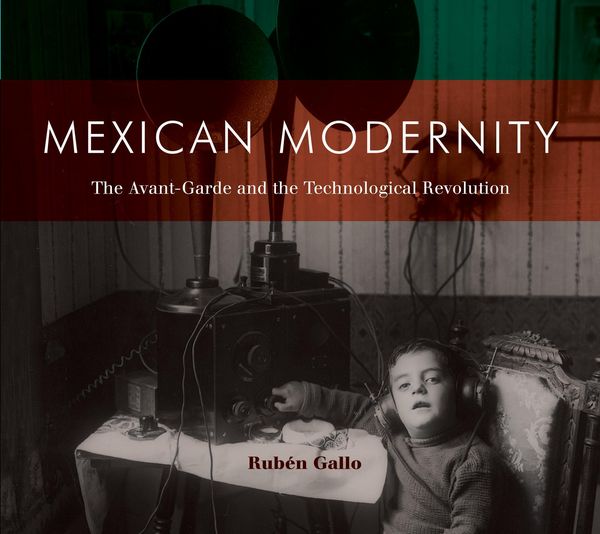
Mexican Modernity The Avant-Garde and the Technological Revolution
-
- Englisch ausgewählt
18,99 €
inkl. gesetzl. MwSt.,
- Kostenlose Lieferung ab 30 € Einkaufswert
- Versandkostenfrei für Bonuscard-Kund*innen
Beschreibung
Produktdetails
Einband
Taschenbuch
Erscheinungsdatum
24.09.2010
Abbildungen
10 color illus., 81 b&w illus., Illustrationen, nicht spezifiziert
Verlag
Random House N.Y.Seitenzahl
248
Maße (L/B/H)
19,6/22,4/1,5 cm
Gewicht
816 g
Sprache
Englisch
ISBN
978-0-262-51496-5
In Mexican Modernity, Rubén Gallo tells the story of a second Mexican Revolution, a battle fought on the front of cultural representation. The new revolutionaries were not rebels or outlaws but artists and writers; their weapons were cameras, typewriters, radios, and other technological artifacts, and their goal was not to topple a dictator but to dethrone nineteenth-century aesthetics. Gallo tells the story of this other revolution by focusing on five artifacts that left a deep mark on the literature and the arts of the 1920s and 1930s: the camera and its novel techniques for seeing the modern world; the typewriter and its mechanization of literary aesthetics; radio and poetic experiments with wireless communication; cement architecture and its celebration of functional internationalism; and the stadium and its deployment as a mass medium for political spectacle.
Gallo traces the ways artists and writers, armed with these artifacts, revolutionized representation by breaking with the traditional modes of production that had dominated Mexican cultural practices: Tina Modotti rose against the conventions of "artistic" photography by promoting a radically modern photographic aesthetics; typewriting authors rejected the literary precepts of modernismo to celebrate the stridencies of mechanical writing; and young architects abandoned older building materials for the symbolic strength of reinforced concrete.
Gallo uncovers a secret history of Mexican modernity that includes a number of fascinating episodes: the pictorialist backlash against Modotti and Edward Weston; the postcolonial Remingtont typewriter; Mexican radio in the North Pole; the campaign to aestheticize cement through journals and artistic competitions; and the protofascist political spectacles held at Mexico City's National Stadium in the 1920s.
Noch keine Bewertungen vorhanden
Verfassen Sie die erste Bewertung zu diesem Artikel
Helfen Sie anderen Kundinnen und Kunden durch Ihre Meinung.
Kurze Frage zu unserer Seite
Vielen Dank für Ihr Feedback
Wir nutzen Ihr Feedback, um unsere Produktseiten zu verbessern. Bitte haben Sie Verständnis, dass wir Ihnen keine Rückmeldung geben können. Falls Sie Kontakt mit uns aufnehmen möchten, können Sie sich aber gerne an unseren Kund*innenservice wenden.
zum Kundenservice