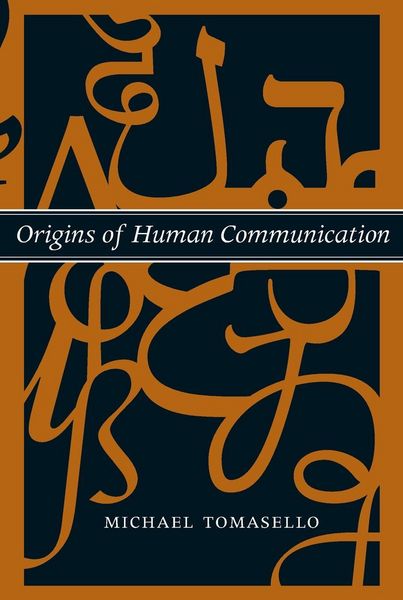
Origins of Human Communication
-
- Taschenbuch ausgewählt
- eBook
-
Sprache:Englisch
29,99 €
inkl. gesetzl. MwSt.,
- Kostenlose Lieferung ab 30 € Einkaufswert
- Versandkostenfrei für Bonuscard-Kund*innen
Beschreibung
Produktdetails
Einband
Taschenbuch
Altersempfehlung
ab 18 Jahr(e)
Erscheinungsdatum
13.08.2010
Verlag
MIT PressSeitenzahl
408
Maße (L/B/H)
20,3/13,7/2,5 cm
Gewicht
527 g
Sprache
Englisch
ISBN
978-0-262-51520-7
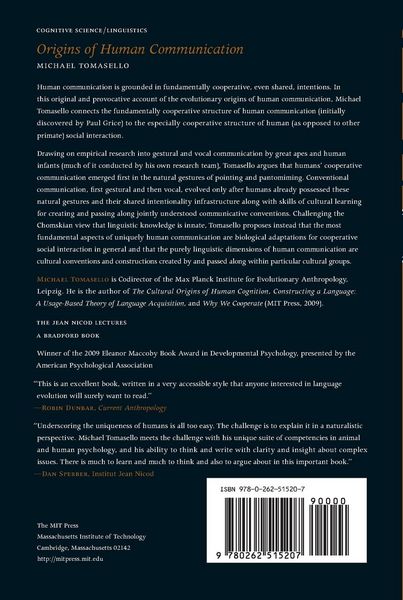
Human communication is grounded in fundamentally cooperative, even shared, intentions. In this original and provocative account of the evolutionary origins of human communication, Michael Tomasello connects the fundamentally cooperative structure of human communication (initially discovered by Paul Grice) to the especially cooperative structure of human (as opposed to other primate) social interaction. Tomasello argues that human cooperative communication rests on a psychological infrastructure of shared intentionality (joint attention, common ground), evolved originally for collaboration and culture more generally. The basic motives of the infrastructure are helping and sharing: humans communicate to request help, inform others of things helpfully, and share attitudes as a way of bonding within the cultural group. These cooperative motives each created different functional pressures for conventionalizing grammatical constructions. Requesting help in the immediate you-and-me and here-and-now, for example, required very little grammar, but informing and sharing required increasingly complex grammatical devices. Drawing on empirical research into gestural and vocal communication by great apes and human infants (much of it conducted by his own research team), Tomasello argues further that humans' cooperative communication emerged first in the natural gestures of pointing and pantomiming. Conventional communication, first gestural and then vocal, evolved only after humans already possessed these natural gestures and their shared intentionality infrastructure along with skills of cultural learning for creating and passing along jointly understood communicative conventions. Challenging the Chomskian view that linguistic knowledge is innate, Tomasello proposes instead that the most fundamental aspects of uniquely human communication are biological adaptations for cooperative social interaction in general and that the purely linguistic dimensions of human communication are cultural conventions and constructions created by and passed along within particular cultural groups.
Noch keine Bewertungen vorhanden
Verfassen Sie die erste Bewertung zu diesem Artikel
Helfen Sie anderen Kundinnen und Kunden durch Ihre Meinung.
Kurze Frage zu unserer Seite
Vielen Dank für Ihr Feedback
Wir nutzen Ihr Feedback, um unsere Produktseiten zu verbessern. Bitte haben Sie Verständnis, dass wir Ihnen keine Rückmeldung geben können. Falls Sie Kontakt mit uns aufnehmen möchten, können Sie sich aber gerne an unseren Kund*innenservice wenden.
zum Kundenservice