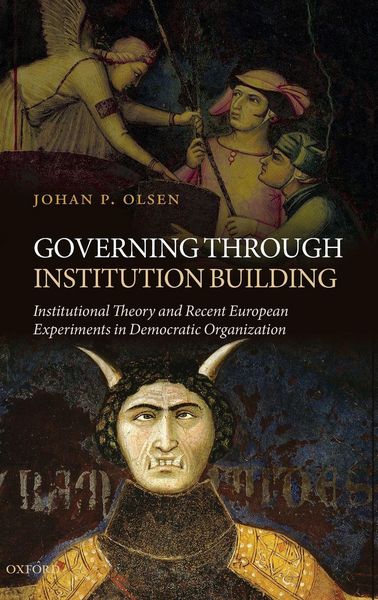
Governing Through Institution Building Institutional Theory and Recent European Experiments in Democratic Organization
-
- Englisch ausgewählt
159,99 €
inkl. gesetzl. MwSt.,
Beschreibung
Produktdetails
Einband
Gebundene Ausgabe
Erscheinungsdatum
09.09.2010
Verlag
Oxford AcademicSeitenzahl
264
Maße (L/B/H)
24/16,1/1,9 cm
Gewicht
564 g
Sprache
Englisch
ISBN
978-0-19-959393-4
Many reformers argue that the future of democracies depends on the quality of their political institutions. If so, it may be worthwhile examining the democratic-instrumental vision of citizens and their representatives -- which assumes that they can and should decide how they might be organized and governed -- and thereby develop a better theoretical understanding of the nature, architecture, dynamics of change, performance, and effects of institutions.
It may be useful to study the possibilities and limitations of governing through deliberately changing institutional arrangements and thereby achieving intended, anticipated and desired effects - including how institutions contribute to organized rule, orderly change, civilized co-existence, unity in diversity and the ability to accommodate and continuously balance rather than eliminate what John Stuart Mill called "standing antagonisms".
This book offers an organization-theory-based institutional approach and it assumes that a fruitful route to improved understanding of political organization and government is to observe large-scale institutional reforms. The primary source of insight is the grand experiment in political integration through institution building and polity formation in Europe - the European Union. Yet, the book relates to century-long controversies concerning what is good government and how best to organize common affairs. The main challenge is to examine the claim that theoretical ideas and concepts developed in the context of the sovereign state are outdated in the context of the emerging European polity and a globalized world and to analyze what students of political institutions, as well as citizens, can learn from recent European experiments in democratic organization and government.
Noch keine Bewertungen vorhanden
Verfassen Sie die erste Bewertung zu diesem Artikel
Helfen Sie anderen Kundinnen und Kunden durch Ihre Meinung.
Kurze Frage zu unserer Seite
Vielen Dank für Ihr Feedback
Wir nutzen Ihr Feedback, um unsere Produktseiten zu verbessern. Bitte haben Sie Verständnis, dass wir Ihnen keine Rückmeldung geben können. Falls Sie Kontakt mit uns aufnehmen möchten, können Sie sich aber gerne an unseren Kund*innenservice wenden.
zum Kundenservice