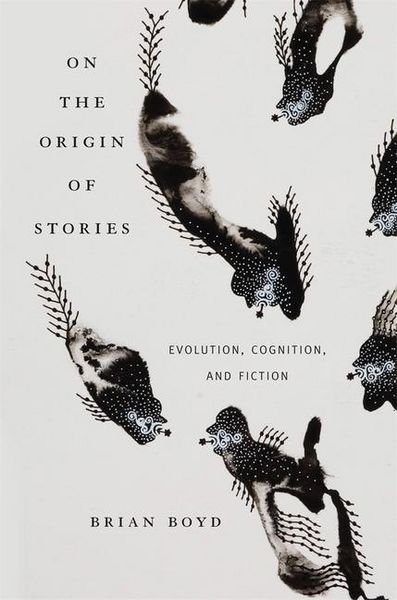
On the Origin of Stories: Evolution, Cognition, and Fiction
-
- Englisch ausgewählt
22,70 €
inkl. gesetzl. MwSt.,
- Kostenlose Lieferung ab 30 € Einkaufswert
- Versandkostenfrei für Bonuscard-Kund*innen
Beschreibung
Produktdetails
Einband
Taschenbuch
Erscheinungsdatum
01.11.2010
Abbildungen
14 halftones
Verlag
Harvard University PressSeitenzahl
540
Maße (L/B/H)
23,3/17/4,1 cm
Gewicht
639 g
Sprache
Englisch
ISBN
978-0-674-05711-1
A century and a half after the publication of Origin of Species, evolutionary thinking has expanded beyond the field of biology to include virtually all human-related subjects¿anthropology, archeology, psychology, economics, religion, morality, politics, culture, and art. Now a distinguished scholar offers the first comprehensive account of the evolutionary origins of art and storytelling. Brian Boyd explains why we tell stories, how our minds are shaped to understand them, and what difference an evolutionary understanding of human nature makes to stories we love.
Art is a specifically human adaptation, Boyd argues. It offers tangible advantages for human survival, and it derives from play, itself an adaptation widespread among more intelligent animals. More particularly, our fondness for storytelling has sharpened social cognition, encouraged cooperation, and fostered creativity.
After considering art as adaptation, Boyd examines Homer¿s Odyssey and Dr. Seuss¿s Horton Hears a Who! demonstrating how an evolutionary lens can offer new understanding and appreciation of specific works. What triggers our emotional engagement with these works? What patterns facilitate our responses? The need to hold an audience¿s attention, Boyd underscores, is the fundamental problem facing all storytellers. Enduring artists arrive at solutions that appeal to cognitive universals: an insight out of step with contemporary criticism, which obscures both the individual and universal. Published for the bicentenary of Darwin¿s birth and the 150th anniversary of the publication of Origin of Species, Boyd¿s study embraces a Darwinian view of human nature and art, and offers a credo for a new humanism.
Noch keine Bewertungen vorhanden
Verfassen Sie die erste Bewertung zu diesem Artikel
Helfen Sie anderen Kundinnen und Kunden durch Ihre Meinung.
Kurze Frage zu unserer Seite
Vielen Dank für Ihr Feedback
Wir nutzen Ihr Feedback, um unsere Produktseiten zu verbessern. Bitte haben Sie Verständnis, dass wir Ihnen keine Rückmeldung geben können. Falls Sie Kontakt mit uns aufnehmen möchten, können Sie sich aber gerne an unseren Kund*innenservice wenden.
zum Kundenservice