
Gutscheinbedingungen

**Gültig bis 06.07.2026 auf fremdsprachige Bücher online auf thalia.at, in der Thalia App ab einem Mindestbestellwert von 30€ und in allen Thalia Buchhandlungen in Österreich. In den Buchhandlungen nur gültig auf lagernde Ware. Einzelne Artikel können ausgeschlossen sein. Ausgenommen sind preisgebundene Artikel & eBooks. Pro Einkauf einmal einlösbar. Nur gültig gegen Vorlage oder im Onlineshop hinterlegter Bonuscard. Infos zur Einlösung in der Buchhandlung sind auf der Bonuscard-Vorteilspreisseite zu finden. Click & Collect nur bei Onlinevorabzahlung möglich. Keine Einlösung bei Scan & Go-Bezahlung. Keine Barauszahlung. Nicht kombinierbar mit anderen Aktionen und Gutscheinen. Gutschein wird auf max. 500€ Bestellwert angerechnet. Nicht gültig für Versandkosten und Services.

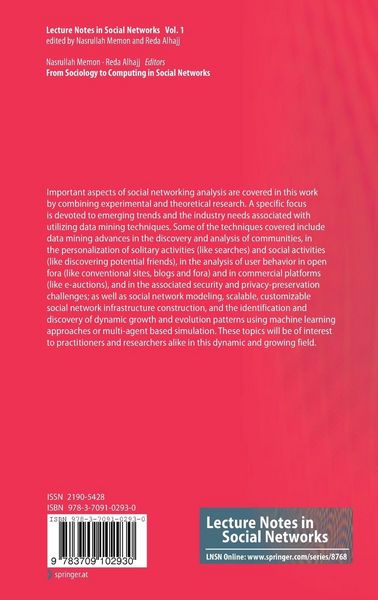
  • Produktbild: From Sociology to Computing in Social Networks
  • Produktbild: From Sociology to Computing in Social Networks

From Sociology to Computing in Social Networks Theory, Foundations and Applications

144,99 €

inkl. gesetzl. MwSt., Versandkostenfrei


Beschreibung

Produktdetails

Einband

Gebundene Ausgabe

Erscheinungsdatum

14.07.2010

Herausgeber

Nasrullah Memon + weitere

Verlag

Springer Wien

Seitenzahl

430

Maße (L/B/H)

24,1/16/3 cm

Gewicht

783 g

Auflage

2010

Sprache

Englisch

ISBN

978-3-7091-0293-0

Beschreibung

Produktdetails

Einband

Gebundene Ausgabe

Erscheinungsdatum

14.07.2010

Herausgeber

Verlag

Springer Wien

Seitenzahl

430

Maße (L/B/H)

24,1/16/3 cm

Gewicht

783 g

Auflage

2010

Sprache

Englisch

ISBN

978-3-7091-0293-0

Herstelleradresse

Springer-Verlag KG
Sachsenplatz 4-6
1201 Wien
AT

Email: GPSR Kontakt

Noch keine Bewertungen vorhanden

Verfassen Sie die erste Bewertung zu diesem Artikel

Helfen Sie anderen Kundinnen und Kunden durch Ihre Meinung.

Kundinnen und Kunden meinen

Bewertungen (0)

  • Produktbild: From Sociology to Computing in Social Networks
  • Produktbild: From Sociology to Computing in Social Networks
  • Social Networks: A powerful model for serving a wide range of domains (Nasrullah Memon and Reda Alhaj

    Part I Mining based Social Network Methods

    Employing Social Network Construction and Analysis in Web Structure
    Optimization (Mohamad Nagi, Abdelghani Guerbas, Keivan Kianmehr, Panagiotis
    Karampelas, Mick Ridley, Reda Alhajj, and Jon Rokne)
    Mining Heterogeneous Social Networks for Egocentric Information
    Abstraction (Cheng-Te Li and Shou-De Lin)
    PROG: A Complementary Model to the Social Networks for Mining
    Forums (Anna Stavrianou, Julien Velcin, and Jean-Hugues Chauchat)
    Socio-Contextual Network Mining for User Assistance in Web-based
    Knowledge Gathering Tasks (Balaji Rajendran and Iyakutti Kombiah)
    Integrating Entropy and Closed Frequent Pattern Mining for Social
    Network Modelling and Analysis (Muhaimenul Adnan, Reda Alhajj, and Jon Rokne)

    Part II Dynamics in Social Network Models

    Visualisation of the Dynamics for longitudinal analysis of Computer -
    Mediated Social Networks - Concept and Exemplary Cases (Andreas Harrer, Sam Zeini, and Sabrina Ziebarth)
    EWAS: Modeling Application for Early Detection of Terrorist Threats (Pir Abdul Rasool Qureshi, Nasrullah Memon, and Uffe Kock Wiil)
    Complex Dynamics in Information Sharing Networks (Bruce Cronin)
    Harnessing Wisdom of the Crowds Dynamics for Time-Dependent
    Reputation and Ranking (Elizabeth M. Daly)

    Part III Discovering Structures in Social Networks

    Detecting Communities in Social Networks using Local Information (Jiyang Chen, Osmar R. Zaïane, and Randy Goebel)
    Why Do Diffusion Data not Fit the Logistic Model? A Note on Network
    Discreteness, Heterogeneity and Anisotropy (Dominique Raynaud)
    Interlocking Communication Measuring Collaborative Intensity in
    Social Networks (Klaus Stein and Steffen Blaschke)
    The Structural Underpinnings Of Policy Learning: A Classroom Policy
    Simulation (Stephen Bird)

    Part IV Social Media

    A Journey to the Core of the Blogosphere (Darko Obradovic and Stephan Baumann)
    Social Physics ofthe Blogosphere Capturing, Analyzing and Presenting
    Interdependencies within a Single Framework (Justus Bross, Keven Richly, Patrick Schilf, and Christoph Meinel)
    Twitmographics: Learning the Emergent Properties of the Twitter
    Community (Marc Cheong and Vincent Le)
    Dissecting Twitter: A Review on Current Microblogging Research, and
    Lessons from Related Fields (Marc Cheong and Vincent Lee)

    Part V Software Applications

    Unleash the CSS-Factor A Social Capital Approach to the Benefits and
    Challenges of Corporate Social Software (Carina Heppke)
    Extending SQL to Support Privacy Policies (Kambiz Ghazinour, Sampson Pun, Maryam Majedi, Amir H. Chinaei, and Ken Barker)
    nCompass Service Oriented Architecture for Tacit Collaboration
    Services (David Schroh, Neil Bozowsky, Mike Savigny, and William Wright)
    SOA Security Aspects in Web-Based Architectural Design (Asadullah Shaikh, Sheeraz Ali, Nasrullah Memon, and Panagiotis Karampela)