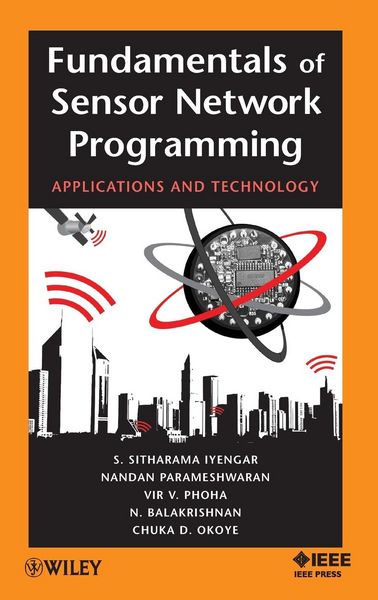
Sensor Network Programming Applications and Technology
-
- Englisch ausgewählt
155,99 €
inkl. gesetzl. MwSt.,
Beschreibung
Produktdetails
Einband
Gebundene Ausgabe
Erscheinungsdatum
03.12.2010
Verlag
John Wiley & Sons IncSeitenzahl
344
Maße (L/B/H)
24/16,1/2,3 cm
Gewicht
680 g
Auflage
1. Auflage
Sprache
Englisch
ISBN
978-0-470-87614-5
Sensor processing is central to aerospace and defense, automation, medical imaging, and robotics. Fundamentals of Sensor Network Programming provides the basics needed to develop sensor network software and supplements. It also examines how to develop onboard applications on individual sensors, how to interconnect these sensors, how to form networks of sensors, and how these networks interact with the physical world. Included is actual code tested in a laboratory environment, as well as structured examples that allow demonstration of material with only a small network of four or more sensor nodes and a laptop.
Fundamentals of Sensor Network Programming concentrates on the class of sensors having severely constrained computation, communication, and energy resources. These devices are usually penny- to matchbox-sized and are deployed in an ad-hoc fashion. This book presents techniques for programming so the sensors can work effectively as a group. Although the focus is on programming the individual sensor, the goal is to make the sensor work in a collaborative environment. With principles that may serve as building blocks for developing large-scale, long-lived systems, the book:
Develops programming methodologies unique to sensor networks
Examines how sensors can be interconnected
Shows how networks of sensors are formed
Includes actual code tested in a laboratory environment
Presents case studies covering network applications
Providing a balance between theory and applications, this resource will prove beneficial for professionals working in industry, graduate students, computer science professionals, and academic researchers.
Dr. S. Sitharama Iyengar is the Roy Paul Daniels Professor and Chairman of the Computer Science Department at Louisiana State University. He heads the Wireless Sensor Networks Laboratory and the Robotics Research Laboratory.
Noch keine Bewertungen vorhanden
Verfassen Sie die erste Bewertung zu diesem Artikel
Helfen Sie anderen Kundinnen und Kunden durch Ihre Meinung.
Kurze Frage zu unserer Seite
Vielen Dank für Ihr Feedback
Wir nutzen Ihr Feedback, um unsere Produktseiten zu verbessern. Bitte haben Sie Verständnis, dass wir Ihnen keine Rückmeldung geben können. Falls Sie Kontakt mit uns aufnehmen möchten, können Sie sich aber gerne an unseren Kund*innenservice wenden.
zum Kundenservice