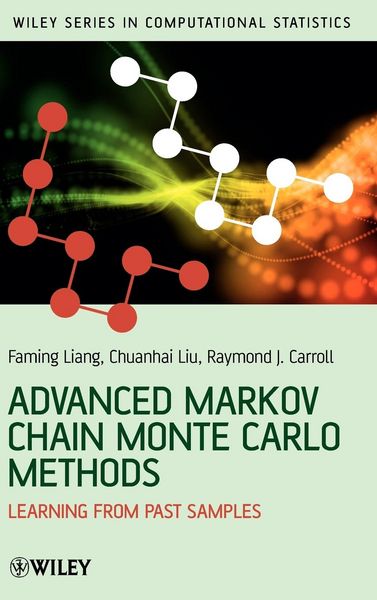
Produktbild: Advanced Markov Chain Monte Carlo

Advanced Markov Chain Monte Carlo

167,99 €

inkl. gesetzl. MwSt., Versandkostenfrei


Beschreibung

Produktdetails

Einband

Gebundene Ausgabe

Erscheinungsdatum

10.08.2010

Verlag

John Wiley & Sons

Seitenzahl

378

Maße (L/B/H)

23,5/15,7/2,7 cm

Gewicht

765 g

Auflage

1. Auflage

Sprache

Englisch

ISBN

978-0-470-74826-8

Beschreibung

Rezension

"The book is suitable as a textbook for one-semester courses on Monte Carlo methods, offered at the advance postgraduate levels." ( Mathematical Reviews , 1 December 2012) "Researchers working in the field of applied statistics will profit from this easy-to-access presentation. Further illustration is done by discussing interesting examples and relevant applications. The valuable reference list includes technical reports which are hard to and by searching in public data bases." (Zentralblatt MATH, 2011) "This book can be used as a textbook or a reference book for a one-semester graduate course in statistics, computational biology, engineering, and computer sciences.

Produktdetails

Einband

Gebundene Ausgabe

Erscheinungsdatum

10.08.2010

Verlag

John Wiley & Sons

Seitenzahl

378

Maße (L/B/H)

23,5/15,7/2,7 cm

Gewicht

765 g

Auflage

1. Auflage

Sprache

Englisch

ISBN

978-0-470-74826-8

Herstelleradresse

Libri GmbH
Europaallee 1
36244 Bad Hersfeld
DE

Email: gpsr@libri.de

Noch keine Bewertungen vorhanden

Verfassen Sie die erste Bewertung zu diesem Artikel

Helfen Sie anderen Kundinnen und Kunden durch Ihre Meinung.

Kundinnen und Kunden meinen

Bewertungen (0)

Die Leseprobe wird geladen.
  • Produktbild: Advanced Markov Chain Monte Carlo
  • Preface.
     
    Acknowledgments.
     
    Publisher's Acknowledgments.
     
    1 Bayesian Inference and Markov Chain Monte Carlo.
     
    1.1 Bayes.
     
    1.1.1 Specification of Bayesian Models.
     
    1.1.2 The Jeffreys Priors and Beyond.
     
    1.2 Bayes Output.
     
    1.2.1 Credible Intervals and Regions.
     
    1.2.2 Hypothesis Testing: Bayes Factors.
     
    1.3 Monte Carlo Integration.
     
    1.3.1 The Problem.
     
    1.3.2 Monte Carlo Approximation.
     
    1.3.3 Monte Carlo via Importance Sampling.
     
    1.4 Random Variable Generation.
     
    1.4.1 Direct or TransformationMethods.
     
    1.4.2 Acceptance-Rejection Methods.
     
    1.4.3 The Ratio-of-UniformsMethod and Beyond.
     
    1.4.4 Adaptive Rejection Sampling.
     
    1.4.5 Perfect Sampling.
     
    1.5 Markov ChainMonte Carlo.
     
    1.5.1 Markov Chains.
     
    1.5.2 Convergence Results.
     
    1.5.3 Convergence Diagnostics.
     
    Exercises.
     
    2 The Gibbs Sampler.
     
    2.1 The Gibbs Sampler.
     
    2.2 Data Augmentation.
     
    2.3 Implementation Strategies and Acceleration Methods.
     
    2.3.1 Blocking and Collapsing.
     
    2.3.2 Hierarchical Centering and Reparameterization.
     
    2.3.3 Parameter Expansion for Data Augmentation.
     
    2.3.4 Alternating Subspace-Spanning Resampling.
     
    2.4 Applications.
     
    2.4.1 The Student-tModel.
     
    2.4.2 Robit Regression or Binary Regression with the Student-t Link.
     
    2.4.3 Linear Regression with Interval-Censored Responses.
     
    Exercises.
     
    Appendix 2A: The EMand PX-EMAlgorithms.
     
    3 The Metropolis-Hastings Algorithm.
     
    3.1 TheMetropolis-Hastings Algorithm.
     
    3.1.1 Independence Sampler.
     
    3.1.2 RandomWalk Chains.
     
    3.1.3 Problems withMetropolis-Hastings Simulations.
     
    3.2 Variants of theMetropolis-Hastings Algorithm.
     
    3.2.1 The Hit-and-Run Algorithm.
     
    3.2.2 The Langevin Algorithm.
     
    3.2.3 TheMultiple-TryMH Algorithm.
     
    3.3 Reversible Jump MCMC Algorithm for Bayesian Model Selection Problems.
     
    3.3.1 Reversible JumpMCMC Algorithm.
     
    3.3.2 Change-Point Identification.
     
    3.4 Metropolis-Within-Gibbs Sampler for ChIP-chip Data Analysis.
     
    3.4.1 Metropolis-Within-Gibbs Sampler.
     
    3.4.2 Bayesian Analysis for ChIP-chip Data.
     
    Exercises.
     
    4 Auxiliary Variable MCMC Methods.
     
    4.1 Simulated Annealing.
     
    4.2 Simulated Tempering.
     
    4.3 The Slice Sampler.
     
    4.4 The Swendsen-Wang Algorithm.
     
    4.5 TheWolff Algorithm.
     
    4.6 The Mo/ller Algorithm.
     
    4.7 The Exchange Algorithm.
     
    4.8 The DoubleMH Sampler.
     
    4.8.1 Spatial AutologisticModels.
     
    4.9 Monte CarloMH Sampler.
     
    4.9.1 Monte CarloMH Algorithm.
     
    4.9.2 Convergence.
     
    4.9.3 Spatial AutologisticModels (Revisited).
     
    4.9.4 Marginal Inference.
     
    4.10 Applications.
     
    4.10.1 AutonormalModels.
     
    4.10.2 Social Networks.
     
    Exercises.
     
    5 Population-Based MCMC Methods.
     
    5.1 Adaptive Direction Sampling.
     
    5.2 Conjugate GradientMonte Carlo.
     
    5.3 SampleMetropolis-Hastings Algorithm.
     
    5.4 Parallel Tempering.
     
    5.5 EvolutionaryMonte Carlo.
     
    5.5.1 Evolutionary Monte Carlo in Binary-Coded Space.
     
    5.5.2 EvolutionaryMonte Carlo in Continuous Space.
     
    5.5.3 Implementation Issues.
     
    5.5.4 Two Illustrative Examples.
     
    5.5.5 Discussion.
     
    5.6 Sequential Parallel Tempering for Simulation of High Dimensional Systems.
     
    5.6.1 Buil