KI-Beratung Beta

Gutscheinbedingungen

**Gültig bis 11.11.2026 auf Spielzeug, Schreibwaren, Filme, Geschenke & Trends, Musik, tolino eReader & Zubehör, Hörbücher und Hörbuch-Downloads, nicht preisgebundene Bücher und Kalender online auf thalia.at und in der Thalia App. Einzelne Artikel können ausgeschlossen sein. Aufgrund der Buchpreisbindung sind deutschsprachige Bücher und eBooks ausgenommen. Zusätzlich ausgenommen sind Abos & Flatrates, Games, Geschenkkarten/-boxen, Shelfies, Software, Zeitschriften sowie einzelne Artikel von tonies®. Pro Einkauf einmal einlösbar. Click & Collect nur bei Onlinevorabzahlung möglich. Keine Barauszahlung. Nicht kombinierbar mit anderen Aktionen und Gutscheinen. Gutschein wird auf max. 500€ Bestellwert angerechnet. Nicht gültig für Versandkosten und Services.

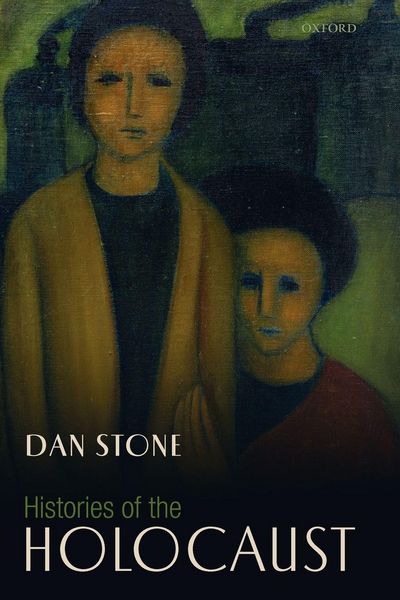
  • Produktbild: Histories of the Holocaust
  • Produktbild: Histories of the Holocaust

Histories of the Holocaust

41,99 €

inkl. gesetzl. MwSt., Versandkostenfrei


Beschreibung

The Holocaust is one of the most intensively studied phenomena in modern history. The volume of writing that fuels the numerous debates about it is overwhelming in quantity and diversity. Even those who have dedicated their professional lives to understanding the Holocaust cannot assimilate it all....

Beschreibung

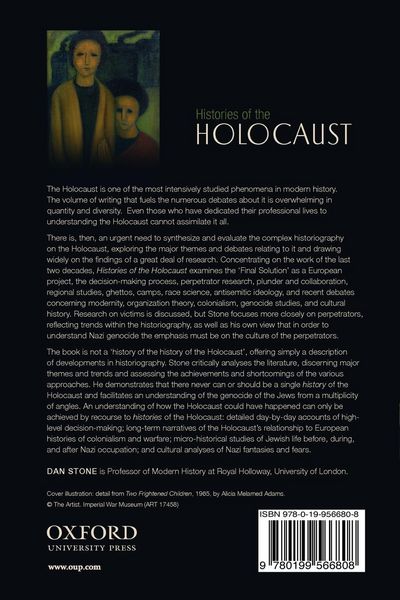
The Holocaust is one of the most intensively studied phenomena in modern history. The volume of writing that fuels the numerous debates about it is overwhelming in quantity and diversity. Even those who have dedicated their professional lives to understanding the Holocaust cannot assimilate it all. There is, then, an urgent need to synthesize and evaluate the complex historiography on the Holocaust, exploring the major themes and debates relating to it and drawing widely on the findings of a great deal of research. Concentrating on the work of the last two decades, Histories of the Holocaust examines the 'Final Solution' as a European project, the decision-making process, perpetrator research, plunder and collaboration, regional studies, ghettos, camps, race science, antisemitic ideology, and recent debates concerning modernity, organization theory, colonialism, genocide studies, and cultural history. Research on victims is discussed, but Stone focuses more closely on perpetrators, reflecting trends within the historiography, as well as his own view that in order to understand Nazi genocide the emphasis must be on the culture of the perpetrators. The book is not a 'history of the history of the Holocaust', offering simply a description of developments in historiography. Stone critically analyses the literature, discerning major themes and trends and assessing the achievements and shortcomings of the various approaches. He demonstrates that there never can or should be a single history of the Holocaust and facilitates an understanding of the genocide of the Jews from a multiplicity of angles. An understanding of how the Holocaust could have happened can only be achieved by recourse to histories of the Holocaust: detailed day-by-day accounts of high-level decision-making; long-term narratives of the Holocaust's relationship to European histories of colonialism and warfare; micro-historical studies of Jewish life before, during, and after Nazi occupation; and cultural analyses of Nazi fantasies and fears.

Produktdetails

Einband

Taschenbuch

Erscheinungsdatum

17.06.2010

Verlag Oxford University Press
Seitenzahl

326

Produktdetails

Einband

Taschenbuch

Erscheinungsdatum

17.06.2010

Verlag Oxford University Press
Seitenzahl

326

Maße (L/B/H)

23,4/15,6/1,8 cm

Gewicht

497 g

Sprache

Englisch

ISBN

978-0-19-956680-8

Herstelleradresse

Libri GmbH
Europaallee 1
36244 Bad Hersfeld
DE

Email: gpsr@libri.de

Noch keine Bewertungen vorhanden

Verfassen Sie die erste Bewertung zu diesem Artikel

Helfen Sie anderen Kundinnen und Kunden durch Ihre Meinung.

Kundinnen und Kunden meinen

Bewertungen (0)

Die Leseprobe wird geladen.
  • Produktbild: Histories of the Holocaust
  • Produktbild: Histories of the Holocaust
    • Introduction: Thinking about the Holocaust
    • 1: The 'Final Solution': A German or European Project?
    • 2: The Decision-Making Process in Context
    • 3: The Holocaust: Child of Modernity?
    • 4: Race Science: The Basis of the Nazi Worldview?
    • 5: Genocide, the Holocaust and the History of Colonialism
    • 6: The Holocaust as an Expression of Nazi Culture
    • Conclusion: Into the Abyss
    • Further Reading
    • Index