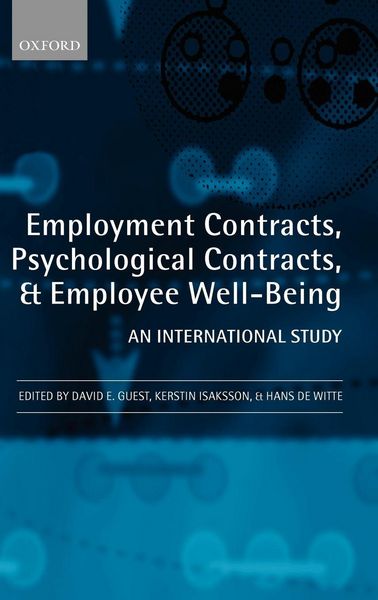
Employment Contracts, Psychological Contracts, and employee well-being An International Study
-
- Englisch ausgewählt
219,99 €
inkl. gesetzl. MwSt.,
Beschreibung
Produktdetails
Einband
Gebundene Ausgabe
Erscheinungsdatum
01.09.2010
Herausgeber
Guest David E. + weitereVerlag
Oxford University PressSeitenzahl
342
Maße (L/B/H)
24/16,1/2,3 cm
Gewicht
690 g
Sprache
Englisch
ISBN
978-0-19-954269-7
Temporary employment has become a focus of policy debate, theory, and research. The book addresses as its core concern the relationship between temporary employment contracts and employee well-being. It does so within the analytic framework of the psychological contract, and advances theory and knowledge about the psychological contract by exploring it from a variety of perspectives. It also sets the psychological contract within the context of a range of other potential influences on work-related well-being including workload, job insecurity, employability, and organizational support. A key aim of the book is to identify the relative importance of these various potential influences on well-being.
The book covers seven countries; Belgium, Germany, The Netherlands, Spain, Sweden and the UK, as well as Israel as a comparator outside Europe. Data were collected from over 5,000 workers in over 200 organizations; and from both permanent and temporary workers as well as from employers.
The book's conclusions are interesting and controversial. The central finding is that contrary to expectations, temporary workers report higher well-being than permanent workers. As expected, a range of factors help to explain variations in work-related well-being and the research highlights the important role of the psychological contract. However, even after taking into account alternative explanations, the significant influence of type of employment contract remains, with temporary workers reporting higher well-being. In addition to this core finding, by exploring several aspects of the psychological contract, and taking into account both employer and employee perspectives, the book sheds new light on the nature and role of the psychological contract. It also raises some challenging policy questions and while acknowledging the potentially precarious nature of temporary jobs, highlights the need to consider the increasingly demanding nature of permanent jobs and their effects on the well-being of employees.
Noch keine Bewertungen vorhanden
Verfassen Sie die erste Bewertung zu diesem Artikel
Helfen Sie anderen Kundinnen und Kunden durch Ihre Meinung.
Kurze Frage zu unserer Seite
Vielen Dank für Ihr Feedback
Wir nutzen Ihr Feedback, um unsere Produktseiten zu verbessern. Bitte haben Sie Verständnis, dass wir Ihnen keine Rückmeldung geben können. Falls Sie Kontakt mit uns aufnehmen möchten, können Sie sich aber gerne an unseren Kund*innenservice wenden.
zum Kundenservice