Gutscheinbedingungen

**Gültig bis 06.07.2026 auf fremdsprachige Bücher online auf thalia.at, in der Thalia App ab einem Mindestbestellwert von 30€ und in allen Thalia Buchhandlungen in Österreich. In den Buchhandlungen nur gültig auf lagernde Ware. Einzelne Artikel können ausgeschlossen sein. Ausgenommen sind preisgebundene Artikel & eBooks. Pro Einkauf einmal einlösbar. Nur gültig gegen Vorlage oder im Onlineshop hinterlegter Bonuscard. Infos zur Einlösung in der Buchhandlung sind auf der Bonuscard-Vorteilspreisseite zu finden. Click & Collect nur bei Onlinevorabzahlung möglich. Keine Einlösung bei Scan & Go-Bezahlung. Keine Barauszahlung. Nicht kombinierbar mit anderen Aktionen und Gutscheinen. Gutschein wird auf max. 500€ Bestellwert angerechnet. Nicht gültig für Versandkosten und Services.

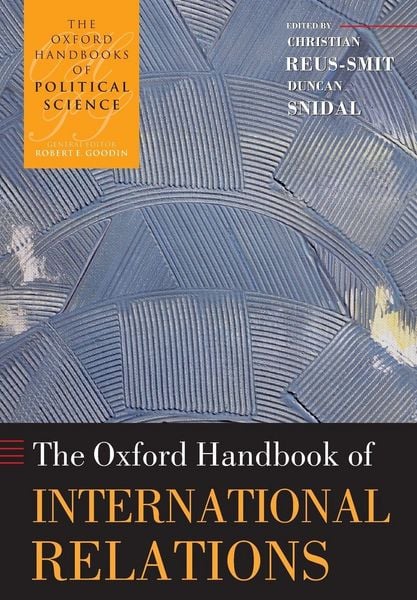
  • Produktbild: Oxford Handbook of International Relations
  • Produktbild: Oxford Handbook of International Relations

Oxford Handbook of International Relations

79,99 €

inkl. gesetzl. MwSt., Versandkostenfrei


Beschreibung

Produktdetails

Einband

Taschenbuch

Erscheinungsdatum

01.07.2010

Herausgeber

Christian Reus-Smit + weitere

Verlag

Oxford Academic

Seitenzahl

788

Maße (L/B/H)

24,4/17/4,2 cm

Gewicht

1387 g

Sprache

Englisch

ISBN

978-0-19-958558-8

Beschreibung

Produktdetails

Einband

Taschenbuch

Erscheinungsdatum

01.07.2010

Herausgeber

Verlag

Oxford Academic

Seitenzahl

788

Maße (L/B/H)

24,4/17/4,2 cm

Gewicht

1387 g

Sprache

Englisch

ISBN

978-0-19-958558-8

Herstelleradresse

Libri GmbH
Europaallee 1
36244 Bad Hersfeld
DE

Email: gpsr@libri.de

Noch keine Bewertungen vorhanden

Verfassen Sie die erste Bewertung zu diesem Artikel

Helfen Sie anderen Kundinnen und Kunden durch Ihre Meinung.

Kundinnen und Kunden meinen

Bewertungen (0)

Die Leseprobe wird geladen.
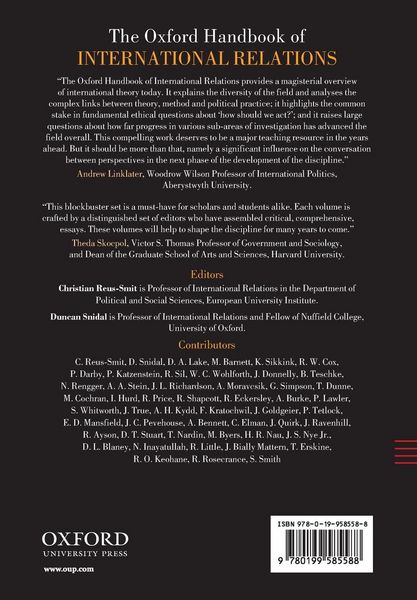
  • Produktbild: Oxford Handbook of International Relations
  • Produktbild: Oxford Handbook of International Relations
    • Part I Introduction

    • 1: Christian Reus-Smit and Duncan Snidal: Between utopia and reality: the practical discourses of international relations

    • Part II Imagining the discipline

    • 2: David A. Lake: The state and international relations

    • 3: Michael Barnett and Kathryn Sikkink: From international relations to global society

    • 4: Robert Cox: The point is not just to explain the world but to change it

    • 5: Phillip Darby: A disabling discipline?

    • Part III Major theoretical perspectives

    • 6: Peter Katzenstein and Rudra Sil: Eclectic theorizing in the study and practice of international relations

    • 7: William C. Wohlforth: Realism

    • 8: Jack Donnelly: The ethics of realism

    • 9: Benno Teschke: Marxism

    • 10: Nicholas Rengger: The ethics of Marxism

    • 11: Arthur A. Stein: Neoliberal institutionalism

    • 12: James L. Richardson: The ethics of neoliberal institutionalism

    • 13: Andrew Moravscik: The new liberalism

    • 14: Gerry Simpson: The ethics of the new liberalism

    • 15: Tim Dunne: The English School

    • 16: Molly Cochran: The ethics of the English School

    • 17: Ian Hurd: Constructivism

    • 18: Richard Price: The ethics of constructivism

    • 19: Richard Shapcott: Critical theory

    • 20: Robyn Eckersley: The ethics of critical theory

    • 21: Anthony Burke: Postmodernism

    • 22: Peter Lawler: The ethics of postmodernism

    • 23: Sandra Whitworth: Feminism

    • 24: Jacqui True: The ethics of feminism

    • Part IV The question of method

    • 25: Andrew H. Kydd: Methodological individualism and rational choice

    • 26: Friedrich Kratochwil: Sociological approaches

    • 27: James Goldgeier and Philip Tetlock: Psychological approaches

    • 28: Edward D. Mansfield and Jon C. Pevehouse: Quantitative approaches

    • 29: Andrew Bennett and Colin Elman: Case study methods

    • 30: Joel Quirk: Historical methods

    • Part V Bridging the subfield boundaries

    • 31: John Ravenhill: International political economy

    • 32: Robert Ayson: Strategic studies

    • 33: Douglas T. Stuart: Foreign policy decision-making

    • 34: Terry Nardin: International ethics

    • 35: Michael Byers: International law

    • Part VI The scholar and the policy-maker

    • 36: Henry R. Nau: Scholarship and policy-making: who speaks truth to whom?

    • 37: Joseph S. Nye, Jr: International relations: the relevance of theory to practice

    • Part VII The question of diversity

    • 38: David L. Blaney and Naeem Inayatullah: International relations from below

    • 39: Richard Little: International relations theory from a former hegemon

    • Part VIII Old and new

    • 40: Janice Bially Mattern: The concept of power and the (un)discipline of international relations

    • 41: Toni Erskine: Locating responsibility: the problem of moral agency in international relations

    • 42: Robert O. Keohane: Big questions in the study of world politics

    • 43: Richard Rosecrance: The failure of static and the need for dynamic approaches to international relations

    • 44: Steve Smith: Six wishes for a more relevant discipline of international relations