KI-Beratung Beta

Gutscheinbedingungen

**Gültig am 25.11.2026 auf fremdsprachige Bücher online auf thalia.at und in der Thalia App. Einzelne Artikel können ausgeschlossen sein. Ausgenommen sind preisgebundene Artikel & eBooks. Pro Einkauf einmal einlösbar. Click & Collect nur bei Onlinevorabzahlung möglich. Keine Barauszahlung. Nicht kombinierbar mit anderen Aktionen und Gutscheinen. Gutschein wird auf max. 500€ Bestellwert angerechnet. Nicht gültig für Geschenkkarten, Versandkosten und Services.

  • Produktbild: Plant Biotechnology for Sustainable Production of Energy and Co-products
  • Produktbild: Plant Biotechnology for Sustainable Production of Energy and Co-products
Band 66 - 10%

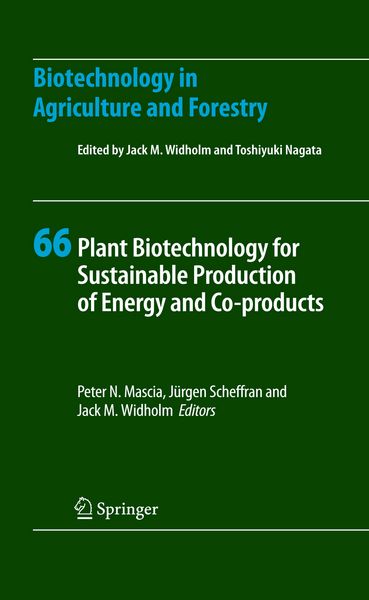
Plant Biotechnology for Sustainable Production of Energy and Co-products

10% sparen

147,99 € UVP 164,99 €

inkl. gesetzl. MwSt., Versandkostenfrei


Beschreibung

This book is a collection of chapters concerning the use of biomass for the sustainable production of energy and chemicals–an important goal that will help decrease the production of greenhouse gases to help mitigate global warming, provide energy security in the face of dwindling petroleum reserves,...

Beschreibung

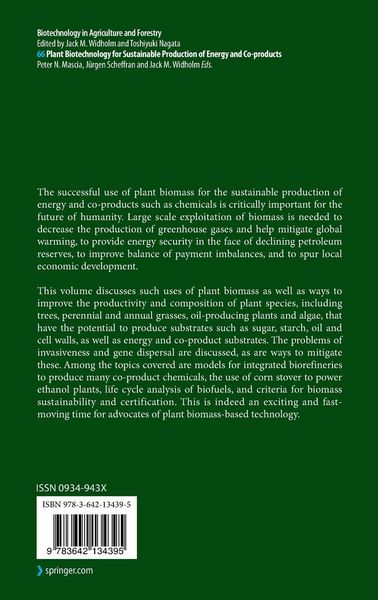
This book is a collection of chapters concerning the use of biomass for the sustainable production of energy and chemicals–an important goal that will help decrease the production of greenhouse gases to help mitigate global warming, provide energy security in the face of dwindling petroleum reserves, improve balance of payment problems and spur local economic development. Clearly there are ways to save energy that need to be encouraged more. These include more use of energy sources such as, among others, manure in anaerobic digesters, waste wood in forests as fuel or feedstock for cellulosic ethanol, and conservation reserve program (CRP) land crops that are presently unused in the US. The use of biofuels is not new; Rudolf Diesel used peanut oil as fuel in the ?rst engines he developed (Chap. 8), and ethanol was used in the early 1900s in the US as automobile fuel [Songstad et al. (2009) Historical perspective of biofuels: learning from the past to rediscover the future. In Vitro Cell Dev Biol Plant 45:189–192). Brazil now produces enough sugar cane ethanol to make up about 50% of its transportation fuel needs (Chap. 4). The next big thing will be cellulosic ethanol. At present, there is also the use of Miscanthus x giganteous as fuel for power plants in the UK (Chap. 2), bagasse (sugar cane waste) to power sugar cane mills (Chap. 4), and waste wood and sawdust to power sawmills (Chap. 7).

Rezension

From the reviews:

“Conversion of biomass to ethanol, diesel substitutes, and other biofuels is the only option for significantly reducing dependence on petroleum for the liquid fuels that are essential to air travel, heavy-duty trucking, and long-distance travel. Here, the editors have compiled expert contributions and perspectives on a wide range of topics. … The contributors are invariably realistic and sober about the challenges and achievements possible. … Summing Up: Recommended. Students of all levels, researchers/faculty, and professionals/practitioners.” (W. Loescher, Choice, Vol. 48 (8), April, 2011)

Produktdetails

Einband

Gebundene Ausgabe

Erscheinungsdatum

16.09.2010

Abbildungen

XVIII, 458 p. 74 illus., 37 illus. in color.

Herausgeber Peter N. Mascia + weitere

Produktdetails

Einband

Gebundene Ausgabe

Erscheinungsdatum

16.09.2010

Abbildungen

XVIII, 458 p. 74 illus., 37 illus. in color.

Herausgeber
Verlag Springer Berlin
Seitenzahl

458

Maße (L/B/H)

24,1/16/3,4 cm

Gewicht

911 g

Auflage

2010

Sprache

Englisch

ISBN

978-3-642-13439-5

Herstelleradresse

Springer-Verlag GmbH
Europaplatz 3
69115 Heidelberg
DE

Email: ProductSafety@springernature.com

Noch keine Bewertungen vorhanden

Verfassen Sie die erste Bewertung zu diesem Artikel

Helfen Sie anderen Kundinnen und Kunden durch Ihre Meinung.

Kundinnen und Kunden meinen

Bewertungen (0)

  • Produktbild: Plant Biotechnology for Sustainable Production of Energy and Co-products
  • Produktbild: Plant Biotechnology for Sustainable Production of Energy and Co-products
  • to Biofuels.- Overview: World Energy Resources and the Need for Biomass for Energy and Lower Fossil Carbon Dioxide Emissions.- Designing Biomass Crops with Improved Calorific Content and Attributes for Burning: a UK Perspective.- Designing Plants To Meet Feedstock Needs.- Specific Biofuel Feedstocks.- Engineering Advantages, Challenges and Status of Sugarcane and other Sugar-Based Biomass Resources.- High Fermentable Corn Hybrids for the Dry-Grind Corn Ethanol Industry.- Engineering Advantages, Challenges and Status of Grass Energy Crops.- Woody Biomass and Purpose-Grown Trees as Feedstocks for Renewable Energy.- Engineering Status, Challenges and Advantages of Oil Crops.- Mitigating Invasiveness.- Invasive Species Biology, Ecology, Management and Risk Assessment: Evaluating and Mitigating the Invasion Risk of Biofuel Crops.- Gene Flow in Genetically Engineered Perennial Grasses: Lessons for Modification of Dedicated Bioenergy Crops.- Genetic Modification in Dedicated Bioenergy Crops and Strategies for Gene Confinement.- Models for Uses of Biomass Feedstocks.- Integrated Biorefineries—A Bottom-Up Approach to Biomass Fractionation.- Heat and Power Production from Stover for Corn Ethanol Plants.- Agricultural Fit of Biomass Crops and Lifecycle Analysis and Criteria.- The Problem is the Solution: the Role of Biofuels in the Transition to a Regenerative Agriculture.- Life-Cycle Analysis of Biofuels.- Criteria for a Sustainable Bioenergy Infrastructure and Lifecycle.