Gutscheinbedingungen

**Gültig bis 17.08.2026 auf Schreibwaren & Office-Artikel online auf thalia.at, in der Thalia App und in teilnehmenden Thalia Buchhandlungen in Österreich mit Schulsortiment. In den Buchhandlungen nur gültig auf lagernde Ware. Einzelne Artikel können ausgeschlossen sein. Ausgenommen sind preisgebundene Artikel. Pro Einkauf einmal einlösbar. Nur gültig gegen Vorlage oder im Onlineshop hinterlegter Bonuscard. Infos zur Einlösung in der Buchhandlung sind auf der Bonuscard-Vorteilspreisseite zu finden. Click & Collect nur bei Onlinevorabzahlung möglich. Keine Einlösung bei Scan & Go-Bezahlung. Keine Barauszahlung. Nicht kombinierbar mit anderen Aktionen und Gutscheinen. Gutschein wird auf max. 500€ Bestellwert angerechnet. Nicht gültig für Geschenkkarten, Versandkosten und Services.

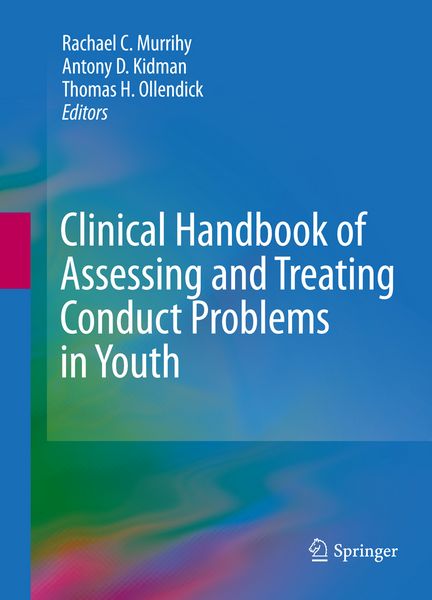
  • Produktbild: Clinical Handbook of Assessing and Treating Conduct Problems in Youth
  • Produktbild: Clinical Handbook of Assessing and Treating Conduct Problems in Youth
- 12%

Clinical Handbook of Assessing and Treating Conduct Problems in Youth

12% sparen

95,99 € UVP 109,99 €

inkl. gesetzl. MwSt., Versandkostenfrei


Beschreibung

Produktdetails

Einband

Gebundene Ausgabe

Erscheinungsdatum

30.09.2010

Herausgeber

Rachael C. Murrihy + weitere

Verlag

Springer Us

Seitenzahl

544

Maße (L/B/H)

26,7/18,7/4,3 cm

Gewicht

1206 g

Auflage

2010

Sprache

Englisch

ISBN

978-1-4419-6295-9

Beschreibung

Rezension

From the reviews:

"Overall, the combination of the traditional subjects, updated and enriched by clinically vivid portraits of the topics, with a healthy infusion of fresh, innovative material, makes this book for now the preferred reference on this topic for practicing clinical psychologists."

Joseph C. Blader

PsycCRITIQUES, July 6, 2011, Vol. 56, Release 27, Article 9

“This book provides a comprehensive overview of what is currently known about child and adolescent behaviour problems. … it’s an easy-to-read resource for both researchers and clinicians who wish to develop a solid theoretical understanding of these problems. It also details practical, evidence-based assessment and intervention options that can be applied across a range of settings and is tailored to meet individual needs, such as parent management strategies, family therapy and cognitive behaviour therapy.” (Danielle Ellis, UTS News Room, November, 2012)

Portrait

Rachael C. Murrihy, PsyD. Dr. Murrihy is currently Senior Clinical Psychologist and Research Associate at the Health Psychology Unit, an adolescent-focused unit, at the University of Technology, Sydney, Australia. Dr Murrihy’s specialty is in the area of clinical adolescent psychology. She has extensive experience lecturing, training, and supervising professionals in this field, including clinical psychologists, psychiatrists, family physicians, nurses, educators, and interns. She also provides mental health lectures for members of the general public. As a practicing clinician, Dr Murrihy works with youth experiencing both internalizing and externalizing disorders across a diverse range of settings, including the university clinic, private practice, inpatient wards, and in mainstream and alternative schools. She has published research on adolescent mental health and has presented this work at conferences, both nationally and internationally. She has held research grants from the Australian Psychological Society, New South Wales (NSW) Department of Health, and the NSW Department of Education and Training. Her research and clinical interests include the assessment and treatment of youth with conduct problems, callous-unemotional traits in youth, cyber bullying and indirect bullying, and Cognitive Behavioral Therapy for early psychosis.

Antony D. Kidman, PhD. Dr. Kidman is a Clinical Psychologist and Director of the Health Psychology Unit of the University of Technology, Sydney, Australia. He has more than 140 scholarly publications to his name including seven books: Tactics for Change; Managing Love and Hate; Family Life, Adapting to Change; Feeling Better, a Guide to Mood Management; From Thought to Action; Stress, Coping and Social Support in the Age of Anxiety, and Schizophrenia, a Guide for Families. Dr Kidman was a member of the National Executive of the Australian college of clinical psychologists for 10 years and was the founderand inaugural Editor for 6 years of the College’s journal, The Clinical Psychologist. He is a Member of the Clinical College of the Australian Psychological Society, an Associate Fellow of the Albert Ellis Institute of Rational Emotive Therapy (NY) and a Fellow of the International Academy of Cognitive Therapy. He has held research grants from the Australian National Health and Medical Research Council and the New South Wales Department of Health. Dr Kidman has had a long-term clinical and research interest in adolescent mental health including anxiety, depression and psychosis. He is a frequent guest speaker on radio and television and writes for the media on mental health. He was made a Member of the Order of Australia in 2005 for his contributions to clinical psychology.

Thomas H. Ollendick, PhD. Dr. Ollendick is University Distinguished Professor in Clinical Psychology and Director of the Child Study Center at Virginia Polytechnic Institute and State University, Blacksburg, Virginia, USA. He is the author of several research articles, book chapters, and books. His books include Clinical Behavior Therapy with Children (Plenum Press), Child Behavioral Assessment: Principles and Procedures (Pergamon Press), Handbook of Child Psychopathology (Plenum Press), Developmental Issues in the Clinical Treatment of Children (Allyn and Bacon) (Oxford), and the Handbook of Interventions that Work with Children and Adolescents (Wiley). He is the past Editor of the Journal of Clinical Child Psychology, past Associate Editor of the Journal of Consulting and Clinical Psychology, current Editor of Behavior Therapy, and founding Co-Editor of Clinical Child and Family Psychology Review. In addition, he is Past-President of the Association for the Advancement of Behavior Therapy (1995), the Society of Clinical Psychology (1999), the Society of Clinical Child and Adolescent Psychology (2003), and is currently President of the Society for the Science of ClinicalPsychology. A frequent speaker at national and international conferences, he is the recipient of several NIH grants. His clinical and research interests range from the study of diverse forms of child psychopathology to the assessment, treatment, and prevention of these child disorders from a social learning/social cognitive theory perspective.

Produktdetails

Einband

Gebundene Ausgabe

Erscheinungsdatum

30.09.2010

Herausgeber

Verlag

Springer Us

Seitenzahl

544

Maße (L/B/H)

26,7/18,7/4,3 cm

Gewicht

1206 g

Auflage

2010

Sprache

Englisch

ISBN

978-1-4419-6295-9

Herstelleradresse

Libri GmbH
Europaallee 1
36244 Bad Hersfeld
DE

Email: gpsr@libri.de

Noch keine Bewertungen vorhanden

Verfassen Sie die erste Bewertung zu diesem Artikel

Helfen Sie anderen Kundinnen und Kunden durch Ihre Meinung.

Kundinnen und Kunden meinen

Bewertungen (0)

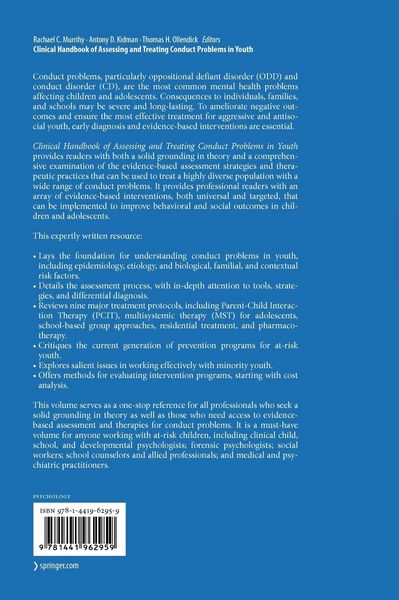
  • Produktbild: Clinical Handbook of Assessing and Treating Conduct Problems in Youth
  • Produktbild: Clinical Handbook of Assessing and Treating Conduct Problems in Youth
  • Preface.
    Part I: An Introduction to Conduct Problems in Youth. Conduct Problems in Youth: Phenomenology, Classification, and Epidemiology. Conduct Problems in Youth: Sociological Perspectives. Etiology of Oppositional Defiant Disorder and Conduct Disorder: Biological, Familial and Environmental Factors Identified in the Development of Disruptive Behavior. Assessment of Conduct Problems Using an Integrated, Process Oriented Approach.-
    Part II. Evidence-Based Treatments of Conduct Problems: An Applied Approach for Practitioners. The Incredible Years Program for Children from Infancy to Pre-Adolescence: Prevention and Treatment of Behavior Problems. Parent-Child Interaction Therapy for Preschool Children with Conduct Problems. Parent Training for the Treatment of Oppositional Behavior in Young Children: Helping the Noncompliant Child. Collaborative Problem Solving. Cognitive Behavior Therapy for the Group Based Treatment of Oppositional Youth. Functional Family Therapy: A Phase Based and Multi-Component Approach to Change. Multisystemic Therapy for Conduct Problems in Youth.-
    Part III: Evidence-based Treatment of Youth with Conduct Problems in Diverse Settings. Social Competency CBT-based Group Training for Youth in Alternative School Settings. Residential Treatment Centers for Children and Adolescents with Conduct Disorders. Alternative Treatments for Conduct Problems: Brats, Boot Camps and Bungee Jumps. Pharmacotherapy for Children and Adolescents with Conduct Problems.-
    Part IV. Looking Forward: Prevention Programs and Advanced Treatment Considerations. The Fast Track Project: Preventing Severe Conduct Problems in School-Age Youth. Prevention: The Role of Early Universal and Targeted Interventions. Evidence-Based Treatments for Conduct Problems among Ethnic Minorities. Evidence-Based Treatment Programs for Conduct Problems: Are They Cost Effective?. Epilogue: Future Directions in Research and Practice.