KI-Beratung Beta

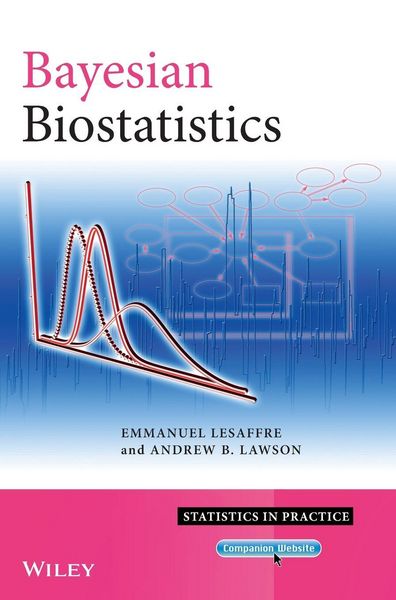
  • Produktbild: Bayesian Biostatistics
  • Produktbild: Bayesian Biostatistics

Bayesian Biostatistics

Aus der Reihe Statistics in Practice

101,99 €

inkl. gesetzl. MwSt., Versandkostenfrei


Beschreibung

The growth of biostatistics has been phenomenal in recent years and has been marked by considerable technical innovation in both methodology and computational practicality. One area that has experienced significant growth is Bayesian methods. The growing use of Bayesian methodology has taken place partly...

Beschreibung

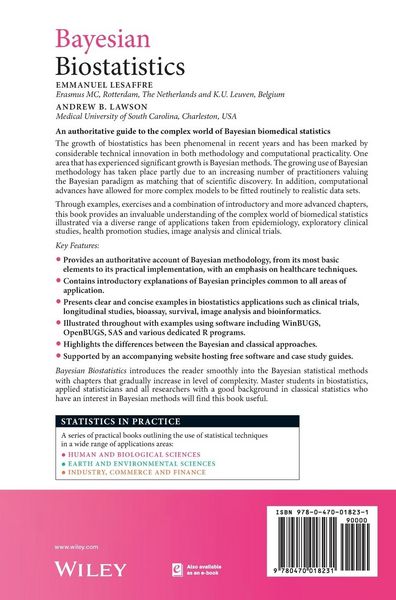
The growth of biostatistics has been phenomenal in recent years and has been marked by considerable technical innovation in both methodology and computational practicality. One area that has experienced significant growth is Bayesian methods. The growing use of Bayesian methodology has taken place partly due to an increasing number of practitioners valuing the Bayesian paradigm as matching that of scientific discovery. In addition, computational advances have allowed for more complex models to be fitted routinely to realistic data sets.
 
Through examples, exercises and a combination of introductory and more advanced chapters, this book provides an invaluable understanding of the complex world of biomedical statistics illustrated via a diverse range of applications taken from epidemiology, exploratory clinical studies, health promotion studies, image analysis and clinical trials.
 
Key Features:
* Provides an authoritative account of Bayesian methodology, from its most basic elements to its practical implementation, with an emphasis on healthcare techniques.
* Contains introductory explanations of Bayesian principles common to all areas of application.
* Presents clear and concise examples in biostatistics applications such as clinical trials, longitudinal studies, bioassay, survival, image analysis and bioinformatics.
* Illustrated throughout with examples using software including WinBUGS, OpenBUGS, SAS and various dedicated R programs.
* Highlights the differences between the Bayesian and classical approaches.
* Supported by an accompanying website hosting free software and case study guides.
 
Bayesian Biostatistics introduces the reader smoothly into the Bayesian statistical methods with chapters that gradually increase in level of complexity. Master students in biostatistics, applied statisticians and all researchers with a good background in classical statistics who have interest in Bayesian methods will find this book useful.

Rezension

"In conclusion, we consider the book by Lesaffre and Lawson a noteworthy contribution to the dissemination of Bayesian methods, and a good manual of reference for many common and some specialized applications in biomedical research. The great variety of examples and topics covered offers both advantages and disadvantages. Some parts might be too specialized for statistics students, but lecturers and applied statisticians will benefit a lot from the authors' wealth of experience." (Biometrical Journal, 15 July 2013)
 
"The book Bayesian Biostatisticsby Lesaffre and Lawson, is a welcoming addition to this important area of research in biostatistical applications. For example, in the area of clinical trials, Bayesian methods provide flexibility and benefits for incorporating historical data with current data and then using the resulting posterior to make probability statements for different outcomes".(Journal of Biopharmaceutical Statistics, 1 January 2013)

Produktdetails

Einband

Gebundene Ausgabe

Erscheinungsdatum

20.08.2012

Verlag John Wiley & Sons Inc
Seitenzahl

544

Produktdetails

Einband

Gebundene Ausgabe

Erscheinungsdatum

20.08.2012

Verlag John Wiley & Sons Inc
Seitenzahl

544

Maße (L/B/H)

25,4/17,6/3,5 cm

Gewicht

1027 g

Auflage

1. Auflage

Sprache

Englisch

ISBN

978-0-470-01823-1

Herstelleradresse

Libri GmbH
Europaallee 1
36244 Bad Hersfeld
DE

Email: gpsr@libri.de

Noch keine Bewertungen vorhanden

Verfassen Sie die erste Bewertung zu diesem Artikel

Helfen Sie anderen Kundinnen und Kunden durch Ihre Meinung.

Kundinnen und Kunden meinen

Bewertungen (0)

Die Leseprobe wird geladen.
  • Produktbild: Bayesian Biostatistics
  • Produktbild: Bayesian Biostatistics
  • Preface xiii
     
    Notation, terminology and some guidance for reading the book xvii
     
    Part I BASIC CONCEPTS IN BAYESIAN METHODS
     
    1 Modes of statistical inference 3
    1.1 The frequentist approach: A critical reflection 4
    1.2 Statistical inference based on the likelihood function 10
    1.3 The Bayesian approach: Some basic ideas 14
    1.4 Outlook 18
     
    2 Bayes theorem: Computing the posterior distribution 20
    2.1 Introduction 20
    2.2 Bayes theorem - the binary version 20
    2.3 Probability in a Bayesian context 21
    2.4 Bayes theorem - the categorical version 22
    2.5 Bayes theorem - the continuous version 23
    2.6 The binomial case 24
    2.7 The Gaussian case 30
    2.8 The Poisson case 36
    2.9 The prior and posterior distribution of h(theta) 40
    2.10 Bayesian versus likelihood approach 40
    2.11 Bayesian versus frequentist approach 41
    2.12 The different modes of the Bayesian approach 41
    2.13 An historical note on the Bayesian approach 42
    2.14 Closing remarks 44
     
    3 Introduction to Bayesian inference 46
     
    3.1 Introduction 46
    3.2 Summarizing the posterior by probabilities 46
    3.3 Posterior summary measures 47
    3.4 Predictive distributions 51
    3.5 Exchangeability 58
    3.6 A normal approximation to the posterior 60
    3.7 Numerical techniques to determine the posterior 63
    3.8 Bayesian hypothesis testing 72
    3.9 Closing remarks 78
     
    4 More than one parameter 82
    4.1 Introduction 82
    4.2 Joint versus marginal posterior inference 83
    4.3 The normal distribution with mu and sigma2 unknown 83
    4.4 Multivariate distributions 89
    4.5 Frequentist properties of Bayesian inference 92
    4.6 Sampling from the posterior distribution: The Method of Composition 93
    4.7 Bayesian linear regression models 96
    4.8 Bayesian generalized linear models 101
    4.9 More complex regression models 102
    4.10 Closing remarks 102
     
    5 Choosing the prior distribution 104
    5.1 Introduction 104
    5.2 The sequential use of Bayes theorem 104
    5.3 Conjugate prior distributions 106
    5.4 Noninformative prior distributions 113
    5.5 Informative prior distributions 121
    5.6 Prior distributions for regression models 129
    5.7 Modeling priors 134
    5.8 Other regression models 136
    5.9 Closing remarks 136
     
    6 Markov chain Monte Carlo sampling 139
    6.1 Introduction 139
    6.2 The Gibbs sampler 140
    6.3 The Metropolis(-Hastings) algorithm 154
    6.4 Justification of the MCMC approaches* 162
    6.5 Choice of the sampler 165
    6.6 The Reversible Jump MCMC algorithm* 168
    6.7 Closing remarks 172
     
    7 Assessing and improving convergence of the Markov chain 175
    7.1 Introduction 175
    7.2 Assessing convergence of a Markov chain 176
    7.3 Accelerating convergence 189
    7.4 Practical guidelines for assessing and accelerating convergence 194
    7.5 Data augmentation 195
    7.6 Closing remarks 200
     
    8 Software 202
    8.1 WinBUGS and related software 202
    8.2 Bayesian analysis using SAS 215
    8.3 Additional Bayesian software and comparisons 221
    8.4 Closing remarks 222
     
    Part II BAYESIAN TOOLS FOR STATISTICAL MODELING
     
    9 Hierarchical models 227
    9.1 Introduction 227
    9.2 The Poisson-gamma hierarchical model 228
    9.3 Full versus empirical Bayesian approach 238
    9.4 Gaussian hierarchical models 240
    9.5 Mixed models 244
    9.6 Propriety of the posterior 260
    9.7 Assessing and accelerating convergence 261
    9.8 Comparison of Bayesian and frequentist hierarchical models 263
    9.9 Closing remarks 265
     
    10 Model building and assessment 267
    10.1 Introduction 267
    10.2 Measures for model selection 268
    10.3 Model checking 288
    10.4 Closing remarks 316
     
    11 Variable selection 319
    11.1 Introduction 319
    11.2 Classical variable selection 320
    11.3 Bayesian variable selection: Concepts and questions 325
    11.4 Introduction