KI-Beratung Beta

  • Produktbild: Argumentation in Multi-Agent Systems
  • Produktbild: Argumentation in Multi-Agent Systems
Band 6057

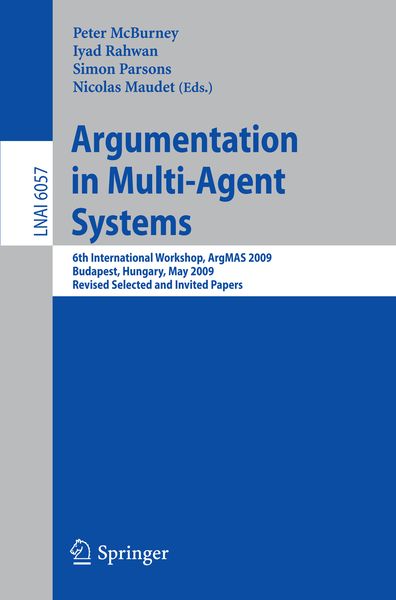
Argumentation in Multi-Agent Systems 6th International Workshop, ArgMAS 2009, Budapest, Hungary, May 12, 2009. Revised Selected and Invited Papers

51,99 €

inkl. gesetzl. MwSt., Versandkostenfrei


Beschreibung

This volume contains revised versions of the papers presented at the sixth e- tion of the International Workshop on Argumentation in Multi-Agent Systems, (ArgMAS2009),heldinBudapest,Hungary,inassociationwiththe8thInter- tional Conference on Autonomous Agents and Multi-Agent Systems (AAMAS 2009) in May...

Beschreibung

This volume contains revised versions of the papers presented at the sixth e- tion of the International Workshop on Argumentation in Multi-Agent Systems, (ArgMAS2009),heldinBudapest,Hungary,inassociationwiththe8thInter- tional Conference on Autonomous Agents and Multi-Agent Systems (AAMAS 2009) in May 2009. Previous ArgMAS workshops have been held in New York City, USA (2004),Utrecht, The Netherlands (2005),Hakodate, Japan (2006), Honolulu, USA (2007) and Estoril, Portugal (2008). The event has now clearlyestablisheditselfonthe internationalcalendaramongresearchersinc- putational argument and dialectics. A brief word to explain these topics is in order. Di?erent agents within a multi-agent system (MAS) potentially have di?erential access to information and di?erent capabilities, di?erent beliefs, di?erent preferences and desires, and di?erent goals. A key aspect of the scienti?c and engineering study of mul- agentsystemsthereforehasbeenthedevelopmentofmethodsandproceduresfor identifying, assessing, reconciling, arbitrating between, managing, and mitig- ing suchdi?erences. Marketmechanismsandvotingproceduresaretwo methods fordealing with thesedi?erences. Argumentationisanother. Argumentationcan be understood as the formal interaction of di?erent arguments for and against some conclusion (e. g. , a proposition, an action intention, a preference, etc. ). An agent may use argumentation techniques to perform individual reasoning for itself alone, in order to resolve con?icting evidence or to decide between c- ?icting goals it may have. Two or more agents may also jointly use dialectical argumentationto identify, express,andreconciledi?erencesbetweenthemselves, by means of interactions such as negotiation, persuasion, inquiry, and joint - liberation.

Produktdetails

Einband

Taschenbuch

Erscheinungsdatum

10.05.2010

Abbildungen

X, 321 p. 36 illus.

Herausgeber Peter McBurney + weitere

Produktdetails

Einband

Taschenbuch

Erscheinungsdatum

10.05.2010

Abbildungen

X, 321 p. 36 illus.

Herausgeber
Verlag Springer Berlin
Seitenzahl

321

Maße (L/B/H)

23,5/15,5/1,9 cm

Gewicht

511 g

Auflage

2010

Sprache

Englisch

ISBN

978-3-642-12804-2

Herstelleradresse

Springer-Verlag GmbH
Tiergartenstr. 17
69121 Heidelberg
DE

Email: ProductSafety@springernature.com

Noch keine Bewertungen vorhanden

Verfassen Sie die erste Bewertung zu diesem Artikel

Helfen Sie anderen Kundinnen und Kunden durch Ihre Meinung.

Kundinnen und Kunden meinen

Bewertungen (0)

  • Produktbild: Argumentation in Multi-Agent Systems
  • Produktbild: Argumentation in Multi-Agent Systems
  • Practical Reasoning and Argument about Action.- Burden of Proof in Deliberation Dialogs.- A Generative Dialogue System for Arguing about Plans in Situation Calculus.- Dominant Decisions by Argumentation Agents.- A Model for Integrating Dialogue and the Execution of Joint Plans.- Practical Reasoning Using Values.- Persuasion and Negotiation.- Strategic Argumentation in Rigorous Persuasion Dialogue.- Assumption-Based Argumentation for the Minimal Concession Strategy.- Subjective Effectiveness in Agent-to-Human Negotiation: A Frame x Personality Account.- Argumentation Theory.- Dynamics in Argumentation with Single Extensions: Attack Refinement and the Grounded Extension (Extended Version).- Arguing Using Opponent Models.- Realizing Argumentation in Multi-agent Systems Using Defeasible Logic Programming.- Computing Abductive Argumentation in Answer Set Programming.- Multi-Party Argument from Experience.- Applications and Emotions.- Using Ontology Modularization for Efficient Negotiation over Ontology Correspondences in MAS.- Applying Dialogue Games to Manage Recommendation in Social Networks.- Emotions in Rational Decision Making.- Using Personality Types to Support Argumentation.- Comparing Argumentation Frameworks for Composite Ontology Matching.