Gutscheinbedingungen

**Gültig bis 06.07.2026 auf fremdsprachige Bücher online auf thalia.at, in der Thalia App ab einem Mindestbestellwert von 30€ und in allen Thalia Buchhandlungen in Österreich. In den Buchhandlungen nur gültig auf lagernde Ware. Einzelne Artikel können ausgeschlossen sein. Ausgenommen sind preisgebundene Artikel & eBooks. Pro Einkauf einmal einlösbar. Nur gültig gegen Vorlage oder im Onlineshop hinterlegter Bonuscard. Infos zur Einlösung in der Buchhandlung sind auf der Bonuscard-Vorteilspreisseite zu finden. Click & Collect nur bei Onlinevorabzahlung möglich. Keine Einlösung bei Scan & Go-Bezahlung. Keine Barauszahlung. Nicht kombinierbar mit anderen Aktionen und Gutscheinen. Gutschein wird auf max. 500€ Bestellwert angerechnet. Nicht gültig für Versandkosten und Services.

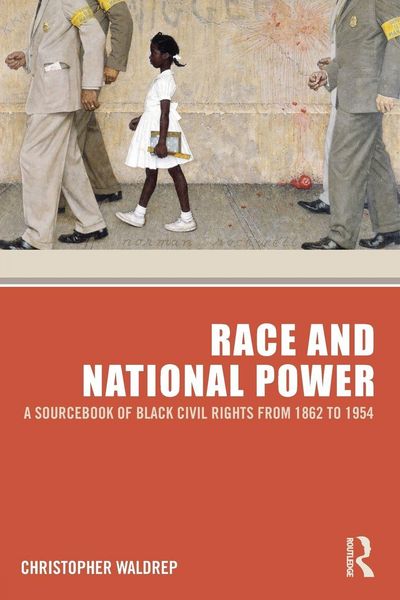
  • Produktbild: Race and National Power
  • Produktbild: Race and National Power

Race and National Power A Sourcebook of Black Civil Rights from 1862 to 1954

72,99 €

inkl. gesetzl. MwSt., Versandkostenfrei


Beschreibung

Produktdetails

Einband

Taschenbuch

Erscheinungsdatum

14.07.2010

Abbildungen

schwarz-weiss Illustrationen

Verlag

Taylor and Francis

Seitenzahl

336

Maße (L/B/H)

23,4/15,6/1,8 cm

Gewicht

1060 g

Sprache

Englisch

ISBN

978-0-415-80281-9

Beschreibung

Zitat

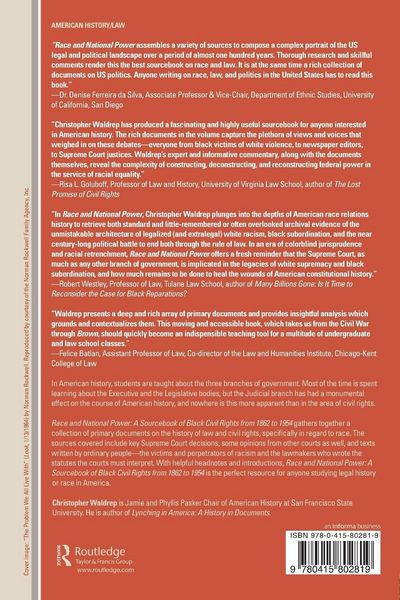
"Race and National Power assembles a variety of sources to compose a complex portrait of the US legal and political landscape over a period of almost one hundred years. Thorough research and skillful comments render this the best sourcebook on race and law. It is at the same time a rich collection of documents on US politics. Anyone writing on race, law, and politics in the United States has to read this book." --Dr. Denise Ferreira da Silva, Associate Professor & Vice-Chair, Department of Ethnic Studies, University of California, San Diego "Christopher Waldrep has produced a fascinating and highly useful sourcebook for anyone interested in American history. The rich documents in the volume capture the plethora of views and voices that weighed in on these debates--everyone from black victims of white violence, to newspaper editors, to Supreme Court justices. Waldrep's expert and informative commentary, along with the documents themselves, reveal the complexity of constructing, deconstructing, and reconstructing federal power in the service of racial equality." --Risa L. Goluboff, Professor of Law and History, University of Virginia Law School, author of The Lost Promise of Civil Rights "Waldrep presents a deep and rich array of primary documents and provides insightful analysis which grounds and contextualizes them. This moving and accessible book, which takes us from the Civil War through Brown, should quickly become an indispensible teaching tool for a multitude of undergraduate and law school classes." --Felice Batlan, Assistant Professor of Law, Co-director of the Law and Humanities Institute, Chicago-Kent College of Law "In Race and National Power Christopher Waldrep plunges into the depths of American race relations history to retrieve both standard and little-remembered or often overlooked archival evidence of the unmistakable architecture of legalized (and extralegal) white racism, black subordination, and the near century-long political battle to end both through the rule of law. In an era of colorblind jurisprudence and racial retrenchment, Race and National Power offers a fresh reminder that the Supreme Court, as much as any other branch of government, is implicated in the legacies of white supremacy and black subordination, and how much remains to be done to heal the wounds of American constitutional history." --Robert Westley, Professor of Law, Tulane Law School, author of Many Billions Gone: Is It Time to Reconsider the Case for Black Reparations? "Unlike many such collections, Waldrep's book has a definite theme. Employing documents from shortly before the Civil War to about the time of Brown v. Board of Education, he traces the link between the cause of civil rights and the power of the national government. ... There is plenty of interesting material in Race and National Power. ... [I]t should be in the collection of every university library. It is also a valuable tool for scholars and teachers to have on hand. Even more it would be a wonderful supplement for both undergraduate and graduate courses in history and political science." --Paul Kens (Texas State University-San Marcos), H-Net Reviews

Produktdetails

Einband

Taschenbuch

Erscheinungsdatum

14.07.2010

Abbildungen

schwarz-weiss Illustrationen

Verlag

Taylor and Francis

Seitenzahl

336

Maße (L/B/H)

23,4/15,6/1,8 cm

Gewicht

1060 g

Sprache

Englisch

ISBN

978-0-415-80281-9

Noch keine Bewertungen vorhanden

Verfassen Sie die erste Bewertung zu diesem Artikel

Helfen Sie anderen Kundinnen und Kunden durch Ihre Meinung.

Kundinnen und Kunden meinen

Bewertungen (0)

  • Produktbild: Race and National Power
  • Produktbild: Race and National Power
  • Preface Chapter 1: Introduction Part I: The Civil War Origins of Civil Rights Chapter 2: The Republicans Debate Civil Rights Chapter 3: The Republicans Enforce Their Civil Rights Policy Chpater 4: White and Black Southerners React to Emancipation Chapter 5: Congress Debates Civil Rights Legislation Part II: Civil Rights as a Lost Opportunity? Chapter 6: Enforcing Civil Rights: Sovereign Will and Public Sentiment Chapter 7: Liberal Republicans Chapter 8: Social Equality Chapter 9: President Hayes and the End of Reconstruction Chapter 10: The Supreme Court Chapter 11: James G. Blaine Reflects on Reconstruction Part III: The Black Struggle for Civil Rights Chapter 12: African Americans COnfront Public Sentiment with - and without -Constitutional Rights Chapter 13: Segregation Chapter 14: Voting Rights Chapter 15: Jury Discrimination Chpater 16: African Americans as Worthy Citizens Part IV: The Progressives Chapter 17: The Progressive State Chapter 18: Progressive Journalism Chapter 19: Progressive Dissatisfaction with Law Chapter 20: Using the Law against Racism Chapter 21: The Age of Theodore Roosevelt Chapter 22: Criminal Procedure Chapter 23: Police Power and Segregation Part V: The Rise of Mass Democracy Chapter 24: America as an "Enormous Community" Chapter 25: The Art and Practice of Mobilizing Public Opinion: Gandhi Chapter 26: The Parker Nomination Chapter 27: The Scottsboro Boys Chapter 28: The NAACP Lobbies for a Law against Lynching Chapter 29: The Constitutional Revolution Chapter 30: Struggle and Conflict are Present in All Phases of Life Chapter 31: Epilogue