KI-Beratung Beta

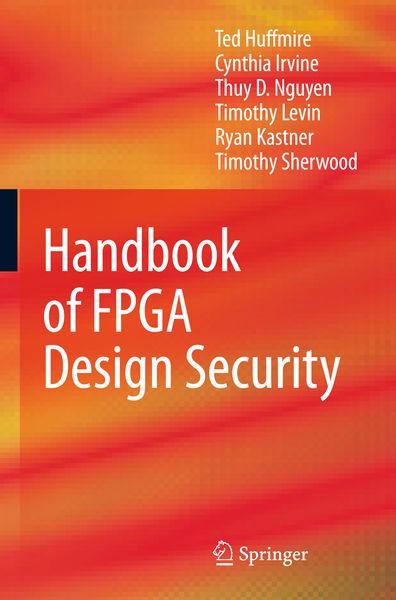
Produktbild: Handbook of FPGA Design Security
- 12%

Handbook of FPGA Design Security

12% sparen

95,99 € UVP 109,99 €

inkl. gesetzl. MwSt., Versandkostenfrei


Beschreibung

Produktdetails

Einband

Gebundene Ausgabe

Erscheinungsdatum

05.07.2010

Verlag

Springer Netherland

Seitenzahl

177

Maße (L/B/H)

24,1/15,6/2 cm

Gewicht

450 g

Auflage

1. Auflage

Sprache

Englisch

ISBN

978-90-481-9156-7

Beschreibung

Produktdetails

Einband

Gebundene Ausgabe

Erscheinungsdatum

05.07.2010

Verlag

Springer Netherland

Seitenzahl

177

Maße (L/B/H)

24,1/15,6/2 cm

Gewicht

450 g

Auflage

1. Auflage

Sprache

Englisch

ISBN

978-90-481-9156-7

Herstelleradresse

Libri GmbH
Europaallee 1
36244 Bad Hersfeld
DE

Email: gpsr@libri.de

Noch keine Bewertungen vorhanden

Verfassen Sie die erste Bewertung zu diesem Artikel

Helfen Sie anderen Kundinnen und Kunden durch Ihre Meinung.

Kundinnen und Kunden meinen

Bewertungen (0)

  • Produktbild: Handbook of FPGA Design Security
  • 1 Introduction and Motivation.- 1.1 The Growing Reliance on FPGAs.- 1.2 FPGA Architectures.- 1.3 The Many Facets of FPGA Security.- 1.4 Organization of This Book.- References.

    2 High Assurance Software Lessons and Techniques.- 2.1 Background.- 2.2 Malicious Software.- 2.3 Assurance.- 2.4 Commensurate Protection.- 2.5 Security Policy Enforcement.- 2.6 Assurance of Policy Enforcement.- References.

    3 Hardware Security Challenges.- 3.1 Malicious Hardware.- 3.2 Covert Channel De?nition.- 3.3 Existing Approaches to Limiting Covert and Side Channel Attacks.- 3.4 Detecting and Mitigating Covert Channels on FPGAs.- 3.5 Policy State as a Covert Storage Channel.- References.

    4 FPGA Updates and Programmability.- 4.1 Introduction.- 4.2 Bitstream Encryption and Authentication.- 4.3 Remote Updates.- 4.4 Partial Recon?guration.- References.

    5 Memory Protection on FPGAs.- 5.1 Overview.- 5.2 Memory Protection on FPGAs.- 5.3 Policy Description and Synthesis.- 5.4 A Higher-Level Speci?cation Language.- 5.5 Example Policies.- 5.6 System Architecture.- 5.7 Evaluation.- 5.8 Using the Policy Compiler.- 5.9 Constructing Mathematically Precise Policies.- 5.10 Summary.- References.

    6 Spatial Separation with Moats.- 6.1 Overview.- 6.2 Separation.- 6.3 Physical Isolation with Moats.- 6.4 Constructing Moats.- 6.5 Secure Interconnect with Drawbridges.- 6.6 Protecting the Reference Monitor with Moats.- References.

    7 Putting it All Together: A Design Example.- 7.1 A Multi-Core Recon?gurable Embedded System.- 7.2 On-chip Peripheral Bus.- 7.3 AES core.- 7.4 Logical Isolation Compartments.- 7.5 Reference Monitor.- 7.6 Stateful Policy.- 7.7 Secure Interconnect Scalability.- 7.8 Covert Channels.- 7.9 Incorporating Moats and Drawbridges.- 7.10 Implementation and Evaluation.- 7.11 Software Interface.- 7.12 Security Usability.- 7.13 More Example Security Architectures.- 7.14 Summary.- References.

    8 Forward-Looking Problems.- 8.1Trustworthy Tools.- 8.2 Formal Veri?cation of Secure Systems.- 8.3 Security Usability.- 8.4 Hardware Trust.- 8.5 Languages.- 8.6 Con?guration Management.- 8.7 Securing the Supply Chain.- 8.8 Physical Attacks on FPGAs.- 8.9 Design Theft and Failure Analysis.- 8.10 Partial Recon?guration and Dynamic Security.- 8.11 Concluding Remarks.- References.

    A Computer Architecture Fundamentals.- A.1 What Do Computer Architects Do All Day?- A.2 Tradeoffs Between CPUs, FPGAs, and ASICs.- A.3 Computer Architecture and Computer Science.- A.4 Program Analysis.- A.5 Novel Computer Architectures.- A.6 Memory.- A.7 Superscalar Processors.- A.8 Multithreading.- References.