Gutscheinbedingungen

**Gültig am 26.09.2026 auf fremdsprachige Mangas (mangas-29438) online auf thalia.at und in der Thalia App. Einzelne Artikel können ausgeschlossen sein. Ausgenommen sind preisgebundene Artikel & eBooks. Pro Einkauf einmal einlösbar. Click & Collect nur bei Onlinevorabzahlung möglich. Keine Barauszahlung. Nicht kombinierbar mit anderen Aktionen und Gutscheinen. Gutschein wird auf max. 500€ Bestellwert angerechnet. Nicht gültig für Geschenkkarten, Versandkosten und Services.

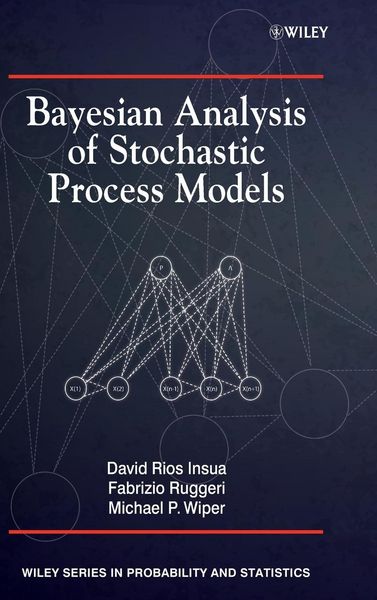
Produktbild: Bayesian Analysis of Stochasti

Bayesian Analysis of Stochasti

147,99 €

inkl. gesetzl. MwSt., Versandkostenfrei


Beschreibung

Produktdetails

Einband

Gebundene Ausgabe

Erscheinungsdatum

25.04.2012

Verlag

John Wiley & Sons

Seitenzahl

320

Maße (L/B/H)

23,5/15,7/2,2 cm

Gewicht

612 g

Auflage

1. Auflage

Sprache

Englisch

ISBN

978-0-470-74453-6

Beschreibung

Produktdetails

Einband

Gebundene Ausgabe

Erscheinungsdatum

25.04.2012

Verlag

John Wiley & Sons

Seitenzahl

320

Maße (L/B/H)

23,5/15,7/2,2 cm

Gewicht

612 g

Auflage

1. Auflage

Sprache

Englisch

ISBN

978-0-470-74453-6

Herstelleradresse

Libri GmbH
Europaallee 1
36244 Bad Hersfeld
DE

Email: gpsr@libri.de

Noch keine Bewertungen vorhanden

Verfassen Sie die erste Bewertung zu diesem Artikel

Helfen Sie anderen Kundinnen und Kunden durch Ihre Meinung.

Kundinnen und Kunden meinen

Bewertungen (0)

Die Leseprobe wird geladen.
  • Produktbild: Bayesian Analysis of Stochasti
  • Preface xi

    PART ONE BASIC CONCEPTS AND TOOLS

    1 Stochastic processes 3
    1.1 Introduction 3
    1.2 Key concepts in stochastic processes 3
    1.3 Main classes of stochastic processes 7
    1.4 Inference, prediction, and decision-making 12
    1.5 Discussion 13

    2 Bayesian analysis 16
    2.1 Introduction 16
    2.2 Bayesian statistics 16
    2.3 Bayesian decision analysis 25
    2.4 Bayesian computation 26
    2.5 Discussion 37

    PART TWO MODELS

    3 Discrete time Markov chains and extensions 45
    3.1 Introduction 45
    3.2 Important Markov chain models 46
    3.3 Inference for ¿rst-order, time homogeneous, Markov chains 49
    3.4 Special topics 58
    3.5 Case study: Wind directions at Gijon 68
    3.6 Markov decision processes 74
    3.7 Discussion 77

    4 Continuous time Markov chains and extensions 82
    4.1 Introduction 82
    4.2 Basic setup and results 83
    4.3 Inference and prediction for CTMCs 85
    4.4 Case study: Hardware availability through CTMCs 88
    4.5 Semi-Markovian processes 93
    4.6 Decision-making with semi-Markovian decision processes 97
    4.7 Discussion 102

    5 Poisson processes and extensions 105
    5.1 Introduction 105
    5.2 Basics on Poisson processes 106
    5.3 Homogeneous Poisson processes 109
    5.4 Nonhomogeneous Poisson processes 117
    5.5 Compound Poisson processes 122
    5.6 Further extensions of Poisson processes 124
    5.7 Case study: Earthquake occurrences 126
    5.8 Discussion 130

    6 Continuous time continuous space processes 135
    6.1 Introduction 135
    6.2 Gaussian processes 135
    6.3 Brownian motion and FBM 139
    6.4 Diffusions 144
    6.5 Case study: Predator-prey systems 147
    6.6 Discussion 153

    PART THREE APPLICATIONS

    7 Queueing analysis 163
    7.1 Introduction 163
    7.2 Basic queueing concepts 163
    7.3 The main queueing models 165
    7.4 Bayesian inference for queueing systems 169
    7.5 Bayesian inference for the M/M/1 system 170
    7.6 Inference for non-Markovian systems 180
    7.7 Decision problems in queueing systems 187
    7.8 Case study: Optimal number of beds in a hospital 188
    7.9 Discussion 194

    8 Reliability 200
    8.1 Introduction 200
    8.2 Basic reliability concepts 201
    8.3 Renewal processes 203
    8.4 Poisson processes 205
    8.5 Other processes 212
    8.6 Maintenance 214
    8.7 Case study: Gas escapes 215
    8.8 Discussion 222

    9 Discrete event simulation 226
    9.1 Introduction 226
    9.2 Discrete event simulation methods 227
    9.3 A Bayesian view of DES 230
    9.4 Case study: A G/G/1 queueing system 231
    9.5 Bayesian output analysis 233
    9.6 Simulation and optimization 237
    9.7 Discussion 238

    10 Risk analysis 243
    10.1 Introduction 243
    10.2 Risk measures 243
    10.3 Ruin problems 256
    10.4 Case study: Estimation of ¿nite-time ruin probabilities in the Sparre Andersen model 261
    10.5 Discussion 266

    References 268
    Appendix A Main distributions 273
    Appendix B Generating functions and the Laplace-Stieltjes transform 283
    Index 285