KI-Beratung Beta

Produktbild: The Spatial Humanities

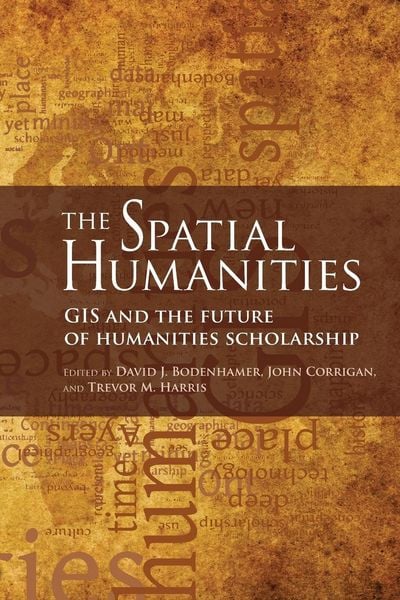
The Spatial Humanities GIS and the Future of Humanities Scholarship

24,99 €

inkl. gesetzl. MwSt., zzgl. Versandkosten


  • Kostenlose Lieferung ab 30 € Einkaufswert
  • Versandkostenfrei für Bonuscard-Kund*innen

Beschreibung

Geographic information systems (GIS) have spurred a renewed interest in the influence of geographical space on human behavior and cultural development. Ideally GIS enables humanities scholars to discover relationships of memory, artifact, and experience that exist in a particular place and across time....

Beschreibung

Geographic information systems (GIS) have spurred a renewed interest in the influence of geographical space on human behavior and cultural development. Ideally GIS enables humanities scholars to discover relationships of memory, artifact, and experience that exist in a particular place and across time. Although successfully used by other disciplines, efforts by humanists to apply GIS and the spatial analytic method in their studies have been limited and halting. The Spatial Humanities aims to re-orient, and perhaps revolutionize, humanities scholarship by critically engaging the technology and specifically directing it to the subject matter of the humanities. This book explores the potential of spatial methods such as text-based geographical analysis, multimedia GIS, animated maps, deep contingency, deep mapping, and the geo-spatial semantic web to re-orient humanities scholarship. It also grapples with the need to create a language that bridges disciplines, how to re-conceptualize the humanities to include the spatial perspective, how to use GIS to analyze text and images, and suggests approaches that will prompt a long-needed reintegration of geography into the humanities.

Rezension

The first attempt to tackle the issue of the humanities as an epistemic unit head-on, and to consider what the use of GIS . . . can bring to them. . . . The technical quality of the chapters is uniformly high: side-by-side they form a wide-ranging account, admirable in its ambition and scope, and authored by contributors who are recognized experts in their fields. The documentation and footnoting are exemplary, and the reader new to the field will find the further reading sections at the end extremely valuable.

(Literary and Linguistic Computing)

Produktdetails

Einband

Taschenbuch

Erscheinungsdatum

01.06.2010

Abbildungen

25 b&w illus.

Herausgeber David J. Bodenhamer + weitere

Produktdetails

Einband

Taschenbuch

Erscheinungsdatum

01.06.2010

Abbildungen

25 b&w illus.

Herausgeber
Verlag Indiana University Press
Seitenzahl

222

Maße (L/B/H)

22,9/15,2/1,2 cm

Gewicht

329 g

Sprache

Englisch

ISBN

978-0-253-22217-6

Herstelleradresse

Mare Nostrum Group B.V.
Doelen 72
4831 GR Breda
NL
gpsr@mare-nostrum.co.uk

Noch keine Bewertungen vorhanden

Verfassen Sie die erste Bewertung zu diesem Artikel

Helfen Sie anderen Kundinnen und Kunden durch Ihre Meinung.

Kundinnen und Kunden meinen

Bewertungen (0)

Die Leseprobe wird geladen.
  • Produktbild: The Spatial Humanities
  • Introduction
    1. Turning toward Place, Space, and Time / Edward L. Ayers
    2. The Potential of Spatial Humanities / David J. Bodenhamer
    3. Geographic Information Science and Spatial Analysis for the Humanities / Karen K. Kemp
    4. Exploiting Time and Space: A Challenge for GIS in the Digital Humanities / Ian Gregory
    5. Qualitative GIS and Emergent Semantics / John Corrigan
    6. Representations of Space and Place in the Humanities / Gary Lock
    7. Mapping Text / May Yuan
    8. The Geospatial Semantic Web, Pareto GIS, and the Humanities / Trevor M. Harris, L. Jesse Rouse, and Susan Bergeron
    9. GIS, e-Science, and the Humanities Grid / Paul S. Ell
    10. Challenges for the Spatial Humanities: Toward a Research Agenda / Trevor M. Harris, John Corrigan, and David J. Bodenhamer
    Suggestions for Further Reading
    List of Contributors
    Index