Gutscheinbedingungen

**Gültig bis 14.09.2026 auf Spielzeug, Schreibwaren, Filme, Geschenke & Trends, Musik, tolino eReader & Zubehör, Hörbücher, nicht preisgebundene Bücher und Kalender in der Thalia App. Einzelne Artikel können ausgeschlossen sein. Aufgrund der Buchpreisbindung sind deutschsprachige Bücher und eBooks ausgenommen. Zusätzlich ausgenommen sind Abos & Flatrates, Games, Geschenkkarten/-boxen, Shelfies, Software, Zeitschriften sowie einzelne Artikel von tonies®. Pro Einkauf einmal einlösbar. Nur gültig mit im Onlineshop hinterlegter Bonuscard. Click & Collect nur bei Onlinevorabzahlung möglich. Keine Barauszahlung. Nicht kombinierbar mit anderen Aktionen und Gutscheinen. Gutschein wird auf max. 500€ Bestellwert angerechnet. Nicht gültig für Versandkosten und Services.

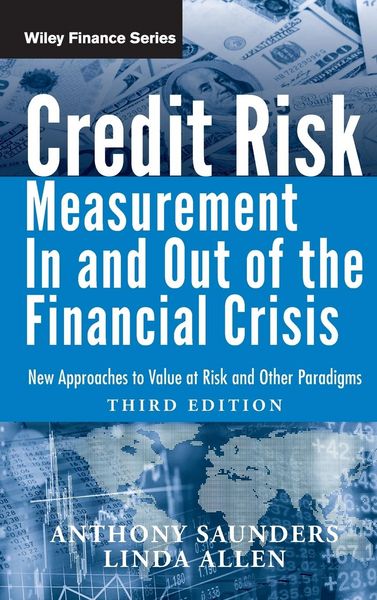
Produktbild: Credit Risk 3E

Credit Risk 3E New Approaches to Value at Risk and Other Paradigms

Aus der Reihe Wiley Finance Editions

85,99 €

inkl. gesetzl. MwSt., Versandkostenfrei


Beschreibung

Produktdetails

Einband

Gebundene Ausgabe

Erscheinungsdatum

19.04.2010

Abbildungen

Charts: 81 B&W, 0 Color; Tables: 49 B&W, 0 Color; Graphs: 0 B&W, 0 Color

Verlag

John Wiley & Sons

Seitenzahl

400

Maße (L/B/H)

23,5/15,7/2,6 cm

Gewicht

727 g

Auflage

3rd edition

Sprache

Englisch

ISBN

978-0-470-47834-9

Beschreibung

Produktdetails

Einband

Gebundene Ausgabe

Erscheinungsdatum

19.04.2010

Abbildungen

Charts: 81 B&W, 0 Color; Tables: 49 B&W, 0 Color; Graphs: 0 B&W, 0 Color

Verlag

John Wiley & Sons

Seitenzahl

400

Maße (L/B/H)

23,5/15,7/2,6 cm

Gewicht

727 g

Auflage

3rd edition

Sprache

Englisch

ISBN

978-0-470-47834-9

Herstelleradresse

Libri GmbH
Europaallee 1
36244 Bad Hersfeld
DE

Email: gpsr@libri.de

Noch keine Bewertungen vorhanden

Verfassen Sie die erste Bewertung zu diesem Artikel

Helfen Sie anderen Kundinnen und Kunden durch Ihre Meinung.

Kundinnen und Kunden meinen

Bewertungen (0)

Die Leseprobe wird geladen.
  • Produktbild: Credit Risk 3E
  • List of Abbreviations.
     
    Preface.
     
    PART ONE: Bubbles and Crises: The Global Financial Crisis of 2007-2009.
     
    CHAPTER 1: Setting the Stage for Financial Meltdown.
     
    Introduction.
     
    The Changing Nature of Banking.
     
    Reengineering Financial Institutions and Markets.
     
    Summary.
     
    Appendix 1.1: Ratings Comparisons for the Three Major Rating Agencies.
     
    CHAPTER 2: The Three Phases of the Credit Crisis.
     
    Introduction.
     
    Bursting of the Credit Bubble.
     
    Phase 1: Credit Crisis in the Mortgage Market.
     
    Phase 2: The Crisis Spreads--Liquidity Risk.
     
    Phase 3: The Lehman Failure--Underwriting and Political Intervention Risk.
     
    Summary.
     
    CHAPTER 3: The Crisis and Regulatory Failure.
     
    Introduction.
     
    Crisis Intervention.
     
    Looking Forward: Restructuring Plans.
     
    Summary.
     
    PART TWO: Probability of Default Estimation.
     
    CHAPTER 4: Loans as Options: The Moody's KMV Model.
     
    Introduction.
     
    The Link between Loans and Options.
     
    TheMoody's KMV Model.
     
    Testing the Accuracy of EDFTM Scores.
     
    Critiques of Moody's KMV EDFTM Scores.
     
    Summary.
     
    Appendix 4.1: Merton's Valuation Model.
     
    Appendix 4.2: Moody's KMV RiskCalc.
     
    CHAPTER 5: Reduced Form Models: Kamakura's Risk Manager.
     
    Introduction.
     
    Deriving Risk-Neutral Probabilities of Default.
     
    Generalizing the Discrete Model of Risky Debt Pricing.
     
    The Loss Intensity Process.
     
    Kamakura's Risk Information Services (KRIS).
     
    Determinants of Bond Spreads.
     
    Summary.
     
    Appendix 5.1: Understanding a Basic Intensity Process.
     
    CHAPTER 6: Other Credit Risk Models.
     
    Introduction.
     
    Credit Scoring Systems.
     
    Mortality Rate Systems.
     
    Artificial Neural Networks.
     
    Comparison of Default Probability Estimation Models.
     
    Summary.
     
    PART THREE: Estimation of Other Model Parameters.
     
    CHAPTER 7: A Critical Parameter: Loss Given Default.
     
    Introduction.
     
    Academic Models of LGD.
     
    Disentangling LGD and PD.
     
    Moody's KMV's Approach to LGD Estimation.
     
    Kamakura's Approach to LGD Estimation.
     
    Summary.
     
    CHAPTER 8: The Credit Risk of Portfolios and Correlations.
     
    Introduction.
     
    Modern Portfolio Theory (MPT): An Overview.
     
    Applying MPT to Nontraded Bonds and Loans.
     
    Estimating Correlations across Nontraded Assets.
     
    Moody's KMV's Portfolio Manager.
     
    Kamakura and Other Reduced Form Models.
     
    Summary.
     
    PART FOUR: Putting the Parameters Together.
     
    CHAPTER 9: The VAR Approach: CreditMetrics and Other Models.
     
    Introduction.
     
    The Concept of Value at Risk.
     
    Capital Requirements.
     
    Technical Issues and Problems.
     
    The Portfolio Approach in CreditMetrics.
     
    Summary.
     
    Appendix 9.1: Calculating the Forward Zero Curve for Loan Valuation.
     
    Appendix 9.2: Estimating Unexpected Losses Using Extreme Value Theory.
     
    Appendix 9.3: The Simplified Two-Asset Subportfolio Solution to the N-Asset Portfolio Case.
     
    Appendix 9.4: CreditMetrics and Swap Credit Risk.
     
    CHAPTER 10: Stress Testing Credit Risk Models: Algorithmics Mark-to-Future.
     
    Introduction.
     
    Back-Testing Credit Risk Models.
     
    Using the Algorithmics Mark-to-Future Model.
     
    Stress Testing U.S. Banks in 2009.
     
    Summary.
     
    CHAPTER 11: RAROC Models.
     
    Introduction.
    &nbs