Gutscheinbedingungen

**Gültig bis 15.06.2026 auf Spiele & Spielzeug online auf thalia.at, in der Thalia App ab einem Mindestbestellwert von 30€ und in allen Thalia Buchhandlungen in Österreich. In den Buchhandlungen nur gültig auf lagernde Ware. Einzelne Artikel können ausgeschlossen sein. Ausgenommen sind preisgebundene Artikel sowie online auf thalia.at und in der Thalia App einzelne Artikel von tonies®. Pro Einkauf einmal einlösbar. Nur gültig gegen Vorlage oder im Onlineshop hinterlegter Bonuscard. Infos zur Einlösung in der Buchhandlung sind auf der Bonuscard-Vorteilspreisseite zu finden. Click & Collect nur bei Onlinevorabzahlung möglich. Keine Einlösung bei Scan & Go-Bezahlung. Keine Barauszahlung. Nicht kombinierbar mit anderen Aktionen und Gutscheinen. Gutschein wird auf max. 500€ Bestellwert angerechnet. Nicht gültig für Geschenkkarten, Versandkosten und Services.

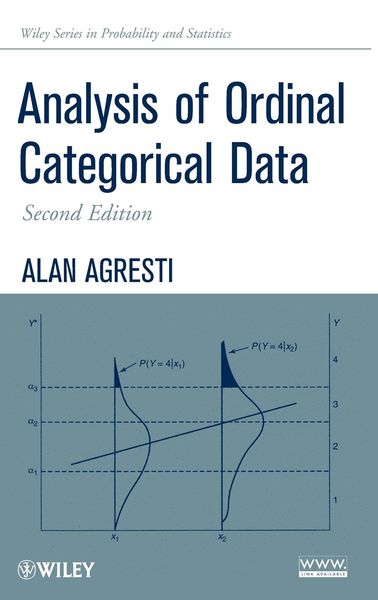
Produktbild: Analysis of Ordinal Categorical Data

Analysis of Ordinal Categorical Data 2nd Edition

183,99 €

inkl. gesetzl. MwSt., Versandkostenfrei


Beschreibung

Produktdetails

Einband

Gebundene Ausgabe

Erscheinungsdatum

19.04.2010

Verlag

John Wiley & Sons Inc

Seitenzahl

418

Maße (L/B/H)

24/16,1/2,7 cm

Gewicht

792 g

Auflage

2nd edition

Sprache

Englisch

ISBN

978-0-470-08289-8

Beschreibung

Produktdetails

Einband

Gebundene Ausgabe

Erscheinungsdatum

19.04.2010

Verlag

John Wiley & Sons Inc

Seitenzahl

418

Maße (L/B/H)

24/16,1/2,7 cm

Gewicht

792 g

Auflage

2nd edition

Sprache

Englisch

ISBN

978-0-470-08289-8

Herstelleradresse

Libri GmbH
Europaallee 1
36244 Bad Hersfeld
DE

Email: gpsr@libri.de

Kundinnen und Kunden meinen

0 Bewertungen

Informationen zu Bewertungen

Zur Abgabe einer Bewertung ist eine Anmeldung im Konto notwendig. Die Authentizität der Bewertungen wird von uns nicht überprüft. Wir behalten uns vor, Bewertungstexte, die unseren Richtlinien widersprechen, entsprechend zu kürzen oder zu löschen.

Die Bewertungen sind nach Format, Anzahl Sterne und Datum sortiert.

Verfassen Sie die erste Bewertung zu diesem Artikel

Helfen Sie anderen Kund*innen durch Ihre Meinung

Kundinnen und Kunden meinen

0 Bewertungen filtern

Die Leseprobe wird geladen.
  • Produktbild: Analysis of Ordinal Categorical Data
  • Preface.

    1. Introduction.

    1.1. Ordinal Categorical Scales.

    1.2. Advantages of Using Ordinal Methods.

    1.3. Ordinal Modeling Versus Ordinary Regession Analysis.

    1.4. Organization of This Book.

    2. Ordinal Probabilities, Scores, and Odds Ratios.

    2.1. Probabilities and Scores for an Ordered Categorical Scale.

    2.2. Ordinal Odds Ratios for Contingency Tables.

    2.3. Confidence Intervals for Ordinal Association Measures.

    2.4. Conditional Association in Three-Way Tables.

    2.5. Category Choice for Ordinal Variables.

    Chapter Notes.

    Exercises.

    3. Logistic Regression Models Using Cumulative Logits.

    3.1. Types of Logits for An Ordinal Response.

    3.2. Cumulative Logit Models.

    3.3. Proportional Odds Models: Properties and Interpretations.

    3.4. Fitting and Inference for Cumulative Logit Models.

    3.5. Checking Cumulative Logit Models.

    3.6. Cumulative Logit Models Without Proportional Odds.

    3.7. Connections with Nonparametric Rank Methods.

    Chapter Notes.

    Exercises.

    4. Other Ordinal Logistic Regression Models.

    4.1. Adjacent-Categories Logit Models.

    4.2. Continuation-Ratio Logit Models.

    4.3. Stereotype Model: Multiplicative Paired-Category Logits.

    Chapter Notes.

    Exercises.

    5. Other Ordinal Multinomial Response Models.

    5.1. Cumulative Link Models.

    5.2. Cumulative Probit Models.

    5.3. Cumulative Log-Log Links: Proportional Hazards Modeling.

    5.4. Modeling Location and Dispersion Effects.

    5.5. Ordinal ROC Curve Estimation.

    5.6. Mean Response Models.

    Chapter Notes.

    Exercises.

    6. Modeling Ordinal Association Structure.

    6.1. Ordinary Loglinear Modeling.

    6.2. Loglinear Model of Linear-by-Linear Association.

    6.3. Row or Column Effects Association Models.

    6.4. Association Models for Multiway Tables.

    6.5. Multiplicative Association and Correlation Models.

    6.6. Modeling Global Odds Ratios and Other Associations.

    Chapter Notes.

    Exercises.

    7. Non-Model-Based Analysis of Ordinal Association.

    7.1. Concordance and Discordance Measures of Association.

    7.2. Correlation Measures for Contingency Tables.

    7.3. Non-Model-Based Inference for Ordinal Association Measures.

    7.4. Comparing Singly Ordered Multinomials.

    7.5. Order-Restricted Inference with Inequality Constraints.

    7.6. Small-Sample Ordinal Tests of Independence.

    7.7. Other Rank-Based Statistical Methods for Ordered Categories.

    Appendix: Standard Errors for Ordinal Measures.

    Chapter Notes.

    Exercises.

    8. Matched-Pairs Data with Ordered Categories.

    8.1. Comparing Marginal Distributions for Matched Pairs.

    8.2. Models Comparing Matched Marginal Distributions.

    8.3. Models for The Joint Distribution in A Square Table.

    8.4. Comparing Marginal Distributions for Matched Sets.

    8.5. Analyzing Rater Agreement on an Ordinal Scale.

    8.6. Modeling Ordinal Paired Preferences.

    Chapter Notes.

    Exercises.

    9. Clustered Ordinal Responses: Marginal Models.

    9.1. Marginal Ordinal Modeling with Explanatory Variables.

    9.2. Marginal Ordinal Modeling: GEE Methods.

    9.3. Transitional Ordinal Modeling, Given the Past.

    Chapter Notes.

    Exercises.

    10. Clustered Ordinal Responses: Random Effects Models.

    10.1. Ordinal Generalized Linear Mixed Models.

    10.2. Examples of Ordinal Random Intercept Models.

    10.3. Models with Multiple Random Effects.

    10.4. Multilevel (Hierarchical) Ordinal Models.

    10.5. Comparing Random Effects Models and Marginal Models.

    Chapter Notes.

    Exercises.

    11. Bayesian Inference for Ordinal Response Data.

    11.1. Bayesian Approach to Statistical Inference.

    11.2. Estimating Multinomial Parameters.

    11.3. Bayesian Ordinal Regression Modeling.

    11.4. Bayesian Ordinal Association Modeling.

    11.5. Bayesian Ordinal Multivariate Regression Modeling.

    11.6. Bayesian Versus Frequentist Approaches to Analyzing Ordinal Data.

    Chapter Notes.

    Exercises.

    Appendix Software for Analyzing Ordinal Categorical Data.

    Bibliography.

    Example Index.

    Subject Index.