
Learning Nineteen Scenarios from Everyday Life
-
- Hardcover
- Taschenbuch ausgewählt
-
Sprache:Englisch
59,99 €
inkl. gesetzl. MwSt.,
Beschreibung
Produktdetails
Einband
Taschenbuch
Erscheinungsdatum
30.11.2009
Abbildungen
Worked examples or Exercises
Verlag
Cambridge AcademicSeitenzahl
344
Maße (L/B/H)
22,9/15,2/2 cm
Gewicht
559 g
Übersetzt von
Smith Joseph A.
Sprache
Englisch
ISBN
978-0-521-47800-7
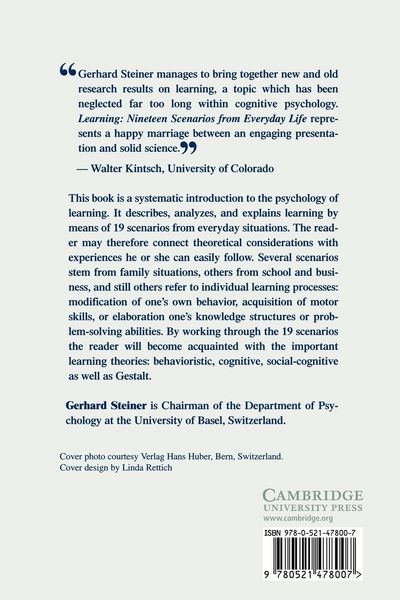
This book is a systematic introduction to learning psychology. It describes, analyzes and explains learning by means of 19 scenarios from everyday situations. The reader may therefore connect theoretical considerations with experiences he or she can easily follow. Several scenarios stem from family situations, others from school and business, and still others refer to very individual learning processes: modification of one's own behavior, acquisition of motor skills, or elaborating one's knowledge structures or problems solving abilities. Having worked through the 19 scenarios the reader will be acquainted with the important learning theories: behavioristic, cognitive, social-cognitive as well as the Gestaltists'.
Noch keine Bewertungen vorhanden
Verfassen Sie die erste Bewertung zu diesem Artikel
Helfen Sie anderen Kundinnen und Kunden durch Ihre Meinung.
Kurze Frage zu unserer Seite
Vielen Dank für Ihr Feedback
Wir nutzen Ihr Feedback, um unsere Produktseiten zu verbessern. Bitte haben Sie Verständnis, dass wir Ihnen keine Rückmeldung geben können. Falls Sie Kontakt mit uns aufnehmen möchten, können Sie sich aber gerne an unseren Kund*innenservice wenden.
zum Kundenservice