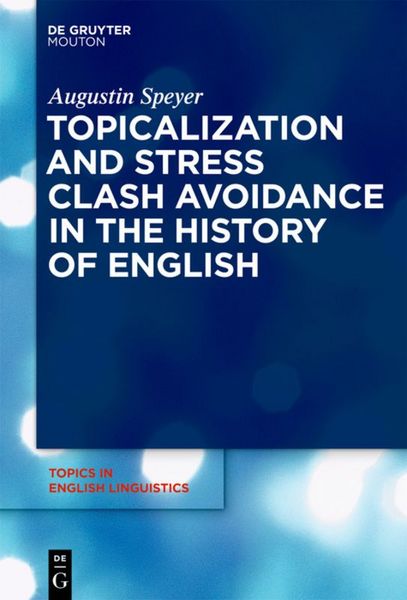
Topicalization and Stress Clash Avoidance in the History of English
187,99 €
inkl. gesetzl. MwSt.,
Beschreibung
Produktdetails
Einband
Gebundene Ausgabe
Erscheinungsdatum
17.03.2010
Abbildungen
19 ill., 64 tbl.
Verlag
De Gruyter MoutonSeitenzahl
286
Maße (L/B/H)
23,6/16/2,2 cm
Gewicht
556 g
Auflage
1
Sprache
Englisch
ISBN
978-3-11-022023-0
The book is concerned with the interaction of syntax, information structure and prosody in the history of English, demonstrating this with a case study of object topicalization. The approach is data-oriented, using material from syntactically parsed digital corpora of Old, Middle and Early Modern English, which serve as a solid foundation for conclusions.
The use of object topicalization underwent a sharp decline from Old English until today. In the present volume, a basic prosodic well-formedness condition, the Clash Avoidance Requirement, is identified as the main factor for this change. With the loss of V2-syntax, object topicalization led more easily to cases in which two focalized phrases, the topicalized object and the subject, are adjacent. The two focal accents on these phrases would produce a clash, thus violating the Clash Avoidance Requirement. In order to circumvent this, the use of topicalization in critical cases is avoided.
The Clash Avoidance Requirement is highly relevant also today, as experimental data on English and German show. Further, the Clash Avoidance Requirement helps to explain the well-known syntactic structure of the left periphery in Old English. An analysis positing two subject positions is defended in the study. The variation of these subject positions is shown to depend not on pronominal vs. lexical status of the subject but on information structural properties.
Noch keine Bewertungen vorhanden
Verfassen Sie die erste Bewertung zu diesem Artikel
Helfen Sie anderen Kundinnen und Kunden durch Ihre Meinung.
Kurze Frage zu unserer Seite
Vielen Dank für Ihr Feedback
Wir nutzen Ihr Feedback, um unsere Produktseiten zu verbessern. Bitte haben Sie Verständnis, dass wir Ihnen keine Rückmeldung geben können. Falls Sie Kontakt mit uns aufnehmen möchten, können Sie sich aber gerne an unseren Kund*innenservice wenden.
zum Kundenservice