KI-Beratung Beta

Gutscheinbedingungen

**Gültig am 25.11.2026 auf fremdsprachige Bücher online auf thalia.at und in der Thalia App. Einzelne Artikel können ausgeschlossen sein. Ausgenommen sind preisgebundene Artikel & eBooks. Pro Einkauf einmal einlösbar. Click & Collect nur bei Onlinevorabzahlung möglich. Keine Barauszahlung. Nicht kombinierbar mit anderen Aktionen und Gutscheinen. Gutschein wird auf max. 500€ Bestellwert angerechnet. Nicht gültig für Geschenkkarten, Versandkosten und Services.

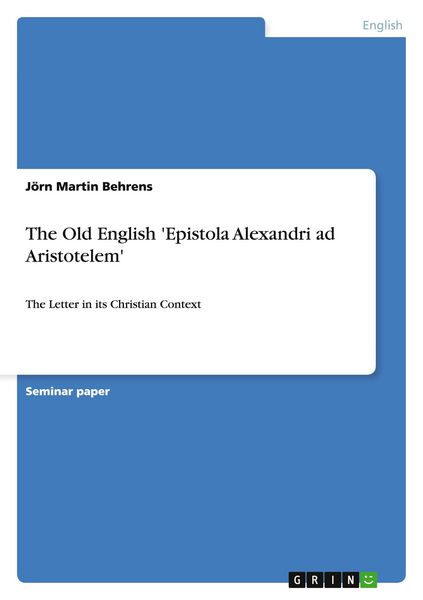
Produktbild: The Old English 'Epistola Alexandri ad Aristotelem'

The Old English 'Epistola Alexandri ad Aristotelem' The Letter in its Christian Context

17,95 €

inkl. gesetzl. MwSt., zzgl. Versandkosten


  • Kostenlose Lieferung ab 30 € Einkaufswert
  • Versandkostenfrei für Bonuscard-Kund*innen

Beschreibung

Seminar paper from the year 2007 in the subject English Language and Literature Studies - Literature, grade: 1,0, Ernst Moritz Arndt University of Greifswald (Department for English and American Studies), course: Historical Linguistics and Medieval English Studies, language: English, abstract: Much time...

Beschreibung

Seminar paper from the year 2007 in the subject English Language and Literature Studies - Literature, grade: 1,0, Ernst Moritz Arndt University of Greifswald (Department for English and American Studies), course: Historical Linguistics and Medieval English Studies, language: English, abstract: Much time and ink has been spent on the study of the so called Beowulf manuscript which nowadays constitutes the presumably "most discussed" (LUCAS 1990: 363) Old English manuscript. Contained in this manuscript is the apocryphal Letter of Alexander to Aristotle that will be central to this paper. The multitude of medieval manuscripts (cf. GUNDERSON 1980: 48) of the Letter leave little doubt that it certainly belongs to some of the "most successful literary impostures of the medieval ages" (RYPINS 1971: xliii). However, its Anglo-Saxon version "has excited little attention over the years" (ORCHARD 1995: 116).Scholar's interest seems to have been much more with the study of the earlier Latin form of the manuscript (RYPINS 1971: xxx): the Epistola Alexandri ad Aristotelem, which seems to derive from an older Greek version (cf. GUNDERSON 1980: 48). The version of the Letter dealt with here is a copy of an earlier (and apparently lost) Old English translation of the Latin Epistola: Thus "it is at least twice removed from the Latin" (Rypins xxxvii).It is my purpose to show within this paper that neither the various monstrous beings (vs. SISAM 1962: 96) nor their "aggression as a particular problem for foreign rulers" (vs. POWELL 2006: 1) that are most commonly said to be the connecting theme of the 'community of manuscripts' of the Norwell Codex are the central aspects of the Letter.Until further studies prove me wrong, we may assume that the Anglo-Saxon scribe consciously altered the Latin Epistola in a way as to ply the reader's attention to the biblical view on Alexander. He did so by opting for biblical phrasings rather than those found in the Epistola. Thus the Letter stresses that Alexander indeed is an paradigm of superbia, as ORCHARD suggests (1995: 135): an eordcyning 'earthly king',who does not accept his limits and rather than being content with his glory (cf. II Regum 14:104) provokes malum. This interpretation perfectly harmonizes withPOWELL's suggestion that "Wonders [...], the Letter [...], and Beowulf form an ideal core for a collection focused on rulership" (POWELL 2006: 15).Beginning with a rather short introduction to the Norwell Codex and the discussion concerning its thematic unity (ch. 2) I shall focus my attention to the Christian dimension of the Letter (ch. 3). Countering SISAM (1962:88) I shall argue that the Letter indeed serves a moralizing function.

Produktdetails

Einband

Taschenbuch

Erscheinungsdatum

30.11.2009

Verlag GRIN
Seitenzahl

28

Produktdetails

Einband

Taschenbuch

Erscheinungsdatum

30.11.2009

Verlag GRIN
Seitenzahl

28

Maße (L/B/H)

21/14,8/0,3 cm

Gewicht

56 g

Auflage

4. Auflage

Sprache

Englisch

ISBN

978-3-640-48231-3

Herstelleradresse


Email: info@bod.de

Noch keine Bewertungen vorhanden

Verfassen Sie die erste Bewertung zu diesem Artikel

Helfen Sie anderen Kundinnen und Kunden durch Ihre Meinung.

Kundinnen und Kunden meinen

Bewertungen (0)

Die Leseprobe wird geladen.
  • Produktbild: The Old English 'Epistola Alexandri ad Aristotelem'