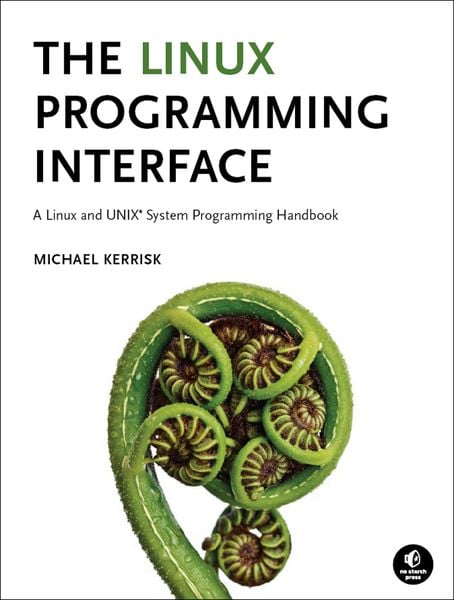
Produktbild: The Linux Programming Interface
- 43%

The Linux Programming Interface A Linux and UNIX System Programming Handbook

43% sparen

70,99 € UVP 126,50 €

inkl. gesetzl. MwSt., Versandkostenfrei


Beschreibung

Produktdetails

Einband

Gebundene Ausgabe

Erscheinungsdatum

01.11.2010

Verlag

No Starch Press,US

Seitenzahl

1547

Maße (L/B/H)

24,4/18,7/6,2 cm

Gewicht

2448 g

Farbe

Weiß / Moosgrün

Auflage

1. Auflage

Sprache

Englisch

ISBN

978-1-59327-220-3

Beschreibung

Rezension

"If I had to choose a single book to sit next to my machine when writing software for Linux, this would be it."
Martin Landers, Software Engineer, Google

"Everything relating to the subject that I could reasonably think of is in the book, in a very thorough and maniacally complete yet enjoyably readable way."
Federico Lucifredi, Slashdot.org

"This book, with its detailed descriptions and examples, contains everything you need to understand the details and nuances of the low-level programming APIs in Linux . . . no matter what the level of reader, there will be something to be learnt from this book."
Mel Gorman, Author of Understanding the Linux Virtual Memory Manager

"Michael Kerrisk has not only written a great book about Linux programming and how it relates to various standards, but has also taken care that bugs he noticed got fixed and the man pages were (greatly) improved. In all three ways, he has made Linux programming easier. The in-depth treatment of topics in The Linux Programming Interface . . . makes it a must-have reference for both new and experienced Linux programmers."
Andreas Jaeger, Program Manager, openSUSE, Novell

"Michael's inexhaustible determination to get his information right, and to express it clearly and concisely, has resulted in a strong reference source for programmers. While this work is targeted at Linux programmers, it will be of value to any programmer working in the UNIX/POSIX ecosystem."
David Butenhof, Author of Programming with POSIX Threads and Contributor to the POSIX and UNIX Standards

". . . a very thorough yet easy to read explanation of UNIX system and network programming, with an emphasis on Linux systems. It's certainly a book I'd recommend to anybody wanting to get into UNIX programming (in general) or to experienced UNIX programmers wanting to know 'what's new' in the popular GNU/Linux system."
Fernando Gont, Network Security Researcher, IETF Participant, and RFC Author

". . . encyclopedic in the breadth and depth of its coverage, and textbook-like in its wealth of worked examples and exercises. Each topic is clearly and comprehensively covered, from theory to hands-on working code. Professionals, students, educators, this is the Linux/UNIX reference that you have been waiting for."
Anthony Robins, Associate Professor of Computer Science, The University of Otago

"I've been very impressed by the precision, the quality and the level of detail Michael Kerrisk put in his book. He is a great expert of Linux system calls and lets us share his knowledge and understanding of the Linux APIs."
Christophe Blaess, Author of Programmation système en C sous Linux

". . . an essential resource for the serious or professional Linux and UNIX systems programmer. Michael Kerrisk covers the use of all the key APIs across both the Linux and UNIX system interfaces with clear descriptions and tutorial examples and stresses the importance and benefits of following standards such as the Single UNIX Specification and POSIX 1003.1."
Andrew Josey, Director, Standards, The Open Group, and Chair of The POSIX 1003.1 Working Group

"What could be better than an encyclopedic reference to the Linux system, from the standpoint of the system programmer, written by none other than the maintainer of the man pages himself? The Linux Programming Interface is comprehensive and detailed. I firmly expect it to become an indispensable addition to my programming bookshelf."
Bill Gallmeister, Author of POSIX.4 Programmer's Guide: Programming for the Real World

". . . the most complete and up-to-date book about Linux and UNIX system programming. If you're new to Linux system programming, if you're a UNIX veteran focused on portability while interested in learning the Linux way, or if you're simply looking for an excellent reference about the Linux programming interface, then Michael Kerrisk's book is definitely the companion you want on your bookshelf."
Loïc Domaigné, Chief Software Architect (Embedded), Corpuls.com

"I found The Linux Programming Interface to be extremely useful and expect to return to it frequently. Anyone who has an interest in programming for Linux will likely feel the same way."
Jake Edge, LWN.net

"Michael Kerrisk's new book [is] a thing of beauty. A book you're proud to just have on the shelf, but too useful to stay there."
Serge Hallyn, Linux Kernel Developer

"If you think you don't need this book since you know everything already, that's what I thought too, and I was wrong."
Bert Hubert, Netherlabs Computer Consulting

Produktdetails

Einband

Gebundene Ausgabe

Erscheinungsdatum

01.11.2010

Verlag

No Starch Press,US

Seitenzahl

1547

Maße (L/B/H)

24,4/18,7/6,2 cm

Gewicht

2448 g

Farbe

Weiß / Moosgrün

Auflage

1. Auflage

Sprache

Englisch

ISBN

978-1-59327-220-3

Herstelleradresse

Libri GmbH
Europaallee 1
36244 Bad Hersfeld
DE

Email: gpsr@libri.de

Kundinnen und Kunden meinen

0 Bewertungen

Informationen zu Bewertungen

Zur Abgabe einer Bewertung ist eine Anmeldung im Konto notwendig. Die Authentizität der Bewertungen wird von uns nicht überprüft. Wir behalten uns vor, Bewertungstexte, die unseren Richtlinien widersprechen, entsprechend zu kürzen oder zu löschen.

Die Bewertungen sind nach Format, Anzahl Sterne und Datum sortiert.

Verfassen Sie die erste Bewertung zu diesem Artikel

Helfen Sie anderen Kund*innen durch Ihre Meinung

Kundinnen und Kunden meinen

0 Bewertungen filtern

  • Produktbild: The Linux Programming Interface
  • Preface
    Chapter 1: History and Standards
    Chapter 2: Fundamental Concepts
    Chapter 3: System Programming Concepts
    Chapter 4: File I/O: The Universal I/O Model
    Chapter 5: File I/O: Further Details
    Chapter 6: Processes
    Chapter 7: Memory Allocation
    Chapter 8: Users and Groups
    Chapter 9: Process Credentials
    Chapter 10: Time
    Chapter 11: System Limits and Options
    Chapter 12: System and Process Information
    Chapter 13: File I/O Buffering
    Chapter 14: File Systems
    Chapter 15: File Attributes
    Chapter 16: Extended Attributes
    Chapter 17: Access Control Lists
    Chapter 18: Directories and Links
    Chapter 19: Monitoring File Events
    Chapter 20: Signals: Fundamental Concepts
    Chapter 21: Signals: Signal Handlers
    Chapter 22: Signals: Advanced Features
    Chapter 23: Timers and Sleeping
    Chapter 24: Process Creation
    Chapter 25: Process Termination
    Chapter 26: Monitoring Child Processes
    Chapter 27: Program Execution
    Chapter 28: Process Creation and Program Execution in More Detail
    Chapter 29: Threads: Introduction
    Chapter 30: Threads: Thread Synchronization
    Chapter 31: Threads: Thread Safety and Per-Thread Storage
    Chapter 32: Threads: Thread Cancellation
    Chapter 33: Threads: Further Details
    Chapter 34: Process Groups, Sessions, and Job Control
    Chapter 35: Process Priorities and Scheduling
    Chapter 36: Process Resources
    Chapter 37: Daemons
    Chapter 38: Writing Secure Privileged Programs
    Chapter 39: Capabilities
    Chapter 40: Login Accounting
    Chapter 41: Fundamentals of Shared Libraries
    Chapter 42: Advanced Features of Shared Libraries
    Chapter 43: Interprocess Communication Overview
    Chapter 44: Pipes and FIFOs
    Chapter 45: Introduction to System V IPC
    Chapter 46: System V Message Queues
    Chapter 47: System V Semaphores
    Chapter 48: System V Shared Memory
    Chapter 49: Memory Mappings
    Chapter 50: Virtual Memory Operations
    Chapter 51: Introduction to POSIX IPC
    Chapter 52: POSIX Message Queues
    Chapter 53: POSIX Semaphores
    Chapter 54: POSIX Shared Memory
    Chapter 55: File Locking
    Chapter 56: Sockets: Introduction
    Chapter 57: Sockets: UNIX Domain
    Chapter 58: Sockets: Fundamentals of TCP/IP Networks
    Chapter 59: Sockets: Internet Domains
    Chapter 60: Sockets: Server Design
    Chapter 61: Sockets: Advanced Topics
    Chapter 62: Terminals
    Chapter 63: Alternative I/O Models
    Chapter 64: Pseudoterminals
    Appendix A: Tracing System Calls
    Appendix B: Parsing Command-Line Options
    Appendix C: Casting the NULL Pointer
    Appendix D: Kernel Configuration
    Appendix E: Further Sources of Information
    Appendix F: Solutions to Selected Exercises