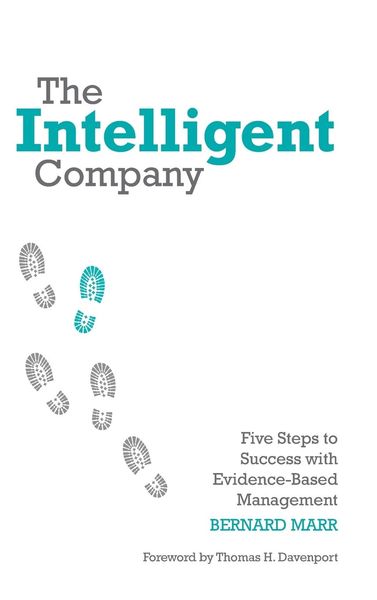
The Intelligent Company Five Steps to Success with Evidence-Based Management
-
- Englisch ausgewählt
59,99 €
inkl. gesetzl. MwSt.,
Beschreibung
Produktdetails
Einband
Gebundene Ausgabe
Erscheinungsdatum
26.02.2010
Verlag
John Wiley & SonsSeitenzahl
252
Maße (L/B/H)
23,5/15,7/1,8 cm
Gewicht
523 g
Sprache
Englisch
ISBN
978-0-470-68595-2
Today's most successful companies are Intelligent Companies that use the best available data to inform their decision making. This is called Evidence-Based Management and is one of the fastest growing business trends of our times. Intelligent Companies bring together tools such as Business Intelligence, Analytics, Key Performance Indicators, Balanced Scorecards, Management Reporting and Strategic Decision Making to generate real competitive advantages.
As information and data volumes grow at explosive rates, the challenges of managing this information is turning into a losing battle for most companies and they end up drowning in data while thirsting for insights. This is made worse by the severe skills shortage in analytics, data presentation and communication.
This latest book by best-selling management expert Bernard Marr will equip you with a set of powerful skills that are vital for successful managers now and in the future. Increase your market value by gaining essential skills that are in high demand but in short supply.
Loaded with practical step-by-step guidance, simple tools and real life examples of how leading organizations such as Google, CocaCola, Capital One, Saatchi & Saatchi, Tesco, Yahoo, as well as Government Departments and Agencies have put the principles into practice.
The five steps to more intelligent decision making are:
- Step 1: More intelligent strategies ? by identifying strategic priorities and agreeing your real information needs
- Step 2: More intelligent data ? by creating relevant and meaningful performance indicators and qualitative management information linked back to your strategic information needs
- Step 3: More intelligent insights ? by using good evidence to test and prove ideas and by analysing the data to gain robust and reliable insights
- Step 4: More intelligent communication ? by creating informative and engaging management information packs and dashboards that provide the essential information, packaged in an easy-to-read way
- Step 5: More intelligent decision making ? by fostering an evidence-based culture of turning information into actionable knowledge and real decisions
"Bernard Marr did it again! This outstanding and practical book will help your company become more intelligent and more successful. Marr takes the fields of business-intelligence, analytics and scorecarding to bring them together into a powerful and easy-to-follow 5-step framework. The Intelligent Company is THE must-read book of our times." Bruno Aziza, Co-author of best-selling book Drive Business Performance and Worldwide Strategy Lead, Microsoft Business Intelligence
"Book after book Bernard Marr is redefining the fundamentals of good business management. The Intelligent Company is a must read in these changing times and a reference you will want on your desk every day!" Gabriel Bellenger, Accenture Strategy
Noch keine Bewertungen vorhanden
Verfassen Sie die erste Bewertung zu diesem Artikel
Helfen Sie anderen Kundinnen und Kunden durch Ihre Meinung.
Kurze Frage zu unserer Seite
Vielen Dank für Ihr Feedback
Wir nutzen Ihr Feedback, um unsere Produktseiten zu verbessern. Bitte haben Sie Verständnis, dass wir Ihnen keine Rückmeldung geben können. Falls Sie Kontakt mit uns aufnehmen möchten, können Sie sich aber gerne an unseren Kund*innenservice wenden.
zum Kundenservice