Gutscheinbedingungen

**Gültig nur für Bestellungen an die Wunsch-Poststation bis 10.06.2026 auf Spielzeug, Schreibwaren, Filme, Geschenke & Trends, Musik, tolino eReader & Zubehör, Hörbücher und Hörbuch-Downloads (außer Abo), nicht preisgebundene Bücher und Kalender online auf thalia.at und in der Thalia App. Einzelne Artikel können ausgeschlossen sein. Aufgrund der Buchpreisbindung sind deutschsprachige Bücher und eBooks ausgenommen. Zusätzlich ausgenommen sind preisgebundene Artikel, Abos & Flatrates, eBooks, Games, Geschenkkarten/-boxen, Shelfies, Software, Zeitschriften sowie einzelne Artikel von tonies®. Pro Einkauf einmal einlösbar. Kein Click & Collect möglich. Keine Barauszahlung. Nicht kombinierbar mit anderen Aktionen und Gutscheinen. Gutschein wird auf max. 500€ Bestellwert angerechnet. Nicht gültig für Versandkosten und Services.

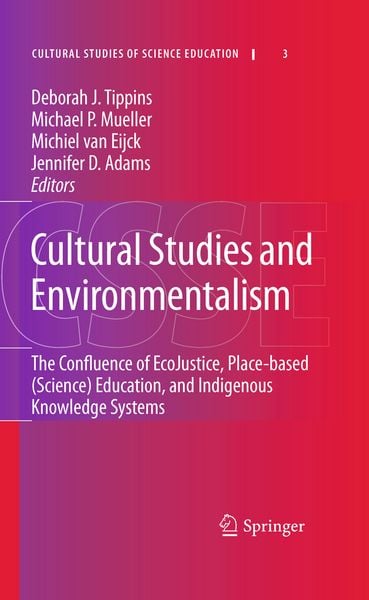
  • Produktbild: Cultural Studies and Environmentalism
  • Produktbild: Cultural Studies and Environmentalism
Band 3 - 12%

Cultural Studies and Environmentalism The Confluence of EcoJustice, Place-based (Science) Education, and Indigenous Knowledge Systems

12% sparen

192,99 € UVP 219,99 €

inkl. gesetzl. MwSt., Versandkostenfrei


Beschreibung

Produktdetails

Einband

Gebundene Ausgabe

Erscheinungsdatum

18.08.2010

Herausgeber

Deborah J. Tippins + weitere

Verlag

Springer Netherland

Seitenzahl

496

Maße (L/B/H)

24,1/15,9/3,8 cm

Gewicht

918 g

Auflage

1. Auflage

Sprache

Englisch

ISBN

978-90-481-3928-6

Beschreibung

Produktdetails

Einband

Gebundene Ausgabe

Erscheinungsdatum

18.08.2010

Herausgeber

Verlag

Springer Netherland

Seitenzahl

496

Maße (L/B/H)

24,1/15,9/3,8 cm

Gewicht

918 g

Auflage

1. Auflage

Sprache

Englisch

ISBN

978-90-481-3928-6

Herstelleradresse

Libri GmbH
Europaallee 1
36244 Bad Hersfeld
DE

Email: gpsr@libri.de

Kundinnen und Kunden meinen

0 Bewertungen

Informationen zu Bewertungen

Zur Abgabe einer Bewertung ist eine Anmeldung im Konto notwendig. Die Authentizität der Bewertungen wird von uns nicht überprüft. Wir behalten uns vor, Bewertungstexte, die unseren Richtlinien widersprechen, entsprechend zu kürzen oder zu löschen.

Die Bewertungen sind nach Format, Anzahl Sterne und Datum sortiert.

Verfassen Sie die erste Bewertung zu diesem Artikel

Helfen Sie anderen Kund*innen durch Ihre Meinung

Kundinnen und Kunden meinen

0 Bewertungen filtern

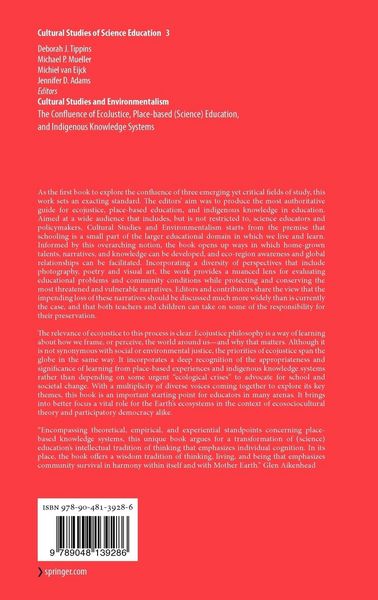
  • Produktbild: Cultural Studies and Environmentalism
  • Produktbild: Cultural Studies and Environmentalism
  • Forward
    David T. Sobel and Paige P. Jackins

    Prologue
    Michael P. Mueller and Deborah J. Tippins

    Poetry
    Arthur J. Stewart

    Table of Contents -----------

    Chapter 1: The Need for Confluence: Why a “River” Runs Through It Deborah J. Tippins and Michael P. Mueller

    ----Section 1: EcoJustice----

    Section Introduction: Nurturing Morally Defensible Environmentalism Michael P. Mueller and Deborah J. Tippins

    Chapter 2: EcoJustice Education for Science Educators Rebecca A. Martusewicz, John Lupinacci, and Gary Schakenberg

    Chapter 2a: Toward Awakening Consciousness: A Response to EcoJustice Education and Science Education Michael L. Bentley

    Chapter 2b: Invoking the Sacred: Reflections on the Implications of EcoJustice for Science Education Maria S. Rivera Maulucci

    Chapter 3: Local Matters, EcoJustice, and Community Opportunities of Village Life for Teaching Science Wolff-Michael Roth

    Chapter 3a: Engaging the Environment: Relationships of Demography, EcoJustice, and Science Teacher Education in Response to Wolff-Michael Roth Kurt Love, Teddie Phillipson Mower, and Peter Veronesi

    Chapter 4: Moral-Ethical Character and Science Education: EcoJustice Ethics through Socioscientific Issues (SSI) Michael P. Mueller and Dana L. Zeidler

    Chapter 4a: What’s Wrong with Genetic Engineering? Ethics, Socioscientific Issues, and Education Bradley D. Rowe

    Chapter 4b: Action-Based Science Instruction: Service Learning, Stewardship, and Civic Involvement Jennifer Ponder and Amy Cox-Peterson

    Chapter 5: Developing a Sustainable Agricultural Curriculum in Malawi: Reconciling a Colonial Legacy with Indigenous Knowledge and Practices George E. Glasson

    Chapter 5a: When Elephants Fight, It is the Grass that Suffers Norman Thomson

    Chapter 5b: Working for Change: Reflections on the Issue of Sustainability and Social Change Ajay Sharma

    Section Summary: Questions for Copenhagen: EcoJustice Perspectives and Summary Deborah J. Tippins and Michael P. Mueller

    ----Section 2: Place-Based(Science) Education----

    Section Introduction: Place-Based (Science) Education: Something is Happening Here Michiel van Eijck

    Chapter 6: Educating-Within-Place: Care, Citizen Science, and EcoJustice Doug Karrow and Xavier Fazio

    Chapter 6a: Invoking the Ontological Realm of Place: A Dialogic Response Jennifer Adams, Sheliza Ibrahim, and Miyoun Lim

    Chapter 7: A Case Study of David, a Native Hawaiian Science Teacher: Cultural Historical Activity Theory and Implications for Teacher Education Pauline W.U. Chinn and David D. Maika‘i Hana‘ike

    Chapter 7a: Deconstructing Chinn and Hana‘ike: Pedagogy through an Indigenous Lens Suzanne L. Stewart

    Chapter 7b: Critical Pedagogy of Place: A Framework for Understanding Relationships between People in (Contested) Shared Places Sonya N. Martin

    Chapter 8: River Advocacy: Valuing Complex Systems as the Groundwork for River Relationships Tina Williams Pagan

    Chapter 8a: Bringing the Invisible to Light: Art as Places for Advocacy Jamie Calkin

    Chapter 8b: River Advocacy as a Case of/for Novelizing Discourse in Science Education Michiel van Eijck

    Chapter 9: Implications of Sense of Place and Place-Based Education for Ecological Integrity and Cultural Sustainability in Diverse Places Steve Semken and Elizabeth Brandt

    Chapter 9a: Responding to Place
    David B. Zandvliet

    Chapter 9b: Envisioning Polysemicity: Generating Insights into the Complexity of Place-Based Research within Contested Spaces Christina A. Siry

    Section Summary: Place-Based Education as a Call from/to Action Michiel van Eijck

    ----Section 3: Indigenous Knowledge Systems----

    Section Introduction: One Hundred Ways to Use a Coconut Jennifer D. Adams

    Chapter 10: Traditional Ecological Knowledge (TEK), Border Theory and Justice Lyn Carter and Nicolas Walker

    Chapter 10a: Considering the Consequences of Hybridity: Protecting Traditional Ecological Knowledge from Predation Deborah J. Tippins, June George, and Stacey Britton

    Chapter 11: On Critical Thinking,