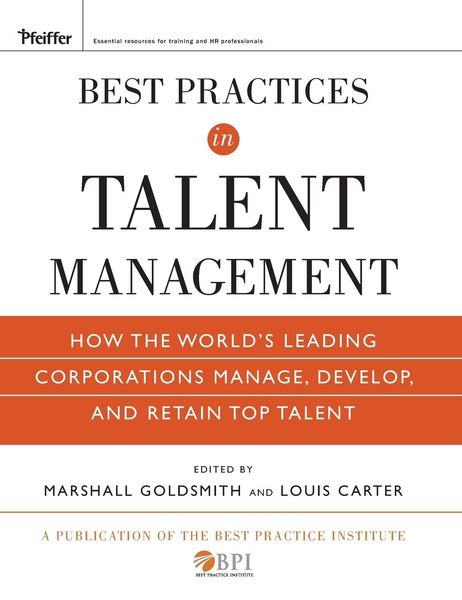
Produktbild: Best Practices in Talent Management

Best Practices in Talent Management How the World's Leading Corporations Manage, Develop, and Retain Top Talent

139,99 €

inkl. gesetzl. MwSt., Versandkostenfrei


Beschreibung

Produktdetails

Einband

Gebundene Ausgabe

Erscheinungsdatum

01.12.2009

Verlag

John Wiley & Sons

Seitenzahl

336

Maße (L/B/H)

24,1/19,6/2,3 cm

Gewicht

748 g

Auflage

1. Auflage

Sprache

Englisch

ISBN

978-0-470-49961-0

Beschreibung

Produktdetails

Einband

Gebundene Ausgabe

Erscheinungsdatum

01.12.2009

Verlag

John Wiley & Sons

Seitenzahl

336

Maße (L/B/H)

24,1/19,6/2,3 cm

Gewicht

748 g

Auflage

1. Auflage

Sprache

Englisch

ISBN

978-0-470-49961-0

Kundinnen und Kunden meinen

0 Bewertungen

Informationen zu Bewertungen

Zur Abgabe einer Bewertung ist eine Anmeldung im Konto notwendig. Die Authentizität der Bewertungen wird von uns nicht überprüft. Wir behalten uns vor, Bewertungstexte, die unseren Richtlinien widersprechen, entsprechend zu kürzen oder zu löschen.

Die Bewertungen sind nach Format, Anzahl Sterne und Datum sortiert.

Verfassen Sie die erste Bewertung zu diesem Artikel

Helfen Sie anderen Kund*innen durch Ihre Meinung

Kundinnen und Kunden meinen

0 Bewertungen filtern

Die Leseprobe wird geladen.
  • Produktbild: Best Practices in Talent Management
  • Introduction, by Louis Carter xiii

    Acknowledgments xxvii

    How to Use This Book xxix

    Chapter One: Avon Products, Inc. 1
    By Marc Effron

    Introduction 2

    A Success-Driven Challenge 2

    The Turnaround 3

    The Talent Challenge 3

    Execute on the "What," Differentiate with "How" 4

    From Opaque to Transparent 5

    From Complex to Simple 7

    From Egalitarian to Differentiated 10

    From Episodic to Disciplined 11

    From Emotional to Factual 12

    From Meaningless to Consequential 13

    The Results of a Talent Turnaround 14

    Measuring the Talent Turnaround's Success 15

    Chapter Two: Bank of America 17
    By Brian Fishel and Jay Conger

    Introduction 18

    Leadership Development Activities for Executive Leaders 21

    Lessons for Designing On-Boarding for Executive Leaders 32

    Chapter Three: Corning Incorporated 36
    By Richard A. O'leary, Gary Jusela, and Heath N. Topper

    Introduction 37

    The Business Case for the Accelerated Development of Corning Program Managers 40

    The Design Flow: Two Weeks of Experiential Learning with an Interim Period of Coaching and Mentoring 48

    Outcomes and Next Steps for Growing the Talent Pipeline of Program Leaders 56

    Next Steps 57

    Chapter Four: Customer and Enterprise Services (CES) Division 60
    By Michael Schecter, John Parker, and Judy Zaucha

    Business Background and Challenges 61

    The Roots of the CES Transformation: Leadership and Process 62

    Diagnosing and Designing the Whole System Transformation: The Leadership Alignment Event 68

    Implementing the Whole System Transformation: The Waves 71

    Supporting and Reinforcing the Whole System Transformation 77

    Evaluation of the CES Whole System Transformation 82

    Chapter Five: Ecolab, Inc. 84
    By Robert C. Barnett, Michael L. Meyer, Sarah J. Murphy, and Susan M. Metcalf

    Introduction 85

    Company Background 85

    Ecolab's 2002-2007 Strategic Plan 85

    Culture is Critical 87

    Ecolab's Talent Management Philosophy 88

    The Ecolab Talent Pipeline 90

    The Importance of Individual Development 90

    Introducing the Talent Pipeline Model at Ecolab 95

    Supporting Successful Implementation 95

    Keeping the Pipeline Full 98

    Results 100

    Conclusion 101

    Chapter Six: GE Money Americas 103
    By Tammy Grisham and D. Zachary Misko

    Introduction 104

    Company Background and Environment 104

    The Challenge and Approach 105

    The Technology 106

    Strategy for Sourcing 108

    LEAN Methodologies 111

    Expansion 113

    Conclusion 114

    Chapter Seven: Internal Revenue Service 115
    By Susan Clayton, Victoria Baugh, And Mathew J. Ferrero

    Introduction 116

    Company Background and Current Leadership Environment 116

    The 21st Century IRS 118

    Leadership Succession Planning-The Challenges 121

    LSR Website and Infrastructure 126

    Results 128

    Indicators of Success 131

    Evaluation 132

    Next Steps 133

    Conclusion 134

    Chapter Eight: Kaiser Permanente Colorado Region 136
    By Margaret Turner

    Introduction 137

    Design 140

    Process 142

    Implementation 150

    Support and Reinforce 152

    Evaluation 153

    Next Steps 153

    Conclusion 154

    Chapter Nine: McDonald's 155
    By James Intagliata and Neal Kulick

    Context for Global Talent Management Initiatives 156

    Evolution of the Talent Management System: Key Initiatives and Enhancements 159

    Overall Summary 175

    Chapter Ten: Microsoft Corporation 177
    By Shannon Wallis, Brian O. Underhill, and Carter Mcnamara

    Introduction 178

    What Led Microsoft SMSG to Make the Change 179

    Expo Leaders Building Leaders-The New High-Potential Development Experience 179

    The Process of Redesigning the High-Potential Development Experience 189

    Coaching as a Primary Development Component for HiPo Development in SMSG 191

    Learning Circles as a Primary Development Component for HiPo Development in SMSG 199

    Conclusion 206

    Chapter Eleven: Murray & Roberts Limited 208
    By Zelia Soares

    Introduction 209

    Design and Alignment 214

    Implementation 220

    Evaluation 223

    Summary 224

    Chapter Twelve: Porter Novelli 225
    By Greg Waldron

    Introduction 226

    Program Implementation 231

    Performance Management System Development 236

    Evaluation 239

    Chapter Thirteen: Southern Company 241
    By Jim Greene

    Introduction 242

    Background 242

    Initial Improvements 243

    The Leadership Action Council 246

    Competency Model 247

    Leadership Assessment 248

    Succession Planning 249

    Leadership Database 254

    Development Activities 254

    Evaluation and Lessons Learned 256

    Chapter Fourteen: Whirlpool Corporation 258
    By Kristen Weirick

    Introduction 259

    The Business Challenge 259

    Design and Approach 260

    Evaluation 265

    Next Steps 266

    Summary 269

    Conclusion 271

    Epilogue, by William J. Rothwell 288

    Index 295

    About Best Practice Institute 303

    About the Editors 305