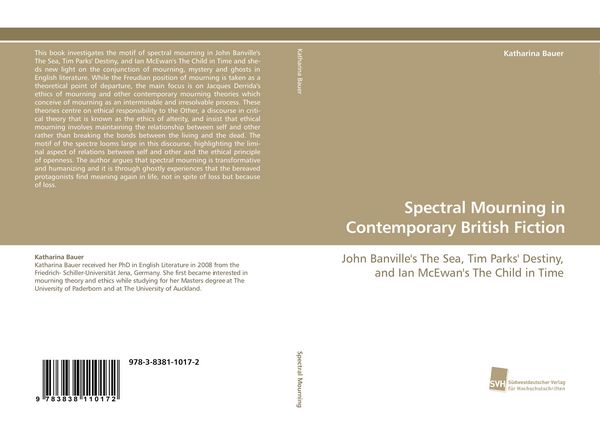
Spectral Mourning in Contemporary British Fiction John Banville's The Sea, Tim Parks' Destiny, and Ian McEwan's The Child in Time
-
- Deutsch ausgewählt
109,99 €
inkl. gesetzl. MwSt.,
Beschreibung
Produktdetails
Einband
Taschenbuch
Erscheinungsdatum
20.08.2009
Verlag
Südwestdeutscher Verlag für HochschulschriftenSeitenzahl
256
Maße (L/B/H)
22/15/1,6 cm
Gewicht
399 g
Auflage
1. Auflage
Sprache
Deutsch
ISBN
978-3-8381-1017-2
This book investigates the motif of spectral mourning in John Banville's The Sea, Tim Parks' Destiny, and Ian McEwan's The Child in Time and sheds new light on the conjunction of mourning, mystery and ghosts in English literature. While the Freudian position of mourning is taken as a theoretical point of departure, the main focus is on Jacques Derrida's ethics of mourning and other contemporary mourning theories which conceive of mourning as an interminable and irresolvable process. These theories centre on ethical responsibility to the Other, a discourse in critical theory that is known as the ethics of alterity, and insist that ethical mourning involves maintaining the relationship between self and other rather than breaking the bonds between the living and the dead. The motif of the spectre looms large in this discourse, highlighting the liminal aspect of relations between self and other and the ethical principle of openness. The author argues that spectral mourning is transformative and humanizing and it is through ghostly experiences that the bereaved protagonists find meaning again in life, not in spite of loss but because of loss.
Noch keine Bewertungen vorhanden
Verfassen Sie die erste Bewertung zu diesem Artikel
Helfen Sie anderen Kundinnen und Kunden durch Ihre Meinung.
Kurze Frage zu unserer Seite
Vielen Dank für Ihr Feedback
Wir nutzen Ihr Feedback, um unsere Produktseiten zu verbessern. Bitte haben Sie Verständnis, dass wir Ihnen keine Rückmeldung geben können. Falls Sie Kontakt mit uns aufnehmen möchten, können Sie sich aber gerne an unseren Kund*innenservice wenden.
zum Kundenservice