Gutscheinbedingungen

**Gültig bis 04.08.2026 ab einem Mindestbestellwert von 30€ auf Spielzeug, Schreibwaren, Filme, Geschenke & Trends, Musik, tolino eReader & Zubehör, Hörbücher und Hörbuch-Downloads (außer Abo), nicht preisgebundene Bücher und Kalender online auf thalia.at und in der Thalia App. Einzelne Artikel können ausgeschlossen sein. Aufgrund der Buchpreisbindung sind deutschsprachige Bücher und eBooks ausgenommen. Zusätzlich ausgenommen sind preisgebundene Artikel, Abos & Flatrates, eBooks, Games, Geschenkkarten/-boxen, Shelfies, Software, Zeitschriften sowie einzelne Artikel von tonies®. Pro Einkauf einmal einlösbar. Click & Collect nur bei Onlinevorabzahlung möglich. Keine Barauszahlung. Nicht kombinierbar mit anderen Aktionen und Gutscheinen. Gutschein wird auf max. 500€ Bestellwert angerechnet. Nicht gültig für Versandkosten und Services. Preisgebundene Artikel sind vom Mindestbestellwert ausgeschlossen.

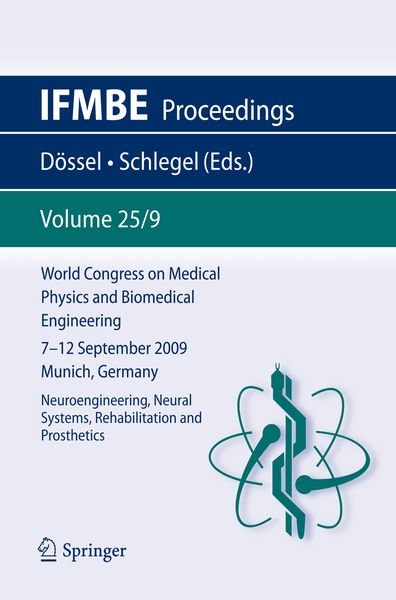
Produktbild: World Congress on Medical Physics and Biomedical Engineering September 7 - 12, 2009 Munich, Germany

World Congress on Medical Physics and Biomedical Engineering September 7 - 12, 2009 Munich, Germany Vol. 25/IX Neuroengineering, Neural Systems, Rehabilitation and Prosthetics

Aus der Reihe IFMBE Proceedings

299,99 €

inkl. gesetzl. MwSt., Versandkostenfrei


Beschreibung

Produktdetails

Einband

Taschenbuch

Erscheinungsdatum

15.12.2009

Herausgeber

Olaf Dössel + weitere

Verlag

Springer Berlin

Seitenzahl

601

Maße (L/B/H)

29,5/21,1/3,8 cm

Gewicht

1605 g

Auflage

2010

Sprache

Englisch

ISBN

978-3-642-03888-4

Beschreibung

Produktdetails

Einband

Taschenbuch

Erscheinungsdatum

15.12.2009

Herausgeber

Verlag

Springer Berlin

Seitenzahl

601

Maße (L/B/H)

29,5/21,1/3,8 cm

Gewicht

1605 g

Auflage

2010

Sprache

Englisch

ISBN

978-3-642-03888-4

Herstelleradresse

Springer Nature Customer Service Center GmbH
Europaplatz 3
69115 Heidelberg
DE
ProductSafety@springernature.com

Noch keine Bewertungen vorhanden

Verfassen Sie die erste Bewertung zu diesem Artikel

Helfen Sie anderen Kundinnen und Kunden durch Ihre Meinung.

Kundinnen und Kunden meinen

Bewertungen (0)

  • Produktbild: World Congress on Medical Physics and Biomedical Engineering September 7 - 12, 2009 Munich, Germany
  • Study on a High Performance Shoes by Using Silicon Rubber Elements with Human Compatibility.- Paraplegic Using a Reciprocating Gait Orthosis (RGO) with Functional Electrical Stimulation.- Habilitation Aid for Children with Balance Disorders.- Prototype Walker for children with cerebral palsy.- Analysis of Joint movements and muscle length during sit-to-stand at various sitting heights in the Korean elderly daily life.- Haptic robot for arm and wrist rehabilitation.- Movement Analysis by Accelerometry of Newborns for the Early Detection of Movement Disorders due to Infantile Cerebral Palsy.- Patient-Specific Finite Element Models of Transtibial Amputation in Several Prosthetic Users: The Inter-Subject Variability.- Development of a Corrugated Polyimide-Based Electrode for Intrafascicular Use in Peripheral Nerves.- Analysis of Gait Rhythm Variability in Patients with Amyotrophic Lateral Sclerosis.- Anatomy of the human cochlear nucleus in relation to auditory brainstem implants.- Estimation and Evaluation of Upper Limb Endpoint Stiffness and Joint Torques for Post-stroke Rehabilitation.- Neuroelectronic interfaces with the central nervous systems – ethical issues.- Ultrasound Pre-study of the Kinematics of the Residual Tibia within a Trans-Tibial Socket during Gait.- Development of Unconstrained Rigidity Measurement System for Quantitative Diagnosis of Parkinson’s Disease.- Measurement of Eye and Head Position in Neurological Practice.- Virtual Reality and Robotics for Neuro-Motor Rehabilitation of Ischemic Stroke Patients.- ARMassist: A low-cost device for telerehabiltation of post-stroke arm deficits.- Application of 3D modeling and modern visualization technique to neurosurgical trigonocephaly correction in children.- Peripheral Inductive Stimulation: Physical Issues and Advanced Technological Solutions.- A Neuronal Network Model with Plasticity for Tinnitus Management by Sound Therapy.- Modular Prosthesis of the Larynx for Application in Laryngectomees – A Theoretical Approach.- A novel method exploiting the nociceptive withdrawal reflexes in rehabilitation of hemiplegic gait.- Compact Assistive Rehabilitation Devices– Concept and Preliminary Function Test.- Feasibility of selective robotic support of foot clearance with continuously adapting impedance levels.- Diffusion Limited Tapered Coating with Parylene C.- Electrical Characterization of Platinum, Stainless Steel and Platinum/Iridium as Electrode Materials for a New Neural Interface.- Position Decoding of Hippocampal Place Cells.- A Novel Assembly Method for Silicon-Based Neural Devices.- Gait Posture Estimation by Wearable Acceleration and Gyro Sensor.- Automobile, which can Control an Autonomic nervous system.- Polymer-Based Approaches to Improve the Long Term Performance of Intracortical Neural Interfaces.- Development of a Neural Interface for Artificial Limbs.- Orthopedic Testing – A device for sagittal and transversal knee stability detection.- ARMin - Exoskeleton Robot for Stroke Rehabilitation.- Comparative Study on the Posture of Individuals with and without Cervical Pain.- Functional Assessment of Orthopedic Aids Using Open Vertical MRIs.- Bioelectric Source Localization in the Rat Sciatic Nerve: Initial Assessment Using an Idealized Nerve Model.- Development of a New Wearable Monitoring System for Posture Changes and Activities and its Application to Rehabilitation.- An Improved Method for Dipole Modeling in EEG-Based Source Localization.- Machines to support motor rehabilitation after stroke.- FEM-based investigation of spatial stimulation properties of a multi-electrode probe with micrometer-size electrodes for cortical and DBS applications.- Silicon Microprobe Systems for Neural Drug Delivery: Experimental Characterization of Liquid Distribution.- A measurement set-up to determine the charge injection capacity of neural microelectrodes.- Patient-Cooperative Control: Providing Safe Support without Restricting Movement.- Estimation of Physical Performance for Elderly People via Markerless Sit to Stand Analysis.- Using a P300 Brain Computer Interface for Smart Home Control.- The use of muscle “creep” as opposed to relaxation in stretching braces: a pseudoelastic device.- Customizable neuro-mechanical model of a hemiplegic elbow interacting with a pseudoelastic dynamic orthosis.- The Use of Radio Frequency Identification System for Wheelchair Security System.- A Lightweight Approach for Activity Classification on Microcontrollers.- Field applications of a prosthetic mobile measuring system.- Force fluctuations in a simulated motoneuron pool.- Effect of passive stepping on the H-reflex in the wrist flexor.- On the Efficacy of Haptic Guidance Schemes for Human Motor Learning.- Design and Development of Acrylic Die for Hip Bone Joint Casting.- Pupillary Responses during Learning of Inverted Tracking Tasks.- Instantaneous Gaze-Target Detection by Empirical Mode Decomposition: Application to Brain Computer Interface.- Using virtual reality for an autonomous navigation with electric wheelchairs.- Design of a new prosthetic mechanical system used in human ankle joint disarticulation.- Development of a Telemetric Goniometer.- Artificial Prehension and the Detection of Object Slip.- Influence of Base Material of TRUCT Braille on Readability of TRUCT Braille.- Functional evaluation of a micro-fabricated planar multielectrode probe for in vivo neuronal recording.- Research on the Perceptual Size of Tactile Dots and Bars.- A Consideration of the Expanded Partial Differential Equations and the Compartment System as the Background of the ABR System.- Development of the Gait Training System Controlled by Pressure Feed-back.- Regional absolute quantification in neurochemical profile of the canine brain: Investigation by 1H nuclear magnetic resonance spectroscopy and tissue extraction.- A Potable System for Foot-Drop Correction using Electrical Stimulation.- An Implantable Epiretinal Vision Prosthesis for Retinitis Pigmentosa Patients.- Development of system for estimating muscle force in real-time.- Sensitivities of Bipolar Subcutaneous and Cortical EEG Leads.- Patient-Cooperative Control: Adapting Robotic Interventions to Individual Human Capabilities.- 1H-MRS study of a depressive animal model for assessment of antidepressant effects.- Improving BCI Performance by Modified Common Spatial Patterns with Robustly Averaged Covariance Matrices.- Enhanced perception for visually impaired people evaluated in a real time setting.- A Preliminary Study of a Power Assist System for Toe Exercise using a Metal Hydride Actuator.- Rehabilitation Robotics for Outpatient Clinical and Domestic Use.- Seizure Control in an In-Silico Model of Epilepsy Using Backstepping Technique.- Walkaround® Assisted Walking of Stroke Patients.- Vision and Distance Based Control of Prehension.- ‘InfoCane’ based on wireless technology for the visually-handicapped people.- To feedback or Not to Feedback? Some Open Questions for Brain-Computer Interfaces Use.- Calculation of Systemic Aerobic Capacity without Contact Using Pattern Light Projection.- Functionality of Neuronal Networks Derived from Human Embryonic Stem Cells.- Pneumatic Test Device for the Accurate Assessment of Pressure Sensors.- Design and fabrication of an ultra-flexible electrode system for invasive continuous monitoring during surgery.- Prototyping all-polymer bioelectrical signal transducers.- Patient-specific models and simulations of deep brain stimulation for postoperative follow-up.- Robot-amplified manual exploration improves load identification.- A New Lightweight, Robust and Forceful Finger for an Artificial Limb.- Leg Muscles Motion during Whole Body Linear Frequency Sweep Vibration.- Motion Capture of Patients with Neurological Disorders by HD Digital Cameras.- Peripheral Arm Nerve Injury Rehabilitation by means of “Virtual Sensibility”.- Realization of Constant Phase Element in Metallic Electodes for Interference Reduction in Neural Recording Tripoles.- Comparison of sensor systems for gait phase detection in hemiplegic gait.- 8-Channel Electrotactile Stimulation System for Auditory Information Substitution.- Intraoperative neural electrode for continuous monitoring of nerve function.- Density Distribution of Denervated Degenerated Rectus Femoris Muscle in Electrical Stimulation treatment.- Application of the ACT3D Robot in the Evaluation of Functional Reaching Performance and the Administration of Experimental Interventions.- Application of electrode matrix to locate stimulation sites for hand functions of SCI patients.- Force field compensation can be learned without proprioceptive error.- Implantable Wireless Cortical Recording Device for Primates.- Is Posturography a Candidate for a Vigilance Test?.- Aspects of Weight-Support Mechanisms in Rehabilitation Robotics.- Studying Mechanisms Underlying Stroke Induced Movement Disorders Using 3-D Robotics.- Use of Artificial Neural Networks for Classification Intracraneal EEG Signals from Epileptic Patients.- Electrical Network for Emulation of Saccadic Eye Movements.- Study toward a Motion Sickness Assessment with Bio-signal indices On Korean Tilting Train eXpress.- Kinematics Analysis of Chopsticks Manipulation.- ZigBee-Based Wireless Neuro-Stimulator for Improving Stroke Recovery.- The effect of clearance upon friction of large diameter hip resurfacing prostheses using blood, clotted blood and bovine serum as lubricants.- Comparison of k-Means and Bayes classifiers for Human Body Motions Classification.- The Effect of Computer Use on Carpal Tunnel Syndrome.- Automated Vigilance Classification based on EOG signals: Preliminary Results.- A Lexicon Driven P300 Speller.- Repositioning Precision of EEG-Caps – A Preliminary Study.- Pick to Place Trajectories in Human Arm Training Environment.- Subretinal Microelectrode Arrays Implanted Into Blind Retinitis Pigmentosa Patients Allow Recognition of Letters and Direction of Thin Stripes.- Investigation of the Adaptation to Artificial Damping in Cerebellar Ataxia Using the Myohaptic Technology.- Analysis of Parkinson gait based on wavelet packet entropy.- Medium-Cost Electronic Prosthetic Knee for Transfemoral Amputees: A Medical Solution for Developing Countries.- Human Gait Data Mining by Symbol Based Descriptive Features.- Novel Control for Ambulation Function Restoration in a Non-invasive Functional Electrical Stimulation System.- Design of a Hybrid Powered Upper Limb Orthosis.- Electrodeposition and characterization of iridium oxide as electrode material for neural recording and stimulation.- Design and Modeling of an Upper Extremity Exoskeleton.- Detection of Steady-State Visual Evoked Potentials for Brain-Computer Interfaces Using PCA and High-Order Statistics.- Intensive FES therapy and its effect on the upper limb motor recovery after stroke.- Dynamics of the Seizure Engine.- Skin properties and the influence on electrode design for transcutaneous (surface) electrical stimulation.- Estimation Method of Consumption Energy in Human Activities for Daily Living.- A Test of Stride Length Measurement with an Accelerometer and a Gyroscope Attached on the Foot.- Ankle and Knee Joint Angle Measurements during Gait with Wearable Sensor System for Rehabilitation.- Performance of novel dry electrode EEG cap for evoked potential and band-power activity detection..- Development of a shoe-type device for collecting gait information.- Optical measurements for guidance during deep brain stimulation surgery.- Trial Study of a Power Presentation Method for Upper-Limb Orthoses.- Movement of Lower Extremity – Development of a Portable System for Movement Analysis.- The role of the sEMG signal processing in the field of the Human Movement Analysis.- Effects of Acupuncture in the Ischemic Model of Diabetes Mellitus Rats.- The Mechanism of Electro-Acupuncture(EA) Treating Cerebral Ischemia: Whether EA Administered to Mobilization of EPCs?.- PERFORM: Building and Mining Electronic Records of Neurological Patients Being Monitored in the Home.- Real-Time Adaptive Neural Predictors for Upper Limb Gestures Blind Recognition.- The European R&D Project RISE - Use of Electrical Stimulation to Restore Standing in Paraplegics with Long-Term Denervated Degenerated Muscles (DDM).- Modulation of stimulation frequency of spinal cord afferents with unchanged intensity and electrode site can induce a variety of movements.- A biofeedback based portable device to support elderly mobility in the home environment.- Measurement System of Hand Tapping Capacity for Quantitative Diagnosis of Parkinson’s Disease.- Optimization of Sensomotoric Insoles.- Modeling the dynamics of recovery in robot-assisted rehabilitation.- Position of the Head Measured by Digital Photograph Analysis.- Is the Bottleneck in Multitasking Of Cognitive Origin? Tapping as an Experimental Assessment Tool.- Superimposition of 2D Pressure Data and 3D Surface Data to Optimize Seat Shells in Rehabilitation.- Spatiotemporal pixelization Method Based on Vertical Sub-sampling to Improve Reading Ability for Visual Prosthesis.- Optimizing Visual Cues for Brain-Computer Interfaces.- Video Game-Based Exercise for Improvement of Calf Muscle Properties: A Case Study.- Implanted Myo-neural Interface for Upper Limb Prosthesis.- Implantable Wireless Cortical Recording Device for Primates.- Closed-loop control of epileptic seizures via deep brain stimulation in a rodent model of chronic epilepsy.