Gutscheinbedingungen

**Gültig bis 25.08.2026 ab einem Mindestbestellwert von 30€ auf Spielzeug, Schreibwaren, Filme, Geschenke & Trends, Musik, tolino eReader & Zubehör, Hörbücher und Hörbuch-Downloads (außer Abo), nicht preisgebundene Bücher und Kalender online auf thalia.at und in der Thalia App. Einzelne Artikel können ausgeschlossen sein. Aufgrund der Buchpreisbindung sind deutschsprachige Bücher und eBooks ausgenommen. Zusätzlich ausgenommen sind preisgebundene Artikel, Abos & Flatrates, eBooks, Games, Geschenkkarten/-boxen, Shelfies, Software, Zeitschriften sowie einzelne Artikel von tonies®. Pro Einkauf einmal einlösbar. Click & Collect nur bei Onlinevorabzahlung möglich. Keine Barauszahlung. Nicht kombinierbar mit anderen Aktionen und Gutscheinen. Gutschein wird auf max. 500€ Bestellwert angerechnet. Nicht gültig für Versandkosten und Services. Preisgebundene Artikel sind vom Mindestbestellwert ausgeschlossen.

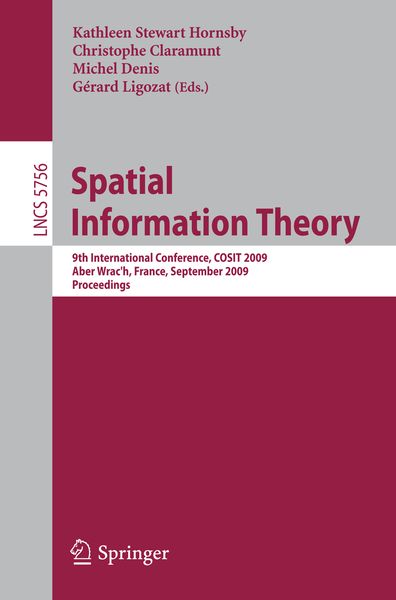
  • Produktbild: Spatial Information Theory
  • Produktbild: Spatial Information Theory

Spatial Information Theory 9th International Conference, COSIT 2009, Aber Wrac'h, France, September 21-25, 2009, Proceedings

51,99 €

inkl. gesetzl. MwSt., Versandkostenfrei


Beschreibung

Produktdetails

Einband

Taschenbuch

Erscheinungsdatum

03.09.2009

Herausgeber

Kathleen Stewart Hornsby + weitere

Verlag

Springer Berlin

Seitenzahl

505

Maße (L/B/H)

23,5/15,5/2,8 cm

Gewicht

779 g

Auflage

2009

Sprache

Englisch

ISBN

978-3-642-03831-0

Beschreibung

Produktdetails

Einband

Taschenbuch

Erscheinungsdatum

03.09.2009

Herausgeber

Verlag

Springer Berlin

Seitenzahl

505

Maße (L/B/H)

23,5/15,5/2,8 cm

Gewicht

779 g

Auflage

2009

Sprache

Englisch

ISBN

978-3-642-03831-0

Herstelleradresse

Springer-Verlag KG
Sachsenplatz 4-6
1201 Wien
AT

Email: GPSR Kontakt

Noch keine Bewertungen vorhanden

Verfassen Sie die erste Bewertung zu diesem Artikel

Helfen Sie anderen Kundinnen und Kunden durch Ihre Meinung.

Kundinnen und Kunden meinen

Bewertungen (0)

  • Produktbild: Spatial Information Theory
  • Produktbild: Spatial Information Theory
  • Cognitive Processing and Models for Spatial Cognition.- A Conceptual Model of the Cognitive Processing of Environmental Distance Information.- Spatial Cognition of Geometric Figures in the Context of Proportional Analogies.- Are Places Concepts? Familarity and Expertise Effects in Neighborhood Cognition.- Semantic Modeling.- A Metric Conceptual Space Algebra.- Grounding Geographic Categories in the Meaningful Environment.- Terabytes of Tobler: Evaluating the First Law in a Massive, Domain-Neutral Representation of World Knowledge.- Spatial Reasoning.- Merging Qualitative Constraint Networks Defined on Different Qualitative Formalisms.- Semi-automated Derivation of Conceptual Neighborhood Graphs of Topological Relations.- Exploiting Qualitative Spatial Constraints for Multi-hypothesis Topological Map Learning.- Comparing Relations with a Multi-holed Region.- Spatial Cognition.- The Endpoint Hypothesis: A Topological-Cognitive Assessment of Geographic Scale Movement Patterns.- Evaluating the Effectiveness and Efficiency of Visual Variables for Geographic Information Visualization.- SeaTouch: A Haptic and Auditory Maritime Environment for Non Visual Cognitive Mapping of Blind Sailors.- Spatial Knowledge.- Assigning Footprints to Dot Sets: An Analytical Survey.- Mental Tectonics - Rendering Consistent ?Maps.- To Be and Not To Be: 3-Valued Relations on Graphs.- Map Algebraic Characterization of Self-adapting Neighborhoods.- Scene and Visibility Modeling.- Scene Modelling and Classification Using Learned Spatial Relations.- A Qualitative Approach to Localization and Navigation Based on Visibility Information.- Showing Where To Go by Maps or Pictures: An Empirical Case Study at Subway Exits.- Spatial Modeling.- The Abduction of Geographic Information Science: Transporting Spatial Reasoning to the Realm of Purpose and Design.- An Algebraic Approach to Image Schemas for Geographic Space.- Spatio-terminological Inference for the Design of Ambient Environments.- Events and Processes.- Defining Spatial Entropy from Multivariate Distributions of Co-occurrences.- Case-Based Reasoning for Eliciting the Evolution of Geospatial Objects.- Composing Models of Geographic Physical Processes.- Route Planning.- Decentralized Time Geography for Ad-Hoc Collaborative Planning.- Adaptable Path Planning in Regionalized Environments.- An Analysis of Direction and Motion Concepts in Verbal Descriptions of Route Choices.- The Role of Angularity in Route Choice.