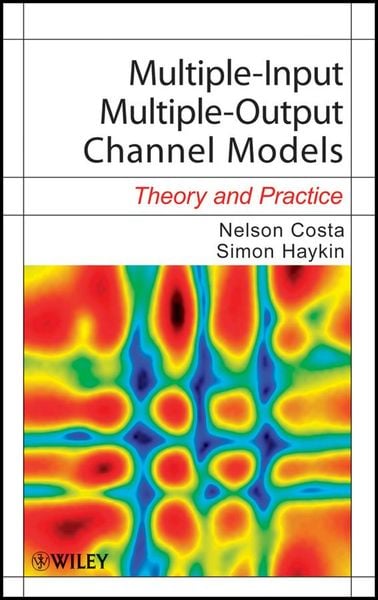
Multiple-Input Multiple-Output Channel Models Theory and Practice
-
- Englisch ausgewählt
124,99 €
inkl. gesetzl. MwSt.,
Beschreibung
Produktdetails
Einband
Gebundene Ausgabe
Erscheinungsdatum
12.04.2010
Verlag
John Wiley & SonsSeitenzahl
248
Maße (L/B/H)
24,3/16,1/2,2 cm
Gewicht
482 g
Auflage
1. Auflage
Sprache
Englisch
ISBN
978-0-470-39983-5
A complete discussion of MIMO communications, from theory to real-world applications
The emerging wireless technology Wideband Multiple-Input, Multiple-Output (MIMO) holds the promise of greater bandwidth efficiency and wireless link reliability. This technology is just now being implemented into hardware and working its way into wireless standards such as the ubiquitous 802.11g, as well as third- and fourth-generation cellular standards.
Multiple-Input Multiple-Output Channel Models uniquely brings together the theoretical and practical aspects of MIMO communications, revealing how these systems use their multipath diversity to increase channel capacity. It gives the reader a clear understanding of the underlying propagation mechanisms in the wideband MIMO channel, which is fundamental to the development of communication algorithms, signaling strategies, and transceiver design for MIMO systems.
MIMO channel models are important tools in understanding the potential gains of a MIMO system. This book discusses two types of wideband MIMO models in detail: correlative channel modelsspecifically the Kronecker, Weichselberger, and structured modelsand cluster models, including Saleh-Valenzuela, European Cooperation in the field of Scientific and Technical Research (COST) 273, and Random Cluster models. From simple to complex, the reader will understand the models' mechanisms and the reasons behind the parameters. Next, channel sounding is explained in detail, presenting the theory behind a few channel sounding techniques used to sound narrowband and wideband channels. The technique of digital matched filtering is then examined and, using real-life data, is shown to provide very accurate estimates of channel gains. The book concludes with a performance analysis of the structured and Kronecker models.
Multiple-Input Multiple-Output Channel Models is the first book to apply tensor calculus to the problem of wideband MIMO channel modeling. Each chapter features a list of important references, including core literary references, Matlab implementations of key models, and the location of databases that can be used to help in the development of new models or communication algorithms. Engineers who are working in the development of telecommunications systems will find this resource invaluable, as will researchers and students at the graduate or post-graduate level.
Noch keine Bewertungen vorhanden
Verfassen Sie die erste Bewertung zu diesem Artikel
Helfen Sie anderen Kundinnen und Kunden durch Ihre Meinung.
Kurze Frage zu unserer Seite
Vielen Dank für Ihr Feedback
Wir nutzen Ihr Feedback, um unsere Produktseiten zu verbessern. Bitte haben Sie Verständnis, dass wir Ihnen keine Rückmeldung geben können. Falls Sie Kontakt mit uns aufnehmen möchten, können Sie sich aber gerne an unseren Kund*innenservice wenden.
zum Kundenservice