
KI-Beratung Beta

  • Produktbild: Non-Western International Relations Theory
  • Produktbild: Non-Western International Relations Theory

Non-Western International Relations Theory Perspectives On and Beyond Asia

69,99 €

inkl. gesetzl. MwSt., Versandkostenfrei


Beschreibung

Given that the world has moved well beyond the period of Western colonialism, and clearly into a durable period in which non-Western cultures have gained their political autonomy, it is long past time that non-Western voices had a higher profile in debates about international relations, not just as disciples...

Beschreibung

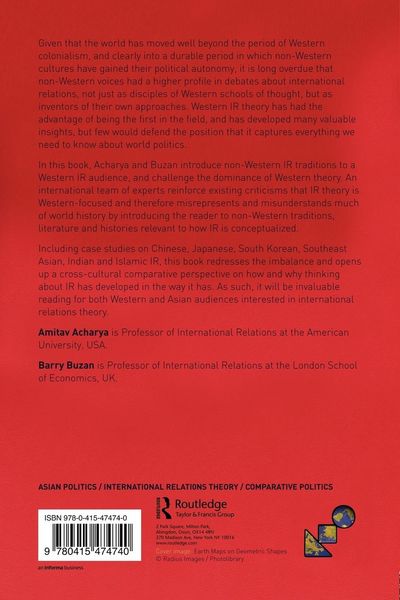
Given that the world has moved well beyond the period of Western colonialism, and clearly into a durable period in which non-Western cultures have gained their political autonomy, it is long past time that non-Western voices had a higher profile in debates about international relations, not just as disciples of Western schools of thought, but as inventors of their own approaches. Western IR theory has had the advantage of being the first in the field, and has developed many valuable insights, but few would defend the position that it captures everything we need to know about world politics.

In this book, Acharya and Buzan introduce non-Western IR traditions to a Western IR audience, and challenge the dominance of Western theory. An international team of experts reinforce existing criticisms that IR theory is Western-focused and therefore misrepresents and misunderstands much of world history by introducing the reader to non-Western traditions, literature and histories relevant to how IR is conceptualised.

Including case studies on Chinese, Japanese, South Korean, Southeast Asian, Indian and Islamic IR this book redresses the imbalance and opens up a cross-cultural comparative perspective on how and why thinking about IR has developed in the way it has. As such, it will be invaluable reading for both Western and Asian audiences interested in international relations theory.

Rezension

"This book adds a critically needed voice that specifies areas of deficiency and methods which may allow for alternative and reasonable disciplinary guidance that can finally address the historical inequity within the study of IR. The authors provide key insights to a problematic theme regarding how to overcome "colonization of the mind" by the limiting and framing scopes of inquiry so as to essentially set an agenda with regard to an entire disciplinary field of academia and its requisite effects." - William J. Jones, Mahidol University International College; Journal of International and Global Studies Volume 4, Number 1, (November 2012).

Produktdetails

Einband

Taschenbuch

Erscheinungsdatum

21.12.2009

Abbildungen

1 SW-Abb., 1 SW-Zeichn., 4 Tabellen

Herausgeber Amitav Acharya + weitere

Produktdetails

Einband

Taschenbuch

Erscheinungsdatum

21.12.2009

Abbildungen

1 SW-Abb., 1 SW-Zeichn., 4 Tabellen

Herausgeber
Verlag Taylor & Francis
Seitenzahl

256

Maße (L/B/H)

23,4/15,6/1,4 cm

Gewicht

395 g

Sprache

Englisch

ISBN

978-0-415-47474-0

Herstelleradresse

Produktsicherheitsverantwortliche/r
Europaallee 1
36244 Bad Hersfeld
DE

Email: gpsr@libri.de

Noch keine Bewertungen vorhanden

Verfassen Sie die erste Bewertung zu diesem Artikel

Helfen Sie anderen Kundinnen und Kunden durch Ihre Meinung.

Kundinnen und Kunden meinen

Bewertungen (0)

Die Leseprobe wird geladen.
  • Produktbild: Non-Western International Relations Theory
  • Produktbild: Non-Western International Relations Theory
  • 1. Why is there no Non-Western International Relations Theory: An Introduction Amitav Acharya and Barry Buzan 2. Why Is There No Chinese International Relations Theory? Yaqing Qin 3. Why Are There No Non-Western Theories of International Relations? The Case of Japan Takashi Inoguchi 4. Why is There No Non-Western International Relations Theory? Reflections on and from Korea Chaesung Chun 5. Re-Imagining IR in India, Navnita Chadha Behera 6. Southeast Asia: Theory between Modernization and Tradition? Alan Chong 7. Perceiving Indonesian Approaches to International Relations Theory Irman G. Lanti and Leonard C. Sebastian 8. International Relations Theory and the Islamic Worldview Shahrbanou Tadjbakhsh 9. World History and the Development of Non-Western IR Theory Barry Buzan and Richard Little 10. Conclusion: On the Possibility of a Non-Western International Relations Theory Amitav Acharya and Barry Buzan