Gutscheinbedingungen

**Gültig nur für Bestellungen an die Wunsch-Poststation bis 10.06.2026 auf Spielzeug, Schreibwaren, Filme, Geschenke & Trends, Musik, tolino eReader & Zubehör, Hörbücher und Hörbuch-Downloads (außer Abo), nicht preisgebundene Bücher und Kalender online auf thalia.at und in der Thalia App. Einzelne Artikel können ausgeschlossen sein. Aufgrund der Buchpreisbindung sind deutschsprachige Bücher und eBooks ausgenommen. Zusätzlich ausgenommen sind preisgebundene Artikel, Abos & Flatrates, eBooks, Games, Geschenkkarten/-boxen, Shelfies, Software, Zeitschriften sowie einzelne Artikel von tonies®. Pro Einkauf einmal einlösbar. Kein Click & Collect möglich. Keine Barauszahlung. Nicht kombinierbar mit anderen Aktionen und Gutscheinen. Gutschein wird auf max. 500€ Bestellwert angerechnet. Nicht gültig für Versandkosten und Services.

  • Produktbild: Logic Programming and Nonmonotonic Reasoning
  • Produktbild: Logic Programming and Nonmonotonic Reasoning

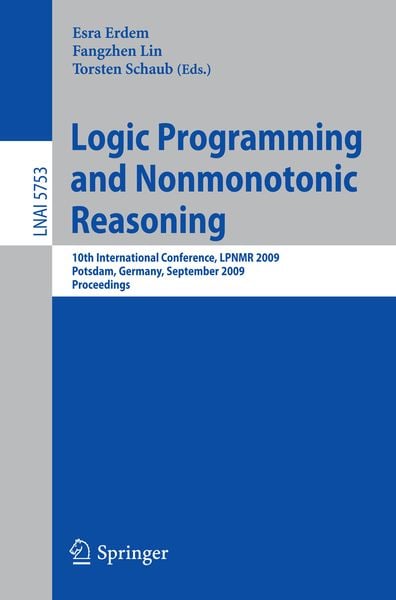
Logic Programming and Nonmonotonic Reasoning 10th International Conference, LPNMR 2009, Potsdam, Germany, September 14-18, 2009, Proceedings

99,99 €

inkl. gesetzl. MwSt., Versandkostenfrei


Beschreibung

Produktdetails

Einband

Taschenbuch

Erscheinungsdatum

07.09.2009

Herausgeber

Esra Erdem + weitere

Verlag

Springer Berlin

Seitenzahl

656

Maße (L/B/H)

23,5/15,5/3,7 cm

Gewicht

1007 g

Auflage

2009

Sprache

Englisch

ISBN

978-3-642-04237-9

Beschreibung

Produktdetails

Einband

Taschenbuch

Erscheinungsdatum

07.09.2009

Herausgeber

Verlag

Springer Berlin

Seitenzahl

656

Maße (L/B/H)

23,5/15,5/3,7 cm

Gewicht

1007 g

Auflage

2009

Sprache

Englisch

ISBN

978-3-642-04237-9

Herstelleradresse

Springer-Verlag KG
Sachsenplatz 4-6
1201 Wien
AT

Email: ProductSafety@springernature.com

Kundinnen und Kunden meinen

0 Bewertungen

Informationen zu Bewertungen

Zur Abgabe einer Bewertung ist eine Anmeldung im Konto notwendig. Die Authentizität der Bewertungen wird von uns nicht überprüft. Wir behalten uns vor, Bewertungstexte, die unseren Richtlinien widersprechen, entsprechend zu kürzen oder zu löschen.

Die Bewertungen sind nach Format, Anzahl Sterne und Datum sortiert.

Verfassen Sie die erste Bewertung zu diesem Artikel

Helfen Sie anderen Kund*innen durch Ihre Meinung

Kundinnen und Kunden meinen

0 Bewertungen filtern

  • Produktbild: Logic Programming and Nonmonotonic Reasoning
  • Produktbild: Logic Programming and Nonmonotonic Reasoning
  • Session 1. Invited Talks.- SAT, SMT and Applications.- Logic-Based Modeling in Systems Biology.- Integrating Answer Set Programming and Satisfiability Modulo Theories.- Session 2. Technical Papers.- How Flexible Is Answer Set Programming? An Experiment in Formalizing Commonsense in ASP.- Splitting a CR-Prolog Program.- Contextual Argumentation in Ambient Intelligence.- Argumentation Context Systems: A Framework for Abstract Group Argumentation.- A Revised Concept of Safety for General Answer Set Programs.- Magic Sets for the Bottom-Up Evaluation of Finitely Recursive Programs.- Relevance-Driven Evaluation of Modular Nonmonotonic Logic Programs.- Complexity of the Stable Model Semantics for Queries on Incomplete Databases.- Manifold Answer-Set Programs for Meta-reasoning.- A Deductive System for FO(ID) Based on Least Fixpoint Logic.- Computing Stable Models via Reductions to Difference Logic.- A Module-Based Framework for Multi-language Constraint Modeling.- Induction on Failure: Learning Connected Horn Theories.- On Reductive Semantics of Aggregates in Answer Set Programming.- A First Order Forward Chaining Approach for Answer Set Computing.- Knowledge Qualification through Argumentation.- Simple Random Logic Programs.- Max-ASP: Maximum Satisfiability of Answer Set Programs.- Belief Revision with Bounded Treewidth.- Casting Away Disjunction and Negation under a Generalisation of Strong Equivalence with Projection.- A Default Approach to Semantics of Logic Programs with Constraint Atoms.- The Complexity of Circumscriptive Inference in Post’s Lattice.- Trichotomy Results on the Complexity of Reasoning with Disjunctive Logic Programs.- Belief Logic Programming: Uncertainty Reasoning with Correlation of Evidence.- Weight Constraint Programs with Functions.- Session 3. Original Application Papers.- Bridging the Gap between High-Level Reasoning and Low-Level Control.- A General Approach to the Verification of Cryptographic Protocols Using Answer Set Programming.- An ASP-Based System for e-Tourism.- cc? on Stage: Generalised Uniform Equivalence Testing for Verifying Student Assignment Solutions.- Session 4. Short Papers.- Translating Preferred Answer Set Programs to Propositional Logic.- CR-Prolog as a Specification Language for Constraint Satisfaction Problems.- Modeling Multi-agent Domains in an Action Languages: An Empirical Study Using .- Computing Weighted Solutions in Answer Set Programming.- Representing Multi-agent Planning in CLP.- Prototypical Reasoning with Low Complexity Description Logics: Preliminary Results.- AQL: A Query Language for Action Domains Modelled Using Answer Set Programming.- Level Mapping Induced Loop Formulas for Weight Constraint and Aggregate Programs.- Layer Supported Models of Logic Programs.- Applying ASP to UML Model Validation.- The Logical Consequence Role in LPNMR: A Parameterized Computation Approach.- Social Default Theories.- Session 5. System Descriptions.- nfn2dlp and nfnsolve: Normal Form Nested Programs Compiler and Solver.- An ASP System with Functions, Lists, and Sets.- A Simple Distributed Conflict-Driven Answer Set Solver.- An Implementation of Belief Change Operations Based on Probabilistic Conditional Logic.- On the Input Language of ASP Grounder Gringo.- The Conflict-Driven Answer Set Solver clasp: Progress Report.- System f2lp – Computing Answer Sets of First-Order Formulas.- The First Version of a New ASP Solver : ASPeRiX.- An ASP-Based Data Integration System.- Gorgias-C: Extending Argumentation with Constraint Solving.- Session 6. Summaries of Existing Successful Applications Papers.- ANTON: Composing Logic and Logic Composing.- Modelling Normative Frameworks Using Answer Set Programing.- Generating Optimal Code Using Answer Set Programming.- Logic Programming Techniques in Protein Structure Determination: Methodologies and Results.- PHYLO-ASP: Phylogenetic Systematics with Answer Set Programming.- HAPLO-ASP: Haplotype Inference Using Answer Set Programming.- Using Answer Set Programming to Enhance Operating System Discovery.- Non-monotonic Reasoning Supporting Wireless Sensor Networks for Intelligent Monitoring: The SINDI System.- Session 7. Short Application Papers.- Some DLV Applications for Knowledge Management.- Application of ASP for Automatic Synthesis of Flexible Multiprocessor Systems from Parallel Programs.- Optimal Multicore Scheduling: An Application of ASP Techniques.- Session 8 (Panel on Future Applications). Position Papers by the Panelists.- From Data Integration towards Knowledge Mediation.- Integrating Answer Set Modules into Agent Programs.- What Next for ASP? (A Not-Entirely-Well-Informed Opinion).- Using Lightweight Inference to Solve Lightweight Problems.- Present and Future Challenges for ASP Systems.- ASP: The Future Is Bright.- Exploiting ASP in Real-World Applications: Main Strengths and Challenges.- Making Your Hands Dirty Inspires Your Brain! Or How to Switch ASP into Production Mode.- Towards an Embedded Approach to Declarative Problem Solving in ASP.- System Competition. Summary of System Competition.- The Second Answer Set Programming Competition.