Gutscheinbedingungen

**Gültig bis 06.07.2026 auf fremdsprachige Bücher online auf thalia.at, in der Thalia App ab einem Mindestbestellwert von 30€ und in allen Thalia Buchhandlungen in Österreich. In den Buchhandlungen nur gültig auf lagernde Ware. Einzelne Artikel können ausgeschlossen sein. Ausgenommen sind preisgebundene Artikel & eBooks. Pro Einkauf einmal einlösbar. Nur gültig gegen Vorlage oder im Onlineshop hinterlegter Bonuscard. Infos zur Einlösung in der Buchhandlung sind auf der Bonuscard-Vorteilspreisseite zu finden. Click & Collect nur bei Onlinevorabzahlung möglich. Keine Einlösung bei Scan & Go-Bezahlung. Keine Barauszahlung. Nicht kombinierbar mit anderen Aktionen und Gutscheinen. Gutschein wird auf max. 500€ Bestellwert angerechnet. Nicht gültig für Versandkosten und Services.

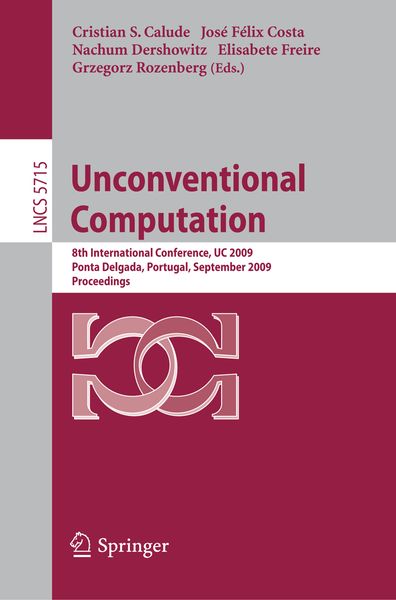
  • Produktbild: Unconventional Computation
  • Produktbild: Unconventional Computation

Unconventional Computation 8th International Conference, UC 2009, Ponta Delgada, Portugal, September 7-11, 2009, Proceedings

51,99 €

inkl. gesetzl. MwSt., Versandkostenfrei


Beschreibung

Produktdetails

Einband

Taschenbuch

Erscheinungsdatum

28.08.2009

Herausgeber

Christian S. Calude + weitere

Verlag

Springer Berlin

Seitenzahl

293

Maße (L/B/H)

23,5/15,5/1,8 cm

Gewicht

482 g

Auflage

2009

Sprache

Englisch

ISBN

978-3-642-03744-3

Beschreibung

Produktdetails

Einband

Taschenbuch

Erscheinungsdatum

28.08.2009

Herausgeber

Verlag

Springer Berlin

Seitenzahl

293

Maße (L/B/H)

23,5/15,5/1,8 cm

Gewicht

482 g

Auflage

2009

Sprache

Englisch

ISBN

978-3-642-03744-3

Herstelleradresse

Springer-Verlag KG
Sachsenplatz 4-6
1201 Wien
AT

Email: GPSR Kontakt

Noch keine Bewertungen vorhanden

Verfassen Sie die erste Bewertung zu diesem Artikel

Helfen Sie anderen Kundinnen und Kunden durch Ihre Meinung.

Kundinnen und Kunden meinen

Bewertungen (0)

  • Produktbild: Unconventional Computation
  • Produktbild: Unconventional Computation
  • Invited Talks and Tutorials.- Using Physical Experiments as Oracles.- A Tutorial on Analog Computation: Computing Functions over the Reals.- Computational Mechanics: Natural Computation and Self-organization.- Diophantine Equations and Computation.- Structure of Reversible Cellular Automata.- Brain Dynamics Promotes Function.- Awakening the Analogue Computer: Rubel’s Extended Analog Computer Workshop.- Artifice, Interpretation and Nature: Key Categories in Radiology Work.- Developmental Computing.- Evolvable Hardware: From Applications to Implications for the Theory of Computation.- Relativistic Computers and Transfinite Computation.- Regular Contributions.- Turing Completeness Using Three Mobile Membranes.- Resource-Competing Oscillator Network as a Model of Amoeba-Based Neurocomputer.- Networks of Evolutionary Picture Processors with Filtered Connections.- Mapping Computation with No Memory.- Real Computable Manifolds and Homotopy Groups.- Distributed Quantum Programming.- Foundations of Optical Encryption: Formal Modeling and Achieving Shannon Secrecy.- Random Number Selection in Self-assembly.- Abstract Geometrical Computation and Computable Analysis.- Descriptional Complexity of Tissue-Like P Systems with Cell Division.- Computing Domains of Attraction for Planar Dynamics.- Approximating the Behaviours of Physarum polycephalum for the Construction and Minimisation of Synthetic Transport Networks.- Simulation of Neurocomputing Based on Photophobic Reactions of Euglena: Toward Microbe–Based Neural Network Computing.- Reasoning about Entanglement and Separability in Quantum Higher-Order Functions.- On the Brightness of the Thomson Lamp: A Prolegomenon to Quantum Recursion Theory.- Advances in I/O, Speedup, and Universality on Colossus, an Unconventional Computer.- Membrane Dissolution and Division in P.- Computing Naturally in the Billiard Ball Model.- Posters.- Water as a Quantum Computing Device.- Cloning for Heteroscedasticity Elimination in GMDH Learning Procedure.- Tug-Of-War Model for Two-Bandit Problem.- Intrusion Detection in Circular Frustrated Systems: An Eminently Parallel Processing Algorithm.- NMR-Based Encoding and Processing of Alphanumeric Information.