
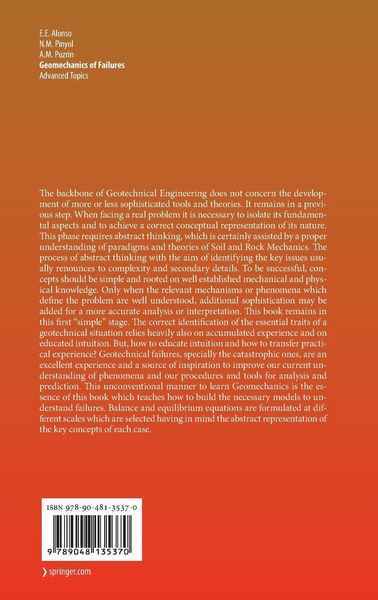
Geomechanics of Failures. Advanced Topics
-
- Hardcover ausgewählt
- Taschenbuch
- eBook
-
Sprache:Englisch
66,99 €
UVP
76,99 €
inkl. gesetzl. MwSt.,
Beschreibung
Produktdetails
Einband
Gebundene Ausgabe
Erscheinungsdatum
17.08.2010
Abbildungen
VIII, 277 p.
Verlag
Springer NetherlandSeitenzahl
277
Maße (L/B/H)
24,1/16/2,1 cm
Gewicht
600 g
Auflage
1. Auflage
Sprache
Englisch
ISBN
978-90-481-3537-0
Geotechnical failures, specially the catastrophic ones, are a stimulus to improve current understanding of phenomena and procedures and tools for analysis and prediction.
This unconventional approach to geomechanics is the essence of this book. In general, soil mechanics and geotechnical textbooks describe first the concepts and theoretical developments and then apply them to interpret or solve a particular applications. This book follows a different course. The case (a failure) is first described and then an explanation is sought. This requires a set of steps which can be summarized as follows: Identify the nature of the problem, develop a dedicated and specific formulation of the case, based on established basic concepts. In general, no single existing theory or procedure is available to solve the case at hand, provide a solution within an acceptable degree of complexity, extract the fundamental aspects of the problem and highlight its relevance.
The cases selected have been grouped into three main topics: Landslides, Embankments and Dams and Dynamics of Failures. Cases selected (Vaiont, Aznalcóllar, Brattas-St. Moritz) are unique and illustrate a number of relevant and to some extent controversial issues which are of wide interest, without claiming exhaustive treatment of the subject.
The book teaches how to build the necessary models to understand the failures. Well established soil mechanics concepts are the necessary background. But the cases analyzed require in general a step ahead which is specific for the case analyzed. Balance and equilibrium equations are often required as a starting point. They are formulated at different scales, which are selected having in mind the abstract representation of each case.
Various chapters illustrate also the coupled nature (flow-deformation-temperature) of geotechnical problems and the need to properly address these complexities in some cases. In fact, temperature effects, a subjectoften neglected in conventional analyses, are necessary to explain some catastrophic landslides (Vaiont). In some of the chapters, specific calculation tools, included in well known and widely available programs (Excel, Maple…) have been used. Details of the ad hoc programs developed have also been included in Appendices to help the readers to follow the details of the calculation.
Finite element methods have not been used. In the landslides analyzed (Vaiont and Brattas-St. Moritz) currently available commercial programs are of limited utility. In the remaining cases the analysis performed provides a sufficient insight and interpretation of field behaviour.
Chapters include also a short description of the changes in the original design and the mitigation measures which could have prevented the failure. Also, a summary section of lessons learned is provided in all chapters. Finally, selected topics and more advanced reading are suggested.
This book is associated with a Master/Doctorate course being offered at the Department of Geotechnical Engineering and Geosciences of UPC, Barcelona. Potential readers therefore include Graduate and Master students, faculty and professionals in the fields of Civil and Geotechnical Engineering.
Noch keine Bewertungen vorhanden
Verfassen Sie die erste Bewertung zu diesem Artikel
Helfen Sie anderen Kundinnen und Kunden durch Ihre Meinung.
Kurze Frage zu unserer Seite
Vielen Dank für Ihr Feedback
Wir nutzen Ihr Feedback, um unsere Produktseiten zu verbessern. Bitte haben Sie Verständnis, dass wir Ihnen keine Rückmeldung geben können. Falls Sie Kontakt mit uns aufnehmen möchten, können Sie sich aber gerne an unseren Kund*innenservice wenden.
zum Kundenservice