KI-Beratung Beta

Gutscheinbedingungen

**Gültig bis 11.11.2026 auf Spielzeug, Schreibwaren, Filme, Geschenke & Trends, Musik, tolino eReader & Zubehör, Hörbücher und Hörbuch-Downloads, nicht preisgebundene Bücher und Kalender online auf thalia.at und in der Thalia App. Einzelne Artikel können ausgeschlossen sein. Aufgrund der Buchpreisbindung sind deutschsprachige Bücher und eBooks ausgenommen. Zusätzlich ausgenommen sind Abos & Flatrates, Games, Geschenkkarten/-boxen, Shelfies, Software, Zeitschriften sowie einzelne Artikel von tonies®. Pro Einkauf einmal einlösbar. Click & Collect nur bei Onlinevorabzahlung möglich. Keine Barauszahlung. Nicht kombinierbar mit anderen Aktionen und Gutscheinen. Gutschein wird auf max. 500€ Bestellwert angerechnet. Nicht gültig für Versandkosten und Services.

  • Produktbild: Changing Cultures in Higher Education
  • Produktbild: Changing Cultures in Higher Education
- 12%

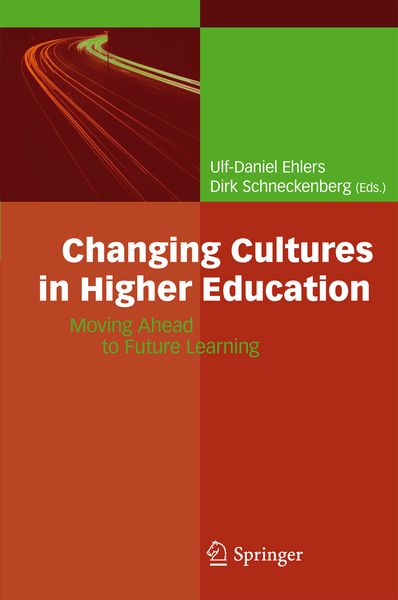
Changing Cultures in Higher Education Moving Ahead to Future Learning

12% sparen

95,99 € UVP 109,99 €

inkl. gesetzl. MwSt., Versandkostenfrei


Beschreibung

More and more educational scenarios and learning landscapes are developed using blogs, wikis, podcasts and e-portfolios. Web 2.0 tools give learners more control, by allowing them to easily create, share or reuse their own learning materials, and these tools also enable social learning networks that...

Beschreibung

More and more educational scenarios and learning landscapes are developed using blogs, wikis, podcasts and e-portfolios. Web 2.0 tools give learners more control, by allowing them to easily create, share or reuse their own learning materials, and these tools also enable social learning networks that bridge the border between formal and informal learning. However, practices of strategic innovation of universities, faculty development, assessment, evaluation and quality assurance have not fully accommodated these changes in technology and teaching.


Ehlers and Schneckenberg present strategic approaches for innovation in universities. The contributions explore new models for developing and engaging faculty in technology-enhanced education, and they detail underlying reasons for why quality assessment and evaluation in new – and often informal – learning scenarios have to change. Their book is a practical guide for educators, aimed at answering these questions. It describes what E-learning 2.0 is, which basic elements of Web 2.0 it builds on, and how E-learning 2.0 differs from Learning 1.0. The book also details a number of quality methods and examples, such as self-assessment, peer-review, social recommendation, and peer-learning, using illustrative cases and giving practical recommendations. Overall, it offers a step-by-step guide for educators so that they can choose their own quality assurance or assessment methods, or develop their own evaluation methodology for specific learning scenarios.


The book addresses everyone involved in higher education – university leaders, chief information officers, change and quality assurance managers, and faculty developers. Pedagogical advisers and consultants will find new insights and practices for the integration and management of novel learning technologies in higher education. The volume fosters in lecturers and teachers a sound understanding of the need and strategy for change, and it provides them withpractical recommendations on competence and quality methodologies.

Rezension

From the reviews:

“If you are concerned with the unrealized potential of technology to increase the abilities of universities to prepare students for work in the twenty-first century, Ehlers and Schneckenberg’s Changing Cultures in Higher Education: Moving Ahead to Future Learning may be of interest. … Changing Cultures in Higher Education can be a useful resource for those who are interested in strategies and case studies about the use of technology to increase the readiness of our universities to prepare students for work.” (Wayne L. Schmadeka, Technical Communication, Vol. 58 (4), November, 2011)

“This book consists of four sections, each comprising a number of chapters contributed by 55 researchers in the field. … The editors did an excellent job in bringing together significant researchers who dedicate their research to the necessary changes that academia should make in order to maximize educational outcomes in our modern culture of technologically supported learning.” (R. Goldberg, ACM Computing Reviews, June, 2011)

Produktdetails

Einband

Gebundene Ausgabe

Erscheinungsdatum

26.02.2010

Abbildungen

XXXIV, 533 p.

Herausgeber Ulf-Daniel Ehlers + weitere

Produktdetails

Einband

Gebundene Ausgabe

Erscheinungsdatum

26.02.2010

Abbildungen

XXXIV, 533 p.

Herausgeber
Verlag Springer Berlin
Seitenzahl

533

Maße (L/B/H)

24,1/16/3,5 cm

Gewicht

958 g

Auflage

2010

Sprache

Englisch

ISBN

978-3-642-03581-4

Herstelleradresse

Springer-Verlag GmbH
Europaplatz 3
69115 Heidelberg
DE

Email: ProductSafety@springernature.com

Noch keine Bewertungen vorhanden

Verfassen Sie die erste Bewertung zu diesem Artikel

Helfen Sie anderen Kundinnen und Kunden durch Ihre Meinung.

Kundinnen und Kunden meinen

Bewertungen (0)

  • Produktbild: Changing Cultures in Higher Education
  • Produktbild: Changing Cultures in Higher Education
  • New Strategies for a Culture of Change and Innovation in Universities.- Introduction: Changing Cultures in Higher Education.- New Challenges for Universities: Why They Must Change.- Learning Innovation for the Twenty-First Century.- “They had People Called Professors…!” Changing Worlds of Learning: Strengthening Informal Learning in Formal Institutions?.- Transforming Universities.- Stories of Change: The University of Zurich, Switzerland.- Shaping Learning Cultures: A Strategic Challenge for Universities.- Faculty Development in Context: Changing Learning Cultures in Higher Education.- Open Content, Open Learning 2.0: Using Wikis and Blogs in Higher Education.- Stories of Change: The National University of Ireland, Galway.- Strategic Integration of Open Educational Resources in Higher Education.- New Directions for Higher Education: Challenges, Opportunities, and Outcomes.- Making User-Generated Content Communities Work in Higher Education – The Importance of Setting Incentives.- Strategic Issues in University Information Management.- Creating the Future: Changing Culture Through Leadership Capacity Development.- Using Appreciative Inquiry for an e-Learning Change Management Programme: The ENTICE Project at Brunel University.- Fostering Connectivity and Reflection as Strategic Investment for Change.- eCompetence and Faculty Engagement for e-learning.- Stories of Change: The K.U. Leuven, Belgium.- What is e-Competence? Conceptual Framework and Implications for Faculty Engagement.- Learning in Communities.- Supporting Changing Cultures Through Emerging Practices.- Conspiracies and Competences.- Education Innovation: Case Studies in e-Learning and Face-to-Face Teaching in Higher Education: What is the Best?.- The Homo Zappiens and its Consequences for Learning inUniversities.- Roles and Domains to Teach in Online Learning Environments: Educational ICT Competency Framework for University Teachers.- Stories of Change: e/merge @ the University of Cape Town.- The Impact of Collaborative e-Learning on Concepts of Teaching.- Stories of Change: TieVie – The Support Service for Finnish Universities Toward the Information Society.- Innovation and Quality through e-learning in Universities.- Stories of Change: The Ruhr University of Bochum.- Moving from Control to Culture in Higher Education Quality.- Quality for Global Knowledge-Intensive Organizations: A Step-by-Step Guide.- Innovation and Quality for New Learning Cultures.- Can Web 2.0 and Social Software Help Transform How We Measure Quality in Teaching, Learning, and Research?.- The Development of a Theoretically Sound Concept of Quality Criteria: As in the Case of the Accreditation for Technology-Enhanced Learning EFMD-CEL.- The MedidaPrix Award: An Agent for Changing Higher Education e-Learning Practice.- The UNIQUe Label: Supporting a Culture of Innovation and Quality in Higher Education.- The Organizational Impact of Open Educational Resources.