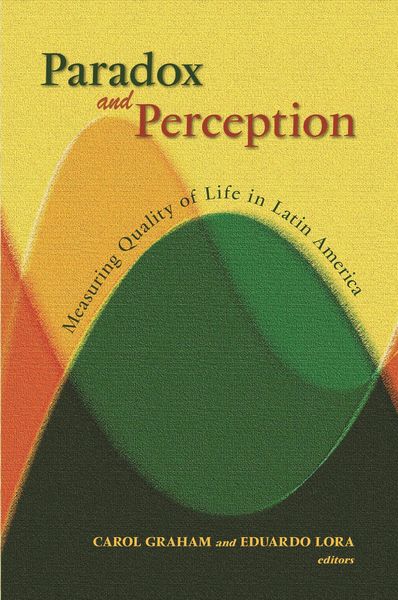
Paradox and Perception Measuring Quality of Life in Latin America
-
- Taschenbuch ausgewählt
- eBook
-
Sprache:Englisch
47,99 €
inkl. gesetzl. MwSt.,
Beschreibung
Produktdetails
Einband
Taschenbuch
Erscheinungsdatum
29.09.2009
Herausgeber
Carol L. Graham + weitereVerlag
Rowman & LittlefieldSeitenzahl
274
Maße (L/B/H)
22,9/15,2/1,6 cm
Gewicht
449 g
Sprache
Englisch
ISBN
978-0-8157-0326-6
" The ""quality of life"" concept of quality of life is a broad one. It incorporates basic needs but also extends beyond them to include capabilities, the ""livability"" of the environment, and life appreciation and happiness. Latin America's diversity in culture and levels of development provide a laboratory for studying how quality of life varies with a number of objective and subjective measures. These measures range from income levels to job insecurity and satisfaction, to schooling attainment and satisfaction, to measured and self-assessed health, among others. Paradox and Perception greatly improves our understanding of the determinants of well-being in Latin America based on a broad ""quality of life"" concept that challenges some standard assumptions in economics, including those about the relationship between happiness and income. The authors' analysis builds upon a number of new approaches in economics, particularly those related to the study of happiness and finds a number of paradoxes as the region's respondents evaluate their well-being. These include the paradox of unhappy growth at the macroeconomic level, happy peasants and frustrated achievers at the microlevel, and surprisingly high levels of satisfaction with public services among the region's poorest. They also have important substantive links with several of the region's realities, such as high levels of income inequality, volatile macroeconomic performance, and low expectations of public institutions and faith in the capacity of the state to deliver. Identifying these perceptions, paradoxes, and their causes will contribute to the crafting of better public policies, as well as to our understanding of why ""populist"" politics still pervade in much of the region."
Noch keine Bewertungen vorhanden
Verfassen Sie die erste Bewertung zu diesem Artikel
Helfen Sie anderen Kundinnen und Kunden durch Ihre Meinung.
Kurze Frage zu unserer Seite
Vielen Dank für Ihr Feedback
Wir nutzen Ihr Feedback, um unsere Produktseiten zu verbessern. Bitte haben Sie Verständnis, dass wir Ihnen keine Rückmeldung geben können. Falls Sie Kontakt mit uns aufnehmen möchten, können Sie sich aber gerne an unseren Kund*innenservice wenden.
zum Kundenservice