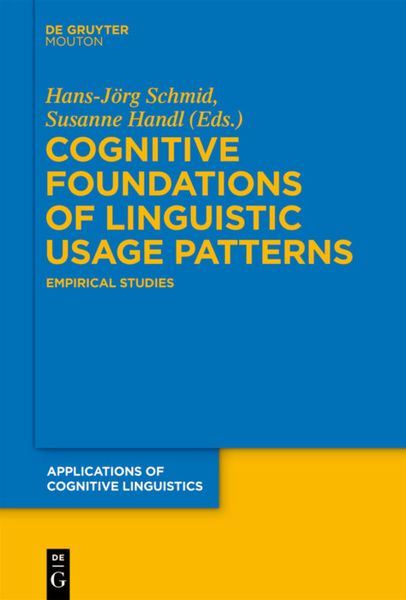
Cognitive Foundations of Linguistic Usage Patterns Empirical Studies
196,99 €
inkl. gesetzl. MwSt.,
Beschreibung
Produktdetails
Einband
Gebundene Ausgabe
Erscheinungsdatum
17.03.2010
Abbildungen
37 ill., 12 tbl.
Herausgeber
Hans-Jörg Schmid + weitereVerlag
De Gruyter MoutonSeitenzahl
277
Maße (L/B/H)
23,6/16/2,2 cm
Gewicht
548 g
Auflage
1
Sprache
Englisch
ISBN
978-3-11-020517-6
The volume presents an up-to-date collection of methodologically sensitive contributions providing mainly enthusiastic, at times also critical support for the cognitive-linguistic enterprise. The book is important for the advancement of cognitive linguistics because the contributions demonstrate the seriousness of its ambitions to develop into a set of testable linguistic approaches. For the same reason, the volume is a contribution to our understanding of language in general, since it puts a promising modern approach on firmer ground. Assets of the book include the wide range of linguistic phenomena studied (individual concepts, fundamental semantic problems like vagueness and polysemy, grammatical issues incl. gender and tense, collocations, constructions and speech acts) and the scope of applied perspectives including lexicographical, computational, developmental and critical discourse ones. The languages investigated are English, German, Dutch, Polish and Italian.
Common to the contributions is the desire to bring together observed patterns of linguistic usage with concepts and models established in cognitive linguistics. In addition, all contributions have an empirical basis and emphasize the need to rely on a sound methodology. The linguistic phenomena investigated span the range from the lexico-conceptual and collocational level to constructions, grammatical categories and functions.
Two complementary perspectives of language and cognition are represented in the volume: In one group, the established methods of psycholinguistic experimentation, quantitative corpus analysis and computational simulation are exploited to demonstrate the viability and to increase the plausibility of cognitive-linguistic thinking. The second group tests well-known cognitive-linguistic approaches like Conceptual Metaphor Theory, the Theory of Idealized Cognitive Models and Construction Grammar against authentic data demonstrating their applicability and explanatory potential. Both groups include contributions reaching beyond the scope of traditional cognitive-linguistic topics, e.g. by taking a critical stance of reductionist cognitive thinking.
The volume is of interest to cognitive linguists, psycholinguists, theoretical linguists, lexicologists, and lexicographers.
Noch keine Bewertungen vorhanden
Verfassen Sie die erste Bewertung zu diesem Artikel
Helfen Sie anderen Kundinnen und Kunden durch Ihre Meinung.
Kurze Frage zu unserer Seite
Vielen Dank für Ihr Feedback
Wir nutzen Ihr Feedback, um unsere Produktseiten zu verbessern. Bitte haben Sie Verständnis, dass wir Ihnen keine Rückmeldung geben können. Falls Sie Kontakt mit uns aufnehmen möchten, können Sie sich aber gerne an unseren Kund*innenservice wenden.
zum Kundenservice