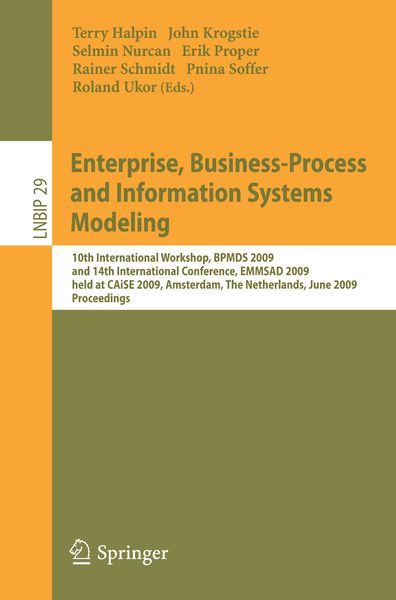
Enterprise, Business-Process and Information Systems Modeling 10th International Workshop, BPMDS 2009, and 14th International Conference, EMMSAD 2009, held at CAiSE 2009, Amsterdam, The Netherlands, June 8-9, 2009, Proceedings
-
- Taschenbuch ausgewählt
- eBook
-
Sprache:Englisch
- Englisch 51,99 € ausgewählt
- Unbestimmt, Englisch 52,99 €
-
Verlag:Springer Berlin
- Springer 51,99 €
- Springer Berlin 51,99 € ausgewählt
-
Auflage:
51,99 €
inkl. gesetzl. MwSt.,
Beschreibung
Produktdetails
Einband
Taschenbuch
Erscheinungsdatum
02.06.2009
Abbildungen
XVI, 420 p.
Herausgeber
Terry Halpin + weitereVerlag
Springer BerlinSeitenzahl
420
Maße (B/H)
15,5/23,5 cm
Gewicht
663 g
Sprache
Englisch
ISBN
978-3-642-01861-9
This book contains the proceedings of two long-standing workshops: The 10th International Workshop on Business Process Modeling, Development and Support, BPMDS 2009, and the 14th International Conference on Exploring Modeling Methods for Systems Analysis and Design, EMMSAD 2009, held in connection with CAiSE 2009 in Amsterdam, The Netherlands, in June 2009.
The 17 papers accepted for BPMDS 2009 were carefully reviewed and selected from 32 submissions. The topics addressed by the BPMDS workshop are business and goal-related drivers; model-driven process change; technological drivers and IT services; technological drivers and process mining; and compliance and awareness.
Following an extensive review process, 16 papers out of 36 submissions were accepted for EMMSAD 2009. These papers cover the following topics: use of ontologies; UML and MDA; ORM and rule-oriented modeling; goal-oriented modeling; alignment and understandability; enterprise modeling; and patterns and anti-patterns in enterprise modeling.
Noch keine Bewertungen vorhanden
Verfassen Sie die erste Bewertung zu diesem Artikel
Helfen Sie anderen Kundinnen und Kunden durch Ihre Meinung.
Kurze Frage zu unserer Seite
Vielen Dank für Ihr Feedback
Wir nutzen Ihr Feedback, um unsere Produktseiten zu verbessern. Bitte haben Sie Verständnis, dass wir Ihnen keine Rückmeldung geben können. Falls Sie Kontakt mit uns aufnehmen möchten, können Sie sich aber gerne an unseren Kund*innenservice wenden.
zum Kundenservice