KI-Beratung Beta

  • Produktbild: Advances in Enterprise Engineering III
  • Produktbild: Advances in Enterprise Engineering III
Band 34

Advances in Enterprise Engineering III 5th International Workshop, CIAO! 2009, and 5th International Workshop, EOMAS 2009, held at CAiSE 2009, Amsterdam, The Netherlands, June 8-9, 2009, Proceedings

51,99 €

inkl. gesetzl. MwSt., Versandkostenfrei


Beschreibung

In the era of continuous changes in internal organizationalsettings and external business environments – such as new regulations and business opportunities – modern enterprises are subject to extensive research and study. For the understanding, design, and engineering of modern enterprises and theircomplexbusiness...

Beschreibung

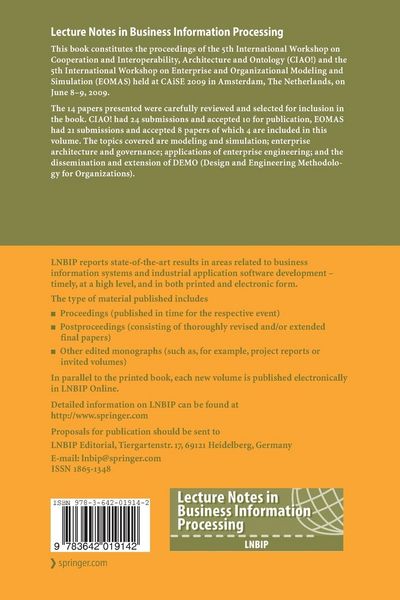
In the era of continuous changes in internal organizationalsettings and external business environments – such as new regulations and business opportunities – modern enterprises are subject to extensive research and study. For the understanding, design, and engineering of modern enterprises and theircomplexbusiness processes,thedisciplineofenterpriseengineeringrequires sound engineering principles and systematic approaches based on rigorous th- ries. Along with that, a paradigm shift seems to be needed for addressing these issues adequately. The main paradigm shift is the consideration of an enterprise and its business processes as a social system. In its social setting, an enterprise and its business processes represent actors with certain authorities and assigned roles, who assume certain responsibilities in order to provide a service to its environment. Second to that, a paradigm shift is to look at an enterprise as an artifact purposefully designed for a certain mission and goal. The need for this paradigm shift, along with the complexity and agility of modern enterprises, gives inspiration for the emerging discipline of enterprise engineering that requires development of new theories and methodologies. To this end, the prominent methods and tools of modeling and simulation play a signi?cant role. Both (conceptual) modeling and simulation are widely used for understanding, analyzing, and engineering an enterprise (its organization and business processes).

Produktdetails

Einband

Taschenbuch

Erscheinungsdatum

25.05.2009

Abbildungen

XVI, 201 p.

Herausgeber Antonia Albani + weitere

Produktdetails

Einband

Taschenbuch

Erscheinungsdatum

25.05.2009

Abbildungen

XVI, 201 p.

Herausgeber
Verlag Springer Berlin
Seitenzahl

201

Maße (L/B/H)

23,5/15,5/1,3 cm

Gewicht

341 g

Auflage

2009

Sprache

Englisch

ISBN

978-3-642-01914-2

Herstelleradresse

Springer-Verlag KG
Sachsenplatz 4-6
1201 Wien
AT

Email: ProductSafety@springernature.com

Noch keine Bewertungen vorhanden

Verfassen Sie die erste Bewertung zu diesem Artikel

Helfen Sie anderen Kundinnen und Kunden durch Ihre Meinung.

Kundinnen und Kunden meinen

Bewertungen (0)

  • Produktbild: Advances in Enterprise Engineering III
  • Produktbild: Advances in Enterprise Engineering III
  • Modeling and Simulation.- Method Versus Model – Two Sides of the Same Coin?.- Capturing Complex Business Processes Interdependencies Using Modeling and Simulation in a Multi-actor Environment.- A Heuristic Method for Business Process Model Evaluation.- Simulating Liquidity in Value and Supply Chains.- Enterprise Architecture and Governance.- Complexity Levels of Representing Dynamics in EA Planning.- An Approach for Creating and Managing Enterprise Blueprints: A Case for IT Blueprints.- An Information Model Capturing the Managed Evolution of Application Landscapes.- Enterprise Engineering – Applications.- A Service Specification Framework for Developing Component-Based Software: A Case Study at the Port of Rotterdam.- Enhancing the Formal Foundations of BPMN by Enterprise Ontology.- Developing Quality Management Systems with DEMO.- Analyzing Organizational Structures Using Social Network Analysis.- DEMO – Dissemination and Extension.- The Adoption of DEMO: A Research Agenda.- ArchiMate and DEMO – Mates to Date?.- Integration Aspects between the B/I/D Organizations of the Enterprise.