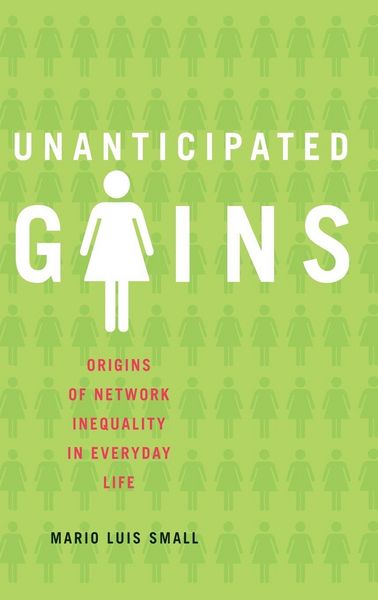
Unanticipated Gains
-
- Hardcover ausgewählt
- Taschenbuch
- eBook
-
Sprache:Englisch
112,99 €
inkl. gesetzl. MwSt.,
Beschreibung
Produktdetails
Einband
Gebundene Ausgabe
Erscheinungsdatum
26.09.2008
Verlag
Oxford University PressSeitenzahl
310
Maße (L/B/H)
24/16,1/2,1 cm
Gewicht
631 g
Sprache
Englisch
ISBN
978-0-19-538435-2
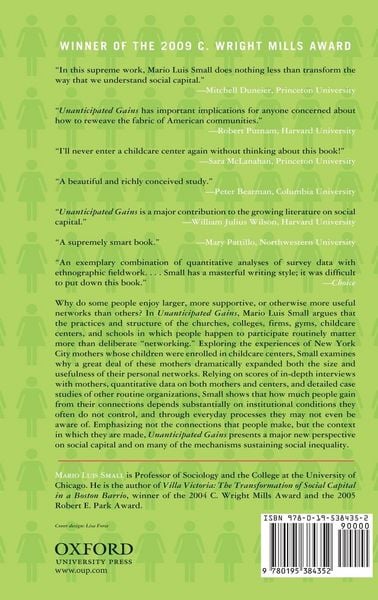
Social capital theorists have shown that inequality arises in part because some people enjoy larger, more supportive or otherwise more useful networks. But why do some people have better networks than others? Unanticipated Gains argues that the answer lies less in people's deliberate "networking" than in the institutional conditions of the colleges, firms, gyms, and other organizations in which they happen to participate routinely.
The book introduces a model of social inequality that takes seriously the embeddedness of networks in formal organizations, proposing that what people gain from their connections depends on where those connections are formed and sustained. It studies an unlikely case: the experiences of mothers whose children were enrolled in New York City childcare centers. As a result of the routine practices and institutional conditions of the centers--from the structure of their parents' associations, to apparently innocuous rules such as pick-up and drop-off times---many of these mothers dramatically increased their social capital and measurably improved their wellbeing. Yet how much they gained depended on how their centers were organized. The daycare centers also brokered connections to other people and organizations, affecting not only the size of mothers' networks but also the resources available through them.
Social inequality then arises not merely out of differences in skills or deliberate investments - as the conventional social scientific and political wisdom would have it - but also out of the differences in the routine organizations in which people belong. In addition to childcare centers, Small also identifies the social forces at work in many other organizations, including beauty salons, bath houses, gyms, and churches.
Noch keine Bewertungen vorhanden
Verfassen Sie die erste Bewertung zu diesem Artikel
Helfen Sie anderen Kundinnen und Kunden durch Ihre Meinung.
Kurze Frage zu unserer Seite
Vielen Dank für Ihr Feedback
Wir nutzen Ihr Feedback, um unsere Produktseiten zu verbessern. Bitte haben Sie Verständnis, dass wir Ihnen keine Rückmeldung geben können. Falls Sie Kontakt mit uns aufnehmen möchten, können Sie sich aber gerne an unseren Kund*innenservice wenden.
zum Kundenservice