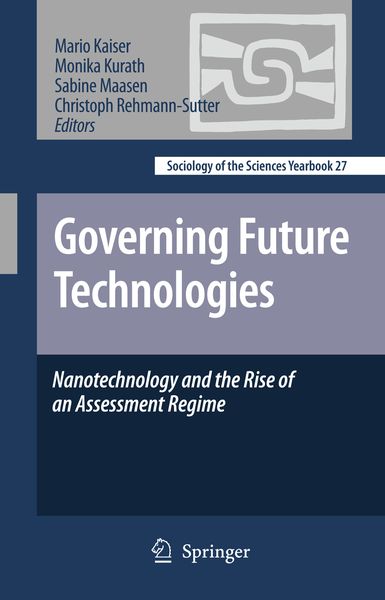
Governing Future Technologies Nanotechnology and the Rise of an Assessment Regime
-
- Hardcover ausgewählt
- Taschenbuch
-
Sprache:Englisch
95,99 €
UVP
109,99 €
inkl. gesetzl. MwSt.,
Beschreibung
Produktdetails
Einband
Gebundene Ausgabe
Erscheinungsdatum
23.11.2009
Abbildungen
XXIII, 314 p.
Herausgeber
Mario Kaiser + weitereVerlag
Springer NetherlandSeitenzahl
314
Maße (L/B/H)
24,3/16,6/3 cm
Gewicht
673 g
Auflage
2010 edition
Sprache
Englisch
ISBN
978-90-481-2833-4
Nanotechnology has been the subject of extensive ‘assessment hype,’ unlike any previous field of research and development. A multiplicity of stakeholders have started to analyze the implications of nanotechnology: Technology assessment institutions around the world, non-governmental organizations, think tanks, re-insurance companies, and academics from science and technology studies and applied ethics have turned their attention to this growing field’s implications. In the course of these assessment efforts, a social phenomenon has emerged – a phenomenon the editors define as assessment regime.
Despite the variety of organizations, methods, and actors involved in the evaluation and regulation of emerging nanotechnologies, the assessment activities comply with an overarching scientific and political imperative: Innovations are only welcome if they are assessed against the criteria of safety, sustainability, desirability, and acceptability. So far, such deliberations and reflections have played only a subordinate role. This book argues that with the rise of the nanotechnology assessment regime, however, things have changed dramatically: Situated at the crossroads of democratizing science and technology, good governance, and the quest for sustainable innovations, the assessment regime has become constitutive for technological development.
The contributions in this book explore and critically analyse nanotechnology’s assessment regime: To what extent is it constitutive for technology in general, for nanotechnology in particular? What social conditions render the regime a phenomenon sui generis? And what are its implications for science and society?
Noch keine Bewertungen vorhanden
Verfassen Sie die erste Bewertung zu diesem Artikel
Helfen Sie anderen Kundinnen und Kunden durch Ihre Meinung.
Kurze Frage zu unserer Seite
Vielen Dank für Ihr Feedback
Wir nutzen Ihr Feedback, um unsere Produktseiten zu verbessern. Bitte haben Sie Verständnis, dass wir Ihnen keine Rückmeldung geben können. Falls Sie Kontakt mit uns aufnehmen möchten, können Sie sich aber gerne an unseren Kund*innenservice wenden.
zum Kundenservice