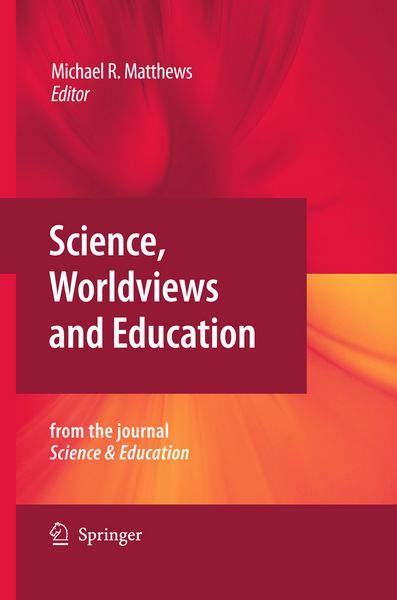
Science, Worldviews and Education Reprinted from the Journal Science & Education
-
- Hardcover ausgewählt
- Taschenbuch
-
Sprache:Englisch
142,99 €
UVP
164,99 €
inkl. gesetzl. MwSt.,
Beschreibung
Produktdetails
Einband
Gebundene Ausgabe
Erscheinungsdatum
24.11.2009
Herausgeber
Michael MatthewsVerlag
Springer NetherlandSeitenzahl
345
Maße (L/B/H)
24,2/16,4/2,8 cm
Gewicht
686 g
Auflage
1. Auflage
Sprache
Englisch
ISBN
978-90-481-2778-8
Science, Worldviews and Education is an important and timely theme as many national and provincial education authorities are requiring that students learn about the Nature of Science (NOS), and that they learn about the broader historical and cultural contexts of science and its practice.
Such topics give rise to questions about science and worldviews: What is a worldview? Does science have a worldview? Are there specific ontological, epistemological and ethical prerequisites for the conduct of science? How can scientific worldviews be reconciled with seemingly discordant religious and cultural worldviews?
Questions about science and worldviews have had a long history. The Galilean revolution, the Darwinian revolution, and the Einsteinian revolution were all associated with profound cultural, religious and philosophical transformations and debates. The European Enlightenment was the first such major impact.
Globalisation and the science-based industrialization of many non-Western societies, with their own religious traditions and worldviews, make urgent the understanding of science and its inter-relation with worldviews, and for the development of informed and appropriate science education.
Contributors to this anthology include scientists, philosophers, theologians, and educators. They all share the conviction that science education has to promote a richer understanding of science and its relations with culture, religion, philosophy, and ultimately the worldview of students.
What is a scientific worldview? How does it differ from other worldviews? Is it possible to be educated in science yet lack a scientific worldview? Can science thrive in a society where such a worldview is lacking? These questions and more are discussed in depth by a distinguished group of scientists, philosophers, educators and theologians in this uniquely valuable volume.
Albert H. Teich , Director, Science & Policy Programs, American Association for the Advancement of Science, USA
This wide ranging collection of essays is an excellent way to enter the too often neglected territory of how science and science education relate to larger socio-cultural world views.
Peter Machamer , Department of History and Philosophy of Science, University of Pittsburgh, USA
Noch keine Bewertungen vorhanden
Verfassen Sie die erste Bewertung zu diesem Artikel
Helfen Sie anderen Kundinnen und Kunden durch Ihre Meinung.
Kurze Frage zu unserer Seite
Vielen Dank für Ihr Feedback
Wir nutzen Ihr Feedback, um unsere Produktseiten zu verbessern. Bitte haben Sie Verständnis, dass wir Ihnen keine Rückmeldung geben können. Falls Sie Kontakt mit uns aufnehmen möchten, können Sie sich aber gerne an unseren Kund*innenservice wenden.
zum Kundenservice