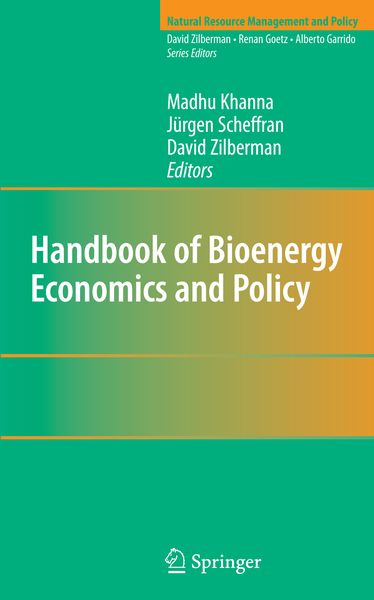
Handbook of Bioenergy Economics and Policy
-
- Hardcover ausgewählt
- Taschenbuch
-
Sprache:Englisch
238,99 €
UVP
274,99 €
inkl. gesetzl. MwSt.,
Beschreibung
Produktdetails
Einband
Gebundene Ausgabe
Erscheinungsdatum
03.12.2009
Abbildungen
XIV, 439 p. 88 illus.
Herausgeber
Madhu Khanna + weitereVerlag
Springer UsSeitenzahl
439
Maße (L/B/H)
24,4/16,3/3,5 cm
Gewicht
812 g
Auflage
2010 edition
Sprache
Englisch
ISBN
978-1-4419-0368-6
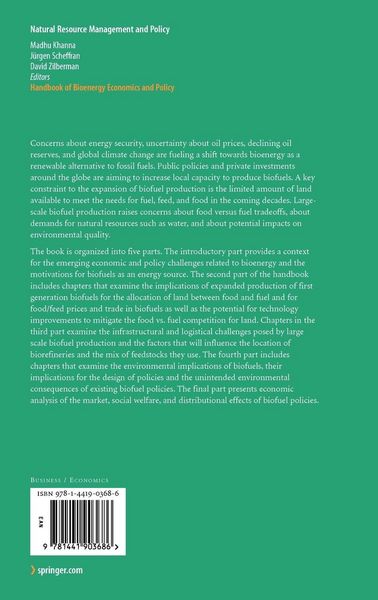
Concerns about energy security, uncertainty about oil prices, declining oil reserves, and global climate change are fueling a shift towards bioenergy as a renewable alternative to fossil fuels. Public policies and private investments around the globe are aiming to increase local capacity to produce biofuels. A key constraint to the expansion of biofuel production is the limited amount of land available to meet the needs for fuel, feed, and food in the coming decades. Large-scale biofuel production raises concerns about food versus fuel tradeoffs, about demands for natural resources such as water, and about potential impacts on environmental quality.
The book is organized into five parts. The introductory part provides a context for the emerging economic and policy challenges related to bioenergy and the motivations for biofuels as an energy source. The second part of the handbook includes chapters that examine the implications of expanded production of first generation biofuels for the allocation of land between food and fuel and for food/feed prices and trade in biofuels as well as the potential for technology improvements to mitigate the food vs. fuel competition for land. Chapters in the third part examine the infrastructural and logistical challenges posed by large scale biofuel production and the factors that will influence the location of biorefineries and the mix of feedstocks they use. The fourth part includes chapters that examine the environmental implications of biofuels, their implications for the design of policies and the unintended environmental consequences of existing biofuel policies. The final part presents economic analysis of the market, social welfare, and distributional effects of biofuel policies.
Noch keine Bewertungen vorhanden
Verfassen Sie die erste Bewertung zu diesem Artikel
Helfen Sie anderen Kundinnen und Kunden durch Ihre Meinung.
Kurze Frage zu unserer Seite
Vielen Dank für Ihr Feedback
Wir nutzen Ihr Feedback, um unsere Produktseiten zu verbessern. Bitte haben Sie Verständnis, dass wir Ihnen keine Rückmeldung geben können. Falls Sie Kontakt mit uns aufnehmen möchten, können Sie sich aber gerne an unseren Kund*innenservice wenden.
zum Kundenservice