Gutscheinbedingungen

**Gültig nur für Bestellungen an die Wunsch-Poststation bis 10.06.2026 auf Spielzeug, Schreibwaren, Filme, Geschenke & Trends, Musik, tolino eReader & Zubehör, Hörbücher und Hörbuch-Downloads (außer Abo), nicht preisgebundene Bücher und Kalender online auf thalia.at und in der Thalia App. Einzelne Artikel können ausgeschlossen sein. Aufgrund der Buchpreisbindung sind deutschsprachige Bücher und eBooks ausgenommen. Zusätzlich ausgenommen sind preisgebundene Artikel, Abos & Flatrates, eBooks, Games, Geschenkkarten/-boxen, Shelfies, Software, Zeitschriften sowie einzelne Artikel von tonies®. Pro Einkauf einmal einlösbar. Kein Click & Collect möglich. Keine Barauszahlung. Nicht kombinierbar mit anderen Aktionen und Gutscheinen. Gutschein wird auf max. 500€ Bestellwert angerechnet. Nicht gültig für Versandkosten und Services.

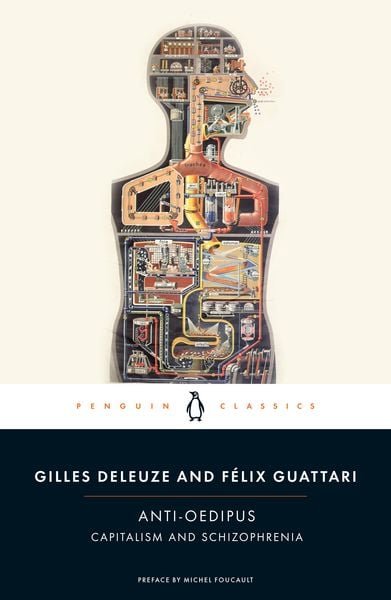
Produktbild: Anti-Oedipus

Anti-Oedipus Capitalism and Schizophrenia

Aus der Reihe Bloomsbury Revelations

19,99 €

inkl. gesetzl. MwSt., zzgl. Versandkosten


  • Kostenlose Lieferung ab 30 € Einkaufswert
  • Versandkostenfrei für Bonuscard-Kund*innen

Beschreibung

Produktdetails

Verkaufsrang

9563

Einband

Taschenbuch

Erscheinungsdatum

01.05.2009

Verlag

Random House N.Y.

Seitenzahl

432

Maße (L/B/H)

21,5/13,9/4,2 cm

Gewicht

357 g

Farbe

Elfenbein / Schwarz

Übersetzt von

Hurley Robert + weitere

Sprache

Englisch

ISBN

978-0-14-310582-4

Beschreibung

Produktdetails

Verkaufsrang

9563

Einband

Taschenbuch

Erscheinungsdatum

01.05.2009

Verlag

Random House N.Y.

Seitenzahl

432

Maße (L/B/H)

21,5/13,9/4,2 cm

Gewicht

357 g

Farbe

Elfenbein / Schwarz

Übersetzt von

  • Hurley Robert
  • Seem Mark
  • Lane Helen R.

Sprache

Englisch

ISBN

978-0-14-310582-4

Herstelleradresse

Libri GmbH
Europaallee 1
36244 Bad Hersfeld
DE

Email: gpsr@libri.de

Kundinnen und Kunden meinen

0 Bewertungen

Informationen zu Bewertungen

Zur Abgabe einer Bewertung ist eine Anmeldung im Konto notwendig. Die Authentizität der Bewertungen wird von uns nicht überprüft. Wir behalten uns vor, Bewertungstexte, die unseren Richtlinien widersprechen, entsprechend zu kürzen oder zu löschen.

Die Bewertungen sind nach Format, Anzahl Sterne und Datum sortiert.

Verfassen Sie die erste Bewertung zu diesem Artikel

Helfen Sie anderen Kund*innen durch Ihre Meinung

Kundinnen und Kunden meinen

0 Bewertungen filtern

Die Leseprobe wird geladen.
  • Produktbild: Anti-Oedipus
  • Preface by Michel Foucault
    Introduction by Mark Seem

    1. THE DESIRING-MACHINES

    1. Desiring-Production

    The schizo's stroll ♦ Nature and industry ♦ The process ♦ Desiring-machine, partial objects and flows: and . . . and . . . ♦ The first synthesis: the connective synthesis or production of production ♦ The production of the body without organs ♦

    2. The Body Without Organs

    Abti-production ♦ Repulsion and the paranoiac machine ♦ Desiring-production and social production: how anti-production appropriates the productive forces ♦ Appropriation or attraction, and the miraculating-machine—The second synthesis: the disjunctive synthesis or production of recording ♦ Either . . . or . . . ♦ The schizophrenic genealogy ♦

    3. The Subject and Enjoyment

    The celibate machine ♦ The third synthesis: the conjunctive synthesis or production of consumption-consummation ♦ So it's . . . ♦ Matter, egg, and intensities: I feel ♦ The names in history ♦

    4. A Materialist Psychiatry

    The unconscious and the category of production ♦ Theater or factory? ♦ The process as production process ♦ The idealist conception of desire as lack (fantasy) ♦ The real and desiring-production: the passive syntheses ♦ One and the same production, social and desiring ♦ The reality of the group fantasy ♦ The differences in regime between desiring-production and social production ♦ The socius and the body without organs ♦ Capitalism, and schizophrenia as its limit (the counteracted tendency) ♦ Neurosis, psychosis, and perversion ♦

    5. The Machines

    Desiring-machines are machines, no metaphor ♦ The first mode of break: flows and selection from flows ♦ The second mode: chains or codes, and detachments from them ♦ The third mode: subject and residue ♦

    6. The Whole and Its Parts

    The status of multiplicities ♦ The partial objects ♦ The critique of Oedipus, the Oedipal mystification ♦ Already the child . . . ♦ The orphan-conscious ♦ What is wrong with psychoanalysis? ♦

    2. PSYCHOANALYSIS AND FAMILIALISM: THE HOLY FAMILY

    1. The Imperialism of Oedipus

    Its modes ♦ The Oedipal turning-point in psychoanalysis ♦ Desiring-production and representation ♦ The abandonment of the desiring-machines ♦

    2. Three texts of Freud

    Oedipalization ♦ The flattening-out of Judge Schreber's delirium ♦ How pyschoanalysis is still pious ♦ The ideology of lack: castration ♦ Every fantasy is collective ♦ The libido as flow ♦ The rebellion of the flows ♦

    3. The Connective Synthesis of Production

    Its two uses, global and specific, partial and non-specific ♦ The family and the couple, filiation and alliance: triangulation ♦ The triangulation's cause ♦ The first paralogism of psychoanalysis: extrapolation ♦ The transcendent use and the immanent use ♦

    4. The Disjunctive Synthesis of Recording

    Its two uses, exclusive and restrictive, inclusive, and nonrestrictive ♦ The inclusive disjunctions: genealogy ♦ The exclusive differentiations and the nondifferentiated ♦ The second paralogism of psychoanalysis: the Oedipal double-bind ♦ Oedipus wins at every turn ♦ Does the borderline pass between the Symbolic and the Imaginary?

    5. The Conjunctive Synthesis of Consumption-Consummation

    Its two uses, segregative and biunivocal, nomadic and polyvocal ♦ The body without organs and intensities ♦ Voyages, passages: I am becoming ♦ Every delirium is social, historical and political ♦ Races ♦ The meaning of identification ♦ How psychoanalysis suppresses sociopolitical content ♦ An unrepentant familialism ♦ The family and the social field ♦ Desiring-production and the investment of social production ♦ From childhood ♦ The third paralogism of psychoanalysis: Oedipus as a biunivocal "application" ♦ The disgrace of psychoanalysis with regard to history ♦ Desire and the infrastructure ♦ Segregation and nomadism ♦

    6. A Recapitulation of the Three Syntheses

    Oedipus would make fools of us all ♦ Oedipus and "belief" ♦ Meaning is use ♦ The immanent criteria of desiring-production ♦ Desire knows nothing of the law, lack, and the signifier ♦ "Were you born Hamlet . . . ? ♦

    7. Social Repression and Psychic Repression

    The law ♦ The fourth paralogism of psychoanalysis: the displacement, or the disfiguration of the repressed ♦ Desire is revolutionary ♦ The delegated agent of psychic repression ♦ It is not psychoanalysis that invents Oedipus ♦

    8. Neurosis and Psychosis

    Reality ♦ The inverse relation ♦ "Undecidable" Oedipus: resonance ♦ The meaning of actual factors ♦ The fifth paralogism of psychoanalysis: the afterward ♦ The actuality of desiring-production ♦

    9. The Process

    Leaving ♦ The painter Turner ♦ The interruptions of the process: neurosis, psychosis, and perversion ♦ The movement of deterritorialization and territorialities ♦

    3. SAVAGES, BARBARIANS, CIVILIZED MEN

    1. The Inscribing Socius

    The recording process ♦ In what sense capitalism is universal ♦ The social machine ♦ The problem of the socius, coding the flows ♦ Not exchanging, but marking and being marked ♦ The investment and the disinvestment of organs ♦ Curelty: creating a memory for man ♦

    2. The Primitive Territorial Machine

    The full body of the earth ♦ Filiation and alliance: their irreducibility ♦ The village pervert and local groups ♦ Filiative stock and blocks of alliance debt ♦ Functional disequilibrium: surplus value of code ♦ It only works by breaking down ♦ The segmentary machine ♦ The great fear of decoded flows ♦ Death which rises from within, but comes from without ♦

    3. The Problem of Oedipus

    Incest ♦ The inclusive disjunctions on the full body of the earth ♦ From intensities to extension: the sign ♦ In what sense incest is impossible ♦ The limit ♦ The conditions of coding ♦ The in-depth elements of representation: the repressed representative, the repressing representation, the displaced represented ♦

    4. Psychoanalysis and Ethnology

    Continuation of the Oedipal problem ♦ A process of treatment in Africa ♦ The conditions of Oedipus and colonization ♦ Oedipus and ethnocide ♦ Those who oedipalize don't know what they're doing ♦ On what is psychic repression brought to bear? ♦ Culturalists and universalists: their common postulates ♦ In what sense Oedipus is indeed universal: the five meanings of limit, Oedipus as one of them ♦ Use, or functionalism in ethnology ♦ The desiring-machines do not mean anything ♦ Molar and molecular ♦

    5. Territorial Representation

    Its surface elements ♦ Debts and exchange ♦ The five postulates of the exchangist conception ♦ Voice, graphism, and eye: the theater of cruelty ♦ Nietzsche ♦ The death of the territorial system ♦

    6. The Barbarian Despotic Machine

    The full body of the despot ♦ New alliance and direct filiation ♦ The paranoiac ♦ Asiatic production ♦ The bricks ♦ The mystifications of the State ♦ Despotic deterritorialization and the infinite debt ♦ Overcoding the flows ♦

    7. Barbarian or Imperial Representation

    Its elements ♦ Incest and overcoding ♦ The in-depth elements and the migration of Oedipus: incest becomes possible ♦ The surface elements, the new voice-graphism relationship ♦ The transcendent object from on high ♦ The signifier as the deterritorialized sign ♦ The despotic signifier, and the signifieds of incest ♦ Terror, the law ♦ The form of the infinite debt: latency, vengeance, and ressentiment ♦ This is still not Oedipus . . . ♦

    8. The Urstaat

    A single State? ♦ The State as a category ♦ Beginning and origin ♦ The evolution of the State: becoming-concrete and becoming-immanent ♦

    9. The Civilized Capitalist Machine

    The full body of money-capital ♦ Decoding and the conjunction of decoded flows ♦ Cynicism ♦ Filiative capital and alliance capital ♦ The transformation of surplus value of code into a surplus value of flux ♦ The two forms of money, the two inscriptions ♦ The falling tendency ♦ Capitalism and deterritorialization ♦ Human surplus value and machinic surplus value ♦ Anti-production ♦ The various aspects of the capitalist immanence ♦ The flows ♦

    10. Capitalist Representation

    Its elements ♦ The figures or schizzes-flows ♦ The two meanings of the schiz-flow: capitalism and schizophrenia ♦ The difference between a code and an axiomatic ♦ The capitalist State, its relationship with the Urstaat ♦ The class ♦ Class bipolarity ♦ Desire and interest ♦ Capitalist deterritorialization and re-territorializations: their relationship, and the law of the falling tendency ♦ The two poles of the axiomatic: the despotic signifier and the schizophrenic figure, paranoia and schizophrenia ♦ A recapitulation of the three great social machines: the territorial, the despotic, and the capitalist (coding, overcoding, decoding) ♦

    11. Oedipus at Last

    Application ♦ Social reproduction and human reproduction ♦ The two orders of images ♦ Oedipus and its limits ♦ Oedipus and the recapitulation of the three states ♦ The despotic symbol and capitalist images ♦ Bad conscience ♦ Adam Smith and Freud ♦

    4. INTRODUCTIONTO SCHIZOANALYSIS

    1. The Social Field

    Father and child ♦ Oedipus, a father's idea ♦ The unconscious as a cycle ♦ The primacy of the social investment: its two poles, paranoia and schizophrenia ♦ Molar and molecular ♦

    2. The Molecular Unconscious

    Desire and machine ♦ Beyond vitalism and mechanism ♦ The two states of the machine ♦ Molecular functionalism ♦ The syntheses ♦ The libido, the large aggregates and the micro-multiplicities ♦ The gigantism and the dwarfism of desire ♦ The nonhuman sex: not one, not two, but n sexes ♦

    3. Psychoanalysis and Capitalism

    Representation ♦ Representation and production ♦ Against myth and tragedy ♦ The ambiguous attitude of psychoanalysis with regard to myth and tragedy ♦ In what sense psychoanalysis fractures representation, in what sense it restores representation ♦ The requirements of capitalism ♦ Mythic, tragic, and psychoanalytic representation ♦ The theater ♦ Subjective representation and structural representation ♦ Structuralism, familialism, and the cult of lack ♦ The destructive task of schizoanalysis, cleansing the unconscious: a malevolent activity ♦ Deterritorialization and re-territorialization: their relationship, and dreams ♦ The machinic indices ♦ Politicization: social alienation and mental alienation ♦ Artifice and process, old earths and the new earth ♦

    4. The First Positive Task of Schizoanalysis

    Desiring-production and its machines ♦ The status of partial objects ♦ The passive syntheses ♦ The status of the body without organs ♦ The signifying chain and codes ♦ The body without organs, death, and desire ♦ Schizophrenizing death ♦ The strange death cult in psychoanalysis: the pseudo-instinct ♦ The problem of affinities between the molar and the molecular ♦ The mechanic's task of schizoanalysis ♦

    5. The Second Positive Task

    Social production and its machines ♦ The theory of the two poles ♦ The first thesis: every investment is molar and social ♦ Gregariousness, selection, and the form of gregariousness ♦ The second thesis: distinguish in social investments the preconscious investment of class or interest, from the unconscious libidinal investment of desire or group ♦ The nature of this libidinal investment of the social field ♦ The two groups ♦ The role of sexuality, the "sexual revolution" ♦ The third thesis: the libidinal invesment of the social field is primary in relation to the familial investments ♦ The theory of "maids" in Freud, Oedipus and universal familialism ♦ The poverty of psychoanalysis: 4, 3, 2, 1, 0 ♦ Even antipsychiatry . . . ♦ What is the schizophrenic sick from? ♦ The fourth thesis: the two poles of the libidinal social investment ♦ Art and science ♦ The task of schizoanalysis in relation to the revolutionary movements.

    Reference Notes
    Index