
Breaking from Taylorism Changing Forms of Work in the Automobile Industry
-
- Hardcover
- Taschenbuch ausgewählt
-
Sprache:Englisch
69,99 €
inkl. gesetzl. MwSt.,
Beschreibung
Produktdetails
Einband
Taschenbuch
Erscheinungsdatum
31.10.2008
Verlag
Cambridge AcademicSeitenzahl
464
Maße (L/B/H)
22,9/15,2/2,7 cm
Gewicht
680 g
Sprache
Englisch
ISBN
978-0-521-10253-7
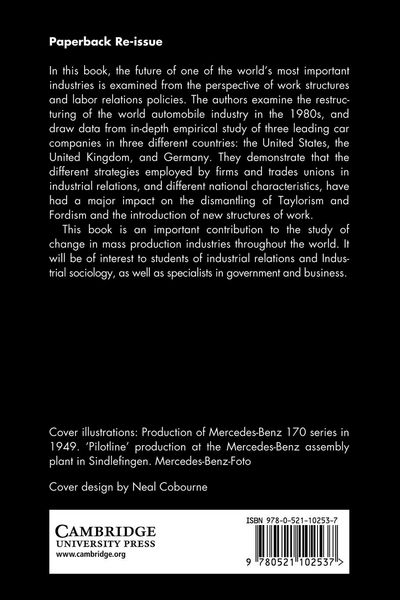
In this book, the future of one of the world's most important industries is examined from the perspective of work structures and labour relations policies. The authors examine the restructuring of the world automobile industry in the 1980s, and draw data from an in-depth empirical study of three leading car companies in three different countries: the United States, the United Kingdom and Germany. They demonstrate that the different strategies employed by firms and trades unions in industrial relations, and different national characteristics, have had a major impact on the dismantling of Taylorism and Fordism and the introduction of new structures of work. This book is an important contribution to the study of change in mass production industries throughout the world. It will be of interest to students of industrial relations and industrial sociology, as well as specialists in government and business.
Noch keine Bewertungen vorhanden
Verfassen Sie die erste Bewertung zu diesem Artikel
Helfen Sie anderen Kundinnen und Kunden durch Ihre Meinung.
Kurze Frage zu unserer Seite
Vielen Dank für Ihr Feedback
Wir nutzen Ihr Feedback, um unsere Produktseiten zu verbessern. Bitte haben Sie Verständnis, dass wir Ihnen keine Rückmeldung geben können. Falls Sie Kontakt mit uns aufnehmen möchten, können Sie sich aber gerne an unseren Kund*innenservice wenden.
zum Kundenservice