KI-Beratung Beta

Gutscheinbedingungen

**Gültig bis 18.11.2026 auf englischsprachige Klassiker (klassiker-32728) online auf thalia.at und in der Thalia App. Einzelne Artikel können ausgeschlossen sein. Ausgenommen sind preisgebundene Artikel & eBooks. Pro Einkauf einmal einlösbar. Click & Collect nur bei Onlinevorabzahlung möglich. Keine Barauszahlung. Nicht kombinierbar mit anderen Aktionen und Gutscheinen. Gutschein wird auf max. 500€ Bestellwert angerechnet. Nicht gültig für Geschenkkarten, Versandkosten und Services.

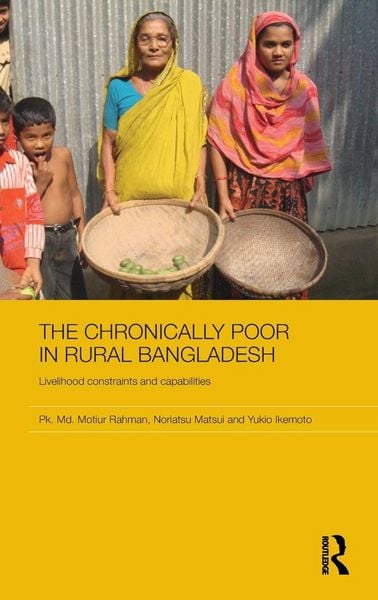
Produktbild: The Chronically Poor in Rural Bangladesh

The Chronically Poor in Rural Bangladesh Livelihood Constraints and Capabilities

202,99 €

inkl. gesetzl. MwSt., Versandkostenfrei


Beschreibung

This book examines rural poverty in Bangladesh. Based on detailed empirical research and surveys of households in Bangladesh, it provides an accurate portrait of the everyday situations faced by the rural poor in Bangladesh today, covering all aspects of household behaviour. All of the key issues are...

Beschreibung

This book examines rural poverty in Bangladesh. Based on detailed empirical research and surveys of households in Bangladesh, it provides an accurate portrait of the everyday situations faced by the rural poor in Bangladesh today, covering all aspects of household behaviour. All of the key issues are explored, including health, nutrition, housing conditions, human capital, household asset and liabilities, gender issues, livelihood strategies, distribution of household income and expenditure, social capital, intergenerational mobility of the chronically poor, women's mobility, shocks and coping strategies, and vulnerability to poverty. The book focuses in particular on the poorest of the poor households, the chronically poor, seen by many in the development community to be the core of the problem of poverty. It shows that the basic characteristics of the chronically poor households in rural Bangladesh are: more heavily female-headed households, higher dependency ratio of children in demographic composition, and dominated by lower levels of assets, shorter years of schooling and limited employment opportunity. Throughout, it draws precise conclusions on the basis of quantitative data, which makes this book an important resource for policy-makers and development practitioners, as well as students and researchers.

Produktdetails

Einband

Gebundene Ausgabe

Erscheinungsdatum

12.11.2008

Abbildungen

schwarz-weiss Illustrationen, Zeichnungen, schwarz-weiss, Tabellen, schwarz-weiss

Verlag Taylor and Francis

Produktdetails

Einband

Gebundene Ausgabe

Erscheinungsdatum

12.11.2008

Abbildungen

schwarz-weiss Illustrationen, Zeichnungen, schwarz-weiss, Tabellen, schwarz-weiss

Verlag Taylor and Francis
Seitenzahl

208

Maße (L/B/H)

23,6/16/2 cm

Gewicht

454 g

Sprache

Englisch

ISBN

978-0-415-46468-0

Herstelleradresse

Libri GmbH
Europaallee 1
36244 Bad Hersfeld
DE

Email: gpsr@libri.de

Noch keine Bewertungen vorhanden

Verfassen Sie die erste Bewertung zu diesem Artikel

Helfen Sie anderen Kundinnen und Kunden durch Ihre Meinung.

Kundinnen und Kunden meinen

Bewertungen (0)

Die Leseprobe wird geladen.
  • Produktbild: The Chronically Poor in Rural Bangladesh
  • 1. Introduction Part 1: Socio-Demographic Issues 2. Population and Household Characteristics Part 2: Monetary Issues 3. Distribution of Household Income and Expenditure 4. Household Assets and Liabilities Part 3: Health and Nutrition Issues 5. Health and Child Nutrition 6. Food, Nutrition and Dietary Diversity 7. Poverty and Food Security Part 4: Human and Social Capital Issues 8. Poverty and Human Capital: Education and Literacy 9. Profile of Social Capital and Women's Mobility Part 5: Vulnerability Issues 10. Livelihood Strategies: Constraints and Choices 11. Shocks and Coping Strategies 12. Vulnerability to Poverty in Rural Bangladesh 13. Synthesis and Recommendations. Appendix-1 Quantitative Survey. Appendix-2 List and Map of Selected Villages. Appendix-3 Important Socio-Economic Indicators of Sample Households. Appendix-4 Important Socio-Economic Indicators of Sample Households by Year of Schooling. Appendix-5 Important Socio-Economic Indicators of Sample Households by Landholding Size. Appendix-6 Important Socio-Economic Indicators of Sample Households by Gender